

International system of units overview
The first in a series of articles about the metric system from Dr. Edmund Isakov.
There are almost 200 countries, but only three — the U.S., Myanmar and Liberia — have not adopted the International System of Units, the official metric system of weights and measures.
Ancient Babylonian and Egyptian records, as well as the Bible, indicate that length first was measured with the forearm, hand or finger. Time was measured by the periods of the sun, moon and other heavenly bodies. Volume was measured with stones and seeds, which served as standards, and “carat” still is used as a unit of weight for diamonds and other gems. Carat was derived from the seed of the carob tree. The uniqueness of these seeds is that their weight is practically the same from one seed to another. In the metric system of units, the weight of a carat equals 200 mg (0.007 oz.).
In the 1790s, the French Academy of Sciences deduced an invariable standard for all measures and weights and established a Commission of Weights and Measures. The commission assigned the name meter to the unit of length. This term was derived from the Greek word “metron,” meaning a measure. The physical standard to represent a meter was to equal one ten-millionth of the distance from the North Pole to the equator along Earth’s meridian running near Dunkirk, a city and port in France on the Strait of Dover, and Barcelona, Spain.
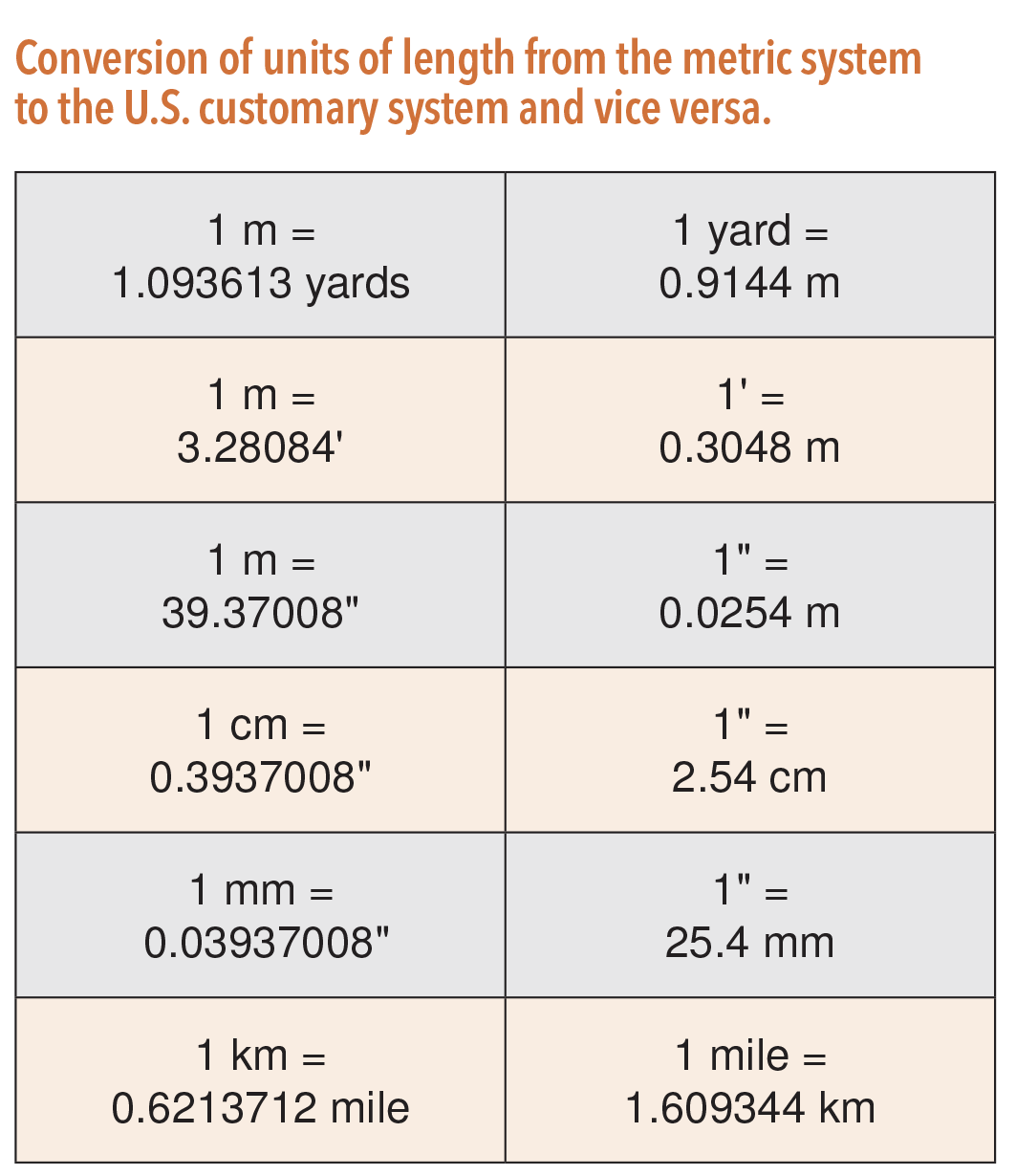
The commission was asked to conduct accurate measurements of the length of the meridian and prepare physical standards for a meter and a unit of mass, the kilogram. France approved the two platinum prototypes Dec. 10, 1799, forming the basis of the metric system.
Review the print ads from this magazine to continue
This quick advertiser review unlocks the rest of the article and keeps the full-screen reader focused on the ads instead of the page chrome.
Advertisers included in this article experience
Print placements connected to this article
Cutting Tool Engineering
®
OPTIMIZED A COMPLEX ROUGHING PROCESS MADE SIMPLE.
® OPTIMIZED A COMPLEX ROUGHING PROCESS MADE SIMPLE. Visit ctemag.com to learn more.
Visit Cutting Tool Engineering View this placement in the issue recordPrint ads from this magazine
OPTIMIZED A COMPLEX ROUGHING PROCESS MADE SIMPLE.
® OPTIMIZED A COMPLEX ROUGHING PROCESS MADE SIMPLE. Visit ctemag.com to learn more.
Continue reading
January 2020
On Sept. 28, 1889, the first General Conference on Weights and Measures, in its resolution “Sanction of the international prototype of the meter,” determined that the international and national prototypes of a meter would be made of a platinum alloy with 10% iridium to within 0.0001 m (0.0003′).
On Oct. 20, 1960, the 11th General Conference on Weights and Measures adopted the name International System of Units. Many scientists, inventors and engineers who lived in the 17th through 20th centuries became immortal when their names were incarnated into the units of measurement. There are seven base units: meter, kilogram, second, ampere, kelvin, mole and candela. Two are named after renowned scientists: André-Marie Ampère (1775 to 1836) and Lord Kelvin (1824 to 1907).
Also at the 11th general conference, the resolution “Definition of the meter” considered whether the international prototype defined a meter with adequate accuracy for present needs of metrology. The adoption of a natural, indestructible standard was examined. The conference decided that a meter is the length equal to 1,650,763.73 wavelengths in a vacuum of the radiation of the krypton-86 atom. It also was determined that the international prototype of a meter sanctioned by the conference in 1889 would be kept at the International Bureau of Weights and Measures under the conditions specified in 1889.
On Oct. 21, 1983, the 17th General Conference on Weights and Measures, in its resolution “Definition of the meter,” considered whether the present definition allowed a sufficiently precise realization of a meter for all requirements. The conference decided that a meter is the length of the path traveled by light in a vacuum during a time interval of 1/299,792,458 of a second.
Related
 MFGAxis Discussion
Be part of the shop-floor conversation
Like, save, or comment on this CTE story.
MFGAxis Discussion
Be part of the shop-floor conversation
Like, save, or comment on this CTE story.


MFGAxis Discussion