STS takes tool coatings in-house
Toolmaker launched its coatings division a year ago with a $2.2M investment.
When the quantity of cutting tools a company makes can achieve a return on investment in a few years, it makes economic sense to coat tools in-house. Superior Tool Service Inc. made that decision about a year ago and launched its STS Coatings division to coat not only the round tools STS produces but tools from other companies, as well as to decoratively coat a variety of products, such as firearms, said STS President Clint Whitney.
To perform physical vapor deposition coating, Wichita, Kansas-based STS reports that it invested $2.2 million in equipment and hired additional employees. STS has a German-made MpC1000 coating vessel from PD2i that has 12 spindles and can deposit a number of coatings, including TiN, TiCN, AlTiN, Alcron, AuRoRa, Micral TeToN and AlTiSiN.
“I spent a straight year studying and working with some coating shops and with the factory that makes the equipment,” Whitney said.
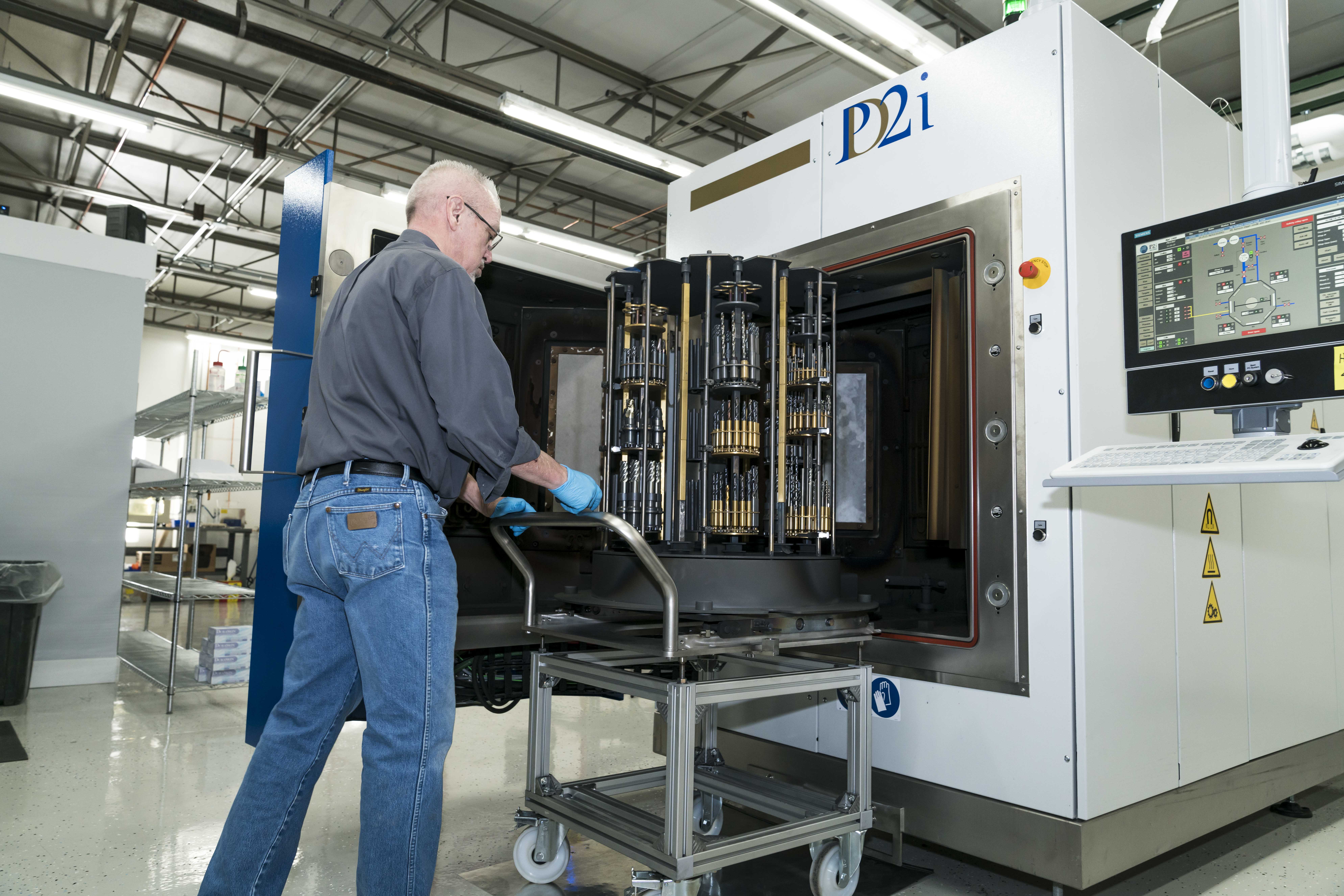
STS has a German-made MpC1000 coating vessel from PD2i. Image courtesy of Superior Tool Service
STS specializes in making custom tools and can coat different types and sizes of tools at one time. “We really have to tailor our recipes and fixturing to make sure we get the same coating thickness,” Whitney said.
Many applications require a tool that’s received multiple nanoscale layers of different coatings, he added. A chrome coating often is deposited first because of its high level of adhesion, with other layers providing a variety of properties, such as heat and wear resistance. The top layers must be hard and lubricious and have a high coefficient of friction. STS offers coatings as hard as 3,800 HV.
Prior to coating, tools go to the nonaqueous cleaning line, which uses a modified alcohol-based solvent, Whitney said. After being coated, the tools receive a post-processing treatment, such as drag finishing to enhance smoothness or aerolapping to impart a smoother, brighter finish. The latter is primarily for decorative applications.
Review the print ads from this magazine to continue
This quick advertiser review unlocks the rest of the article and keeps the full-screen reader focused on the ads instead of the page chrome.
Advertisers included in this article experience
Print placements connected to this article
Check it out: kyoceraprecisiontools.com/CA025P
CA025P
NEXT GENERATION CVD COATED CARBIDE FOR STEEL TURNING Positive and Negative Inserts Available Maximize your steel cutting performance with the new ultra- durable CA025P insert grade. The CA025P grade comes in a variety of chipbreakers to get the job done whether you are roughing at heavy depths of cut or finishing the workpiece at high feed rates
CA025P NEXT GENERATION CVD COATED CARBIDE FOR STEEL TURNING Positive and Negative Inserts Available Maximize your steel cutting performance with the new ultra- durable CA025P insert grade. The CA025P grade comes in a variety of chipbreakers to get the job done whether you are roughing at heavy depths of cut or finishing the workpiece at high feed rates. Check it out: kyoceraprecisiontools.com/CA025P 1-800-823-7284 | [email protected]
Visit Check it out: kyoceraprecisiontools.com/CA025P View this placement in the issue recordPrint ads from this magazine
NEXT GENERATION CVD COATED CARBIDE FOR STEEL TURNING Positive and Negative Inserts Available Maximize your steel cutting performance with the new ultra- durable CA025P insert grade. The CA025P grade comes in a variety of chipbreakers to get the job done whether you are roughing at heavy depths of cut or finishing the workpiece at high feed rates
CA025P NEXT GENERATION CVD COATED CARBIDE FOR STEEL TURNING Positive and Negative Inserts Available Maximize your steel cutting performance with the new ultra- durable CA025P insert grade. The CA025P grade comes in a variety of chipbreakers to get the job done whether you are roughing at heavy depths of cut or finishing the workpiece at high feed rates. Check it out: kyoceraprecisiontools.com/CA025P 1-800-823-7284 | [email protected]
Continue reading
June 2019
Once a coated tool becomes too worn, it can be re-ground and re-coated two or more times, Whitney said. “There is a myth out there that some people think you can’t regrind coated tools because you’ll do more damage to your diamond wheel when grinding it. With titanium silicon, yeah, you get a little more wear on your diamond wheel but not enough to stop regrinding.”
Some people also have the misconception that a coating isn’t worth the additional expense, particularly when machining gummy materials. With a cobalt tool, for example, a coating proves effective when cutting such materials even without flood coolant, Whitney said. “If they’re running MQL, a misting application, a coated cobalt tool is going to outperform a noncoated tool.”
He estimates that a coating adds 1% to 5% to the tool cost while extending tool life 100% to 600% but concedes that the advantages of a coating might not be realized when running at a low spindle speed.
In addition to the significant investment in time and money to obtain a coating vessel and learn how to properly operate it, running a coating service requires a substantial amount of equipment maintenance, Whitney said. “Since you are coating everything inside of the vessel, you constantly have to keep up on that and clean.” STS operates the coating machine six days a week and spends one day on maintenance.
As STS Coatings continues to refine and promote its business, it continues to attract customers, Whitney noted. “We’re looking to grow twofold this year.”
For more information about Superior Tool Service Inc., call 800-428-8665 or visit www.superiortoolservice.com.
For more information about Superior Tool Service’s STS Coatings division, view a video presentation at https://www.ctemag.com/videos/sts-takes-tool-coating-house