

Spin doctors: Inspection Efficiency
Machine tool spindles are high-tech products. Technicians maintaining them typically require special diagnostic tools and intense technical training. Those two issues add up to a serious question for shop managers: Should your shop fully maintain its own spindles?
Machine tool spindles are high-tech products. Technicians maintaining them typically require special diagnostic tools and intense technical training. Those two issues add up to a serious question for shop managers: Should your shop fully maintain its own spindles?
Or, should you largely farm that function out to machine tool builders, spindle builders and spindle maintenance and repair companies? Most experts say don’t try doing complete maintenance in-house. The level of in-house maintenance that’s appropriate depends on several factors.
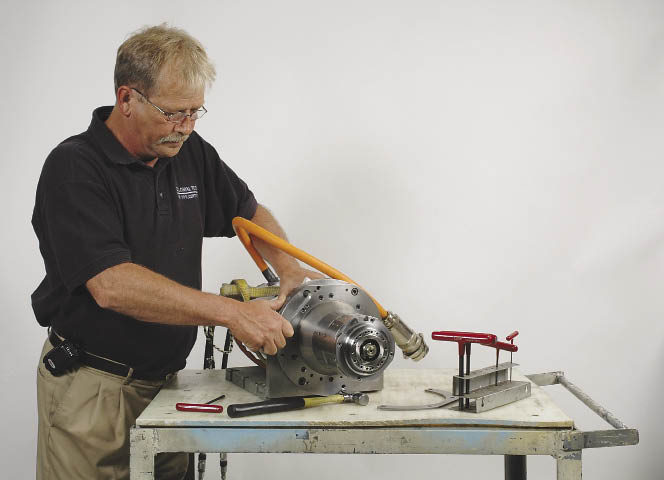
Colonial Tool Technician Duane Eddie maintaining a spindle for a CNC machine tool. Image courtesy of Colonial Tool.
“Companies should not do their own spindle maintenance,” said Tony Landl, chief engineer for Wm. Sopko & Sons Co., Cleveland. “Machine shops that are qualified to repair spindles are few and far between. You should have a relationship with experts. Sometimes shop maintenance people can do more damage to a spindle by taking it apart.”
Are there any kinds of maintenance, then, that can be performed effectively in-house? “Just about anything that does not involve taking a spindle apart, including checking taper runout, balancing tooling and cleaning tapers,” said John Easley, vice president and general manager, business operations, for Fischer Precise USA Inc., Racine, Wis.
Some shops can “do monitoring, but not complete maintenance. Listen for noise from bearings,” Landl said. “The biggest clue that you may need some outside expertise is noise and chatter. It’s really good-old common sense.”
Hardware and Software Tools
In general, spindle manufacturers suggest at least a partnership with outside experts on spindle maintenance. Increasing precision and sophistication in spindle technology means “not many shops can do it, and they typically wait until the last minute,” Landl said.
Other observers agreed and noted the expensive training and tools required for maintaining spindles. “The average shop may not be able to maintain modern spindles, which are lubricated for life,” said Walter Zic, vice president of Dynomax Inc., Mundelein, Ill. “The expense of tools to do this and the higher skills required mean shops need outside expertise and support.”
Various vibration analysis tools are used in spindle maintenance, said Paul Thrasher, president, Colonial Tool Group Inc., Taylor, Mich. There are several manufacturers and “each one has its own distinct features that are sometimes specifically requested by our customers or chosen by our technicians,” he said. “The data can usually be considered similar from each device. However, there are differences that make one or another more functional due to the operating speeds of the spindles or the frequency of the band being studied.” This type of equipment, including software, can cost around $15,000.
Another maintenance tool is the multichannel analyzer, which uses noncontact probes placed normal, or perpendicular, to each other to study the dynamic orbit of the spindle centerline at high speeds. These devices can cost $40,000. The analyzers plot the spindle orbit, which duplicates the cutting path of a single-point tool. “That allows you to predict with relative certainty the in-process performance of the spindle,” Thrasher said.
Spindle assembly running accuracy is a function of multiple component geometry tolerances, bearing accuracy and dynamic effects of the rotating components, which influence the centerline orbit. “Sophisticated assembly techniques can be used to cancel tolerance stack-up errors that can be picked up with this type of specialized equipment,” Thrasher said.
Devices such as hand-held decibel meters for measuring sound levels, portable balancer/vibration analyzers and indicators with magnetic bases can also be used to check spindle runout and end play, according to Sopko’s Landl. Of the three items, the cheapest is the indicator, followed by the decibel monitor. The most costly is the balancer/analyzer, which can cost $10,000. Other monitoring equipment includes temperature sensors and inspection equipment to verify the sizes of shafts and housings.
If a shop has multiple spindles, it may want to consider purchasing and using some of these monitoring and maintenance devices. However, small- to mid-sized shop typically do not have enough spindles to justify the cost and labor required to operate this equipment.
New maintenance tools that can be used by shops are also becoming available. Zic pointed to his company’s soon-to-be-announced diagnostic tool, Smart Spindle Technology, as an example of how sophisticated testing and monitoring has become. “A 5-axis machine or a large gantry machine can use this and download running data onto a laptop computer.” The program is basically an automated maintenance log for cleaning, checking fluid levels and performing vibration analysis on spindles.
Another new spindle analysis and maintenance program is Fischer Precise’s SmartVision, a software package that “provides multiple parameters in real time with the capability of remote access. It can determine spindle service life,” Easley noted.
Many, if not most, shops do some spindle maintenance, even if it’s only cleaning and checking fluids, and then rely on support when they run into problems they can’t handle.
“When a spindle is first built or rebuilt, it is important to document the spindle’s critical [tool interface] geometric and dimensional characteristics, axial and radial compliance and vibration signatures,” Thrasher said. “These are the spindle characteristics most likely to degrade over time and ultimately affect the tool performance and the part being machined. These inspections can normally be performed periodically on the machine and compared to the original for the degree of degradation. This data would be used to set rebuild intervals.”
Machine Complexity
Spindle maintenance is dependent upon the complexity of machine design. “Normally, a belt-driven, grease-lubricated spindle requires little maintenance except for the ancillary utilities,” Thrasher said. The air purge system needs to be maintained for pressure and cleanliness, for example. “More complicated spindles, such as high-speed, motorized CNC spindles with automatic tool drawbars, normally have several ancillary equipment requirements that make maintenance more complicated and more frequent,” he said.
Ancillary equipment also includes chillers for liquid cooling of the motors, oil lubrication systems for the bearings, hydraulic systems to actuate the drawbars and air-pressure tool seat checks. “All these systems have independent pressure-delivery requirements, flow requirements and are more likely to cause the spindle system to fail prematurely than the actual spindle bearings reaching their life expectancy,” Thrasher said.
Further advice on what shop managers should look for in inspections and spindle maintenance came from Dick Garski, senior sales manager, NSK America Corp., Schaumburg, Ill. “A machinist should always wipe oil and chips off the spindle nose with a rag, rather than blowing them off with an air hose. Blowing chips off the nose can allow contamination to get inside the spindle and damage the bearings,” he warned.
If the spindle system uses an oil lubrication system, a machinist should check daily to make sure the oil bowl has a sufficient supply of oil. He should also make sure clean, dry air is being supplied to the lubrication system. If there is water in the air line, an air dryer should be installed, Garski said.
Review the print ads from this magazine to continue
This quick advertiser review unlocks the rest of the article and keeps the full-screen reader focused on the ads instead of the page chrome.
Advertisers included in this article experience
Print placements connected to this article
Iscarmetals
Increasing Your
PROFITABILITY Grooving & Turning Intelligently 5 2 4 3 Cutting Down 5 Cornered Precision Production Costs with Insert for Deeper the High Productivity Grooving and Parting Tangential Parting System Powerful Wide Inserts CBN Inserts for for Grooving, Turning and Cost Effective Grooving and Profiling at High Feeds Turning of Hardened Steel.
Increasing Your PROFITABILITY Grooving & Turning Intelligently 5 2 4 3 Cutting Down 5 Cornered Precision Production Costs with Insert for Deeper the High Productivity Grooving and Parting Tangential Parting System Powerful Wide Inserts CBN Inserts for
Visit Iscarmetals View this placement in the issue recordPrint ads from this magazine
PROFITABILITY Grooving & Turning Intelligently 5 2 4 3 Cutting Down 5 Cornered Precision Production Costs with Insert for Deeper the High Productivity Grooving and Parting Tangential Parting System Powerful Wide Inserts CBN Inserts for for Grooving, Turning and Cost Effective Grooving and Profiling at High Feeds Turning of Hardened Steel.
Increasing Your PROFITABILITY Grooving & Turning Intelligently 5 2 4 3 Cutting Down 5 Cornered Precision Production Costs with Insert for Deeper the High Productivity Grooving and Parting Tangential Parting System Powerful Wide Inserts CBN Inserts for
Continue reading
August 2009
Shop size shouldn’t dictate the type of spindle maintenance programs. “We don’t recommend different maintenance programs, whether a customer is a job shop or a large-scale production facility,” said Fischer Precise’s Easley. “This is because the level of spindle performance for any machining application generally cannot be compromised.”
Some companies offer detailed manuals on spindle operation and maintenance. For example, Dynomax’s manual presents proper operating procedures as part of general preventive maintenance for spindles. The manual is available for download from the company’s Web site.
Interval-Based Maintenance
An interval-based maintenance program can be appropriate. “For most shops, where the jobs are always different, interval-based programs are usually sufficient,” Easley said. “This is because for many condition monitoring programs, you need a lot of comparable data to monitor an ‘optimal’ condition; if the job is always different, collecting this data may not be worth the time and effort.” He explained that, in continuous-production environments where the job remains the same, monitoring can add more value to the process. “This also depends on the value of the individual parts being machined,” he said.
According to Colonial’s Thrasher, routine, periodic condition monitoring should be performed on lower utilization equipment, but continuous operations should use real-time condition monitoring—particularly when availability to inspect the machine is limited. “These systems can deliver data at anytime since the transducers are permanently mounted on the spindle and are normally hard-wired in the machine,” he said. “The only limitation is [a shop’s ability to perform] data management and review.”
Spindles with housings smaller than 170mm in diameter typically do not require condition monitoring, Easley said. “But with larger spindles—which are on machines that are more costly to operate and where downtime is costly—these systems are becoming more desirable.”
Still, all of these approaches and techniques depend upon the type of machine shop, according to NSK America’s Garski. Most shops do not have a complex spindle maintenance program. They typically run a spindle until it fails and then send it out for repair. A better approach, he said, is for machinists to thoroughly understand the spindles they are using. “Without a tool in place, feel the vibration level,” he said. “Watch the load meter with the spindle running without a tool. If the load meter increases more than it did when the spindle was new, this is usually a sign that repair may be needed.”
Monitoring Systems
As a general rule, “any monitoring is an advantage,” Easley noted. For example, temperature monitoring can help identify problems such as overheated bearings. In electrically driven motors, temperature monitoring can isolate problems with motor windings. Vibration monitoring can be an immediate indicator of several potential issues, such as bearing wear, tooling imbalance and taper wear.
Before any monitoring system is purchased, however, the shop manager should “review the degree of usage and data required,” Thrasher said. “There are some [systems] that provide tremendous amounts of data, but the ability to organize and manage the data may be beyond what the customer needs. For a typical machine shop looking to just measure spindle health, a less-sophisticated system with a well-thought-out data collection and analysis process should be designed by the supplier of the equipment.”
For many machine shops, preventive maintenance programs are the best option. For some, “a preventive maintenance program conducted every 6 months” is fine, said Kenneth Catanzaro, president, CAT Spindle Grinding Service, Fort Gratiot, Mich. That set of procedures should include a drawbar test using a dynamometer, he said.
The cost for PM diagnostic tools can be relatively modest. “A dynamometer can be purchased for $800 to $3,000; a test bar for checking runout costs $500 to $600. Bluing paste to check taper contact runs a couple of dollars,” Catanzaro said. “Employees must be trained to perform PM and retrained as new spindle technology is implemented.” (Bluing paste is put on the toolholder, which is then clamped in the spindle to visually determine the percentage of contact between the two tapers.)
The amount of in-house maintenance done depends on the size and technical sophistication of the shop. A high-production shop with 5-axis equipment is a candidate for sophisticated condition monitoring. If a shop is using machines with older, smaller spindles, routine in-house cleaning, oil level checking and vibration monitoring at various intervals, combined with periodic outside expert attention, should suffice.
In some ways, properly maintaining a machine tool spindle is similar to properly maintaining your car. You can change the oil every 3,000 miles and wash it. But few drivers would try doing a complete overhaul. Even fewer would do it correctly. Spindle builders use various diagnostic tools and monitoring devices that can keep spindles operating at peak performance levels. The key for shops is to opt for the level of sophistication that matches the spindles they use. CTE
About the Author: George Weimer is a freelance writer based in Lakewood, Ohio, with an extensive background in the metalworking industry’s business press. Contact him at weimerG4@yahoo.com.
Contributors
CAT Spindle Grinding Service
(810) 334-3754
www.catspindlegrinding.com
Colonial Tool Group Inc.
(866) 611-5119
www.colonialtool.com
Dynomax Inc.
(847) 680-8833
www.dynospindles.com
Fischer Precise USA Inc.
(800) 333-6173
www.fischerprecise.com
NSK America Corp.
(800) 585-4675
www.nskamericacorp.com
Wm. Sopko & Sons Co.
(888) 967-6756
www.wmsopko.com
Spindle inspection & maintenance tips
The following are tips on spindle inspection and maintenance. They include not only the spindle but also peripheral devices, such as cooling units and lubricators.
• Check and periodically clean the spindle taper. Never use compressed air. Instead, use a specially designed vacuum cleaning device.
• Check and periodically clean toolholders and tooling. Unbalanced and/or worn tooling will lead to higher-than-anticipated vibration and therefore shorter bearing life.
• For belt-driven spindles, periodically check belts for wear. For electrically driven spindles, periodically check the amperage under load to see if it is increasing over time to do the same job. Increasing amperage may indicate bearing wear.
• Periodically check spindle runout with a test arbor.
• For oil-lubricated spindles, periodically check that the oil flow rate is at the proper level.
• Check coolant level and flow rate in spindle cooling units, where applicable.
• After longer usage, check test clamping force of the spindle clamping system and, if needed, clean and regrease gripper fingers.
• After longer usage, check and replace hydraulic oil, if applicable.
• If multiple machines are using the same type of spindle, keep records of what spindle serial number has been in which machine and for how long. This makes it easier to troubleshoot if there is ever a problem and to more readily identify variables to track issues (i.e., is it a spindle issue or a machine issue). A surprising number of shops do not do this.
—John Easley, Fischer Precise USA
Glossary terms in this article
Related


Subscribers can use MFGAxis notes, saves and discussion tools with their innoNET account.


