


Spot On: Turning Performance
The timing of the IMTS trade show in Chicago last September couldn't have been better for Jason Bromiley. As vice president and co-owner of John R. Bromiley Machine Co. Inc., a job shop in Chalfont, Pa., Bromiley has the lead role in company plans to expand into aerospace manufacturing.
Tool presetters help three shops boost accuracy, productivity and savings.
Courtesy of Advanced Manufacturing Branch/Goddard Space Flight Center
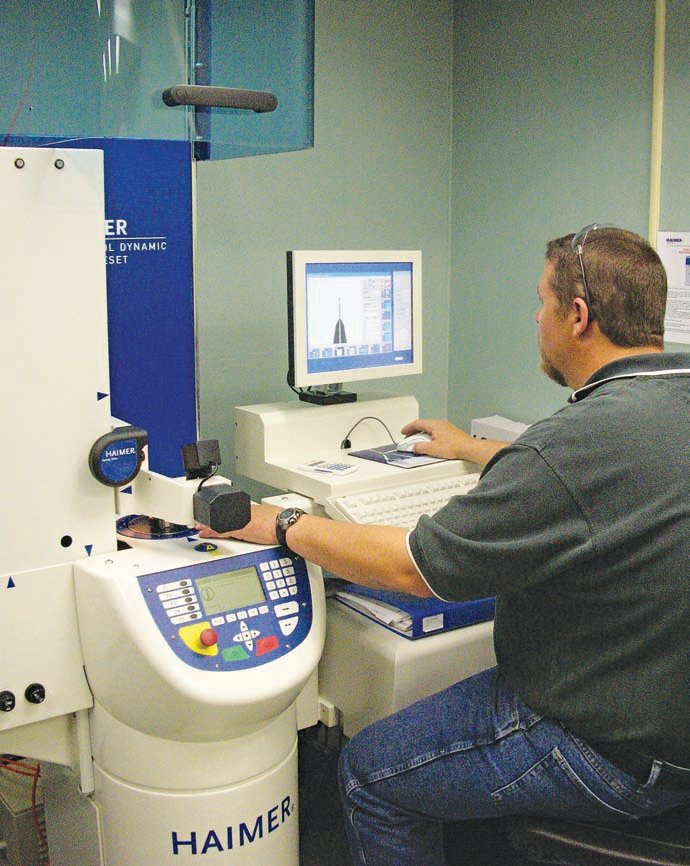
Bob Taylor, lead technician for high-speed machining at the Advanced Manufacturing Branch/Goddard Space Flight Center, uses the Haimer Tool Dynamic Preset to inspect a 0.1mm-dia., 2-flute endmill.
The timing of the IMTS trade show in Chicago last September couldn’t have been better for Jason Bromiley. As vice president and co-owner of John R. Bromiley Machine Co. Inc., a job shop in Chalfont, Pa., Bromiley has the lead role in company plans to expand into aerospace manufacturing.
Early last fall, the firm already was working on attaining the requisite certification (AS 9100B and ISO 9001:2008). And, as IMTS rolled around, Bromiley was in the market for equipment that would both streamline his shop’s current workload and handle the added rigors of aerospace machining—specifically, tool presetters.
“I wanted something to help with the setups,” said Bromiley. “Being a job shop, our biggest time-consuming factor is multiple setups. We try to adhere to our customers’ requirements and demands; they’ll call us one day and expect us to change setups to get them another hot job that they may not have foreseen, so to accommodate them we usually do more setups than anticipated. [Also,] a lot of the documentation requirements for our AS certificate are preventive, or corrective, actions. So I consider using [a tool presetter] a preventive action, so that we don’t lose customers by not being able to provide their parts on time.”
Courtesy of John R. Bromiley Machine Co.
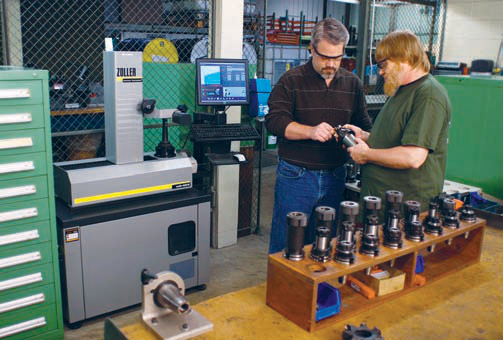
With the Zoller smile 400/pilot 3.0 presetter in the background, Jason Bromiley (left), vice president John R. Bromiley Machine Co. Inc., and Steve Atlee, toolroom attendant, discuss tooling.
In addition to minimizing setup time, presetters ensure consistent, accurate tool measurements. The potential time and cost savings are numerous—from extended tool life to increased productivity and reduced machine downtime.
High-End Choice
The Bromiley shop houses 25 CNC machines, ranging from a small Swiss-style lathe to larger turning centers with 11-axis capability. The selection also includes five vertical and four horizontal milling centers. Aside from its pursuit of aerospace contracts, the company primarily serves the hydraulic, medical, petrochemical and instrumentation industries.
At IMTS, Bromiley surveyed the presetters on display, eventually deciding on a Zoller smile 400/pilot 3.0 from Zoller Inc., Ann Arbor, Mich. “I purposely bought a higher-end unit for its durability and to be able to maximize what we could [add to it]. I can always add a camera, for example. So I don’t have to worry about buying a new machine in 3 years because of outdated technology.”
Incorporating the technology, which took place over the winter, was seamless, Bromiley said. Zoller provided 2 days of training, “and by the end of the first day my toolcrib attendant had already set up 10 tools, which to me was pretty surprising, considering how uncomputer savvy he claimed to be,” said Bromiley.
Courtesy of Cascade Corp.
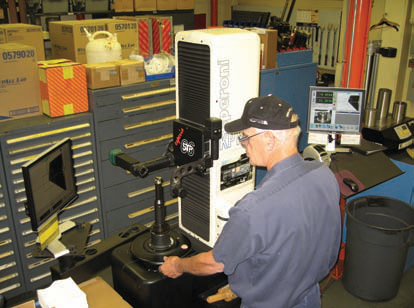
Key to Cascade Corp.’s decision to purchase the Speroni STP66 from Big Kaiser was the user-friendly software so that shop personnel, such as Fred Montgomery (shown), can easily operate the presetter.
According to Alexander Zoller, vice president of Zoller, the biggest hurdle shops often face when adding a presetter is the need to adjust their mindset. “Basically, it’s that an external machine is now taking care of the measurements workers previously took,” he said. “They find it difficult to believe that they only have to load the tools, hit a button and run good parts.”
Bromiley said adding a presetter already has resulted in significant cost savings and error-free, quality machining. While it’s currently used only on the company’s nine HMCs and VMCs (expanded applications are planned), he figures it’s saving 18 hours in setup time per week (two hours per machine), which translates to a weekly savings of nearly $1,000. “So my return on investment will be under a year,” Bromiley said. “You don’t buy too many assets that pay themselves off in that short amount of time.”
Also, Bromiley’s milling supervisors endorsed the tool presetter’s working capability. “They both told me that when they punch in the number my toolcrib attendant provides on the tool, it’s dead nuts every time. There’s no guessing as to where the tool sits; it eliminates a lot of possible error on the part of the setup operator.”
And, importantly, the presetter has helped position the company—which earned its AS and ISO certification this past March—to attract more aerospace contracts. “I’m hoping,” said Bromiley, “that [the certification and presetter] will take us to a whole different level of manufacturing—competing to do business for Lockheed Martin, Boeing, General Dynamics and Sikorsky.”
Balancing and Presetting
Upgrading capabilities also played a part in adding presetting technology at the Advanced Manufacturing Branch of NASA’s Goddard Space Flight Center, Greenbelt, Md. The AMB, though, purchased a novel instrument that combines both presetting and balancing capabilities from Haimer USA LLC, Villa Park, Ill. The decision to buy the hybrid instrument, called the Tool Dynamic Preset, stemmed from a dovetailing of emerging needs.
The AMB is NASA/Goddard’s lead facility for developing “spaceflight hardware components for instruments, solar panels, metallic and composite components and composite structures,” said Matt Showalter, associate branch head of AMB. To more productively handle the workload, 3 years ago the AMB purchased a number of 5-axis, high-speed machining centers. Some of the equipment has spindle speeds from 25,000 rpm to 36,000 rpm. As a result, Showalter also decided to step up the facility’s balancing capabilities.
One of the machining centers, a GF AgieCharmilles Mikron HSM 600V, “has an internal alert system monitoring the spindle that lets you know if your tool is out of balance, but it didn’t tell you how much or where the imbalance was located on the tooling package,” Show- alter said. “So we thought it would be more proactive if we could determine that the tool package was balanced and inspected before it goes into the machine.”
At the same time, AMB was doing more micromachining, and the shortcomings of lasers used to measure the microtool lengths was a growing concern. “When you get down to the width of the focal point of the laser, sometimes we’d see a discrepancy of 0.0005 “,” said Showalter. “Well, when it’s an endmill that tiny and you’ve missed the tool length by even that small of a variance, you’ve overloaded it and you’ll break the tool. So presetting became critical at that point.”
As part of AMB’s equipment upgrade, it had also purchased shrink-fit holders and tooling adapters from Haimer. When Showalter learned about Haimer’s Tool Dynamic Preset, which combines balancing and presetting technologies into one machine, he soon had that in the shop, too. “It was just a natural progression,” he said.
The Tool Dynamic Preset includes Haimer’s TD2002 balancing machine and a Zoller presetter, which enables the operator to set the length and diameter of tools and measure cutting edge geometries. “Basically, the presetting software has the ability to hold the X-axis diameter dimension, allowing one to then set the Z-height dimension without any problems,” said Brendt Holden, president of Haimer USA. “Once all is set, then the data can be recorded for both the X and Z dimensions in one setup.”
The device’s balancing accuracy is based on Haimer centrifugal force sensors, hard-bearing technology, clamping spindle adapter and calibration process. After an imbalance is detected, the software calculates where to add, remove or displace weight on the toolholder.
“You’re balancing and presetting to a spindle taper that is more representative of what you’re actually going to use, as opposed to just an adapter,” said Showalter. “It was actually [connected] to the spindle cartridge itself, which I think is a better simulation. When you’re looking at both technologies on one machine, protecting the spindles is the critical thing operators are interested in. And the presetter was a priority for micromachining.”
The AMB has seen several benefits from the presetting and balancing technology. On the micromachining side, tool life has increased, said Showalter. “When you’re talking about a 0.004 “-dia. endmill, it doesn’t take much for it to snap. We’re cutting titanium, brass, aluminum and exotic materials, so if you’re running out on it or if the holder’s got some harmonics on it from being out of balance, you’ll snap an endmill.”
AMB workers also use the presetter on larger tools to inspect edges and look for microcracking and loading on the cutter tips, for example. “We are able to monitor tool life better,” said Showalter, adding that “there’s also the benefit of being able to track the tooling. You eliminate errors of manually entering offsets on the machine by being able to download the data directly to the machines.” Training took a couple of days, though occasionally the AMB calls on Haimer for a refresher course when, for example, new employees are hired, which is the kind of support Showalter values. “It’s not about just buying a tool or a one-time sale, to tell you the truth,” said Showalter. “One of the reasons that we are developing partnerships with our vendors is that we’re looking for companies that are going to support us across the board. And [Haimer] continues to stand up pretty well for that.”
Presetter Upgrade
Unlike the Bromiley shop and AMB, when Cascade Corp., Fairview, Ore., was looking for a tool presetter several years ago, it wasn’t the company’s first experience with the technology. The 66-year-old manufacturer of lift truck attachments (forks, clamps, layer pickers, side shifters) had a presetter that was pushing 20 years.
The higher speeds and feeds achieved in the industry during those 2 decades put an added premium on accuracy. “A lot of the newer presetters make a lot of sense to me because they hold the tool vertically, so gravity helps to pull it down into the adapter,” said Bob Allen, Cascade’s manufacturing technical services manager. He explained that his older presetter held tools horizontally and, consequently, gravity often caused the tools to bend, or droop. “Droop was a big issue because we have many longer cutting tools,” Allen said. “And there wasn’t a lot of viewing area either [with the previous technology]; it was like a poorly lighted, small-diameter optical comparator screen. That made it difficult to check both length and runout. You’d be lucky to get tool runout less than 0.010 “. With today’s higher speeds, it’s critical to keep tool runout to an absolute minimum to reduce vibration and wear.”
After reviewing several products, Cascade purchased a Speroni STP66 from BIG Kaiser Precision Tooling Inc., Elk Grove Village, Ill. Its user-friendliness and accuracy were priorities for Cascade.
“The ease of use of the software was very important because we have an open toolcrib, so shop personnel need to be able to easily figure out how to operate [the presetter],” said Allen.
With dozens of machining and turning centers in the shop, Cascade workers routinely measure an assortment of round tools, such as milling cutters, drills and boring tools.
“Also, we needed something that can measure tools up to at least 24 ” in length, and we have some milling cutters that are 16 ” in diameter. This machine is capable of measuring 24 “×24 “, and the accuracy is amazing. In fact, I recently checked its accuracy with a calibration tool and the runout was less than 0.0002 ” at a height of 12 “, which is pretty phenomenal.”
Getting workers up to speed with the presetters required about an hour of training, said Allen. Although BIG Kaiser provided instruction, Allen took a lead role in educating his workers on the technology. “I wanted to provide the training to the operators because I wanted to present it in a way that fit with our process and that I knew our people would understand,” he said.
In addition, Cascade’s presetting capabilities have provided some unanticipated money-saving benefits. “Somebody talked me into buying a knock-off brand collet chuck,” said Allen. “They claimed that their quality was just as good as a higher-end brand [Rego-Fix]. I bought 20 of them with a guarantee that if there were problems, they would replace all units with the higher-end brand, including freight, at their expense. With the Speroni, I was able to verify that a certain portion of the knock-off tool body was inaccurate. So it was pretty expensive for that company [to buy the higher-end collet chuck].”
Nor was that an isolated incident. The Speroni presetter also has enabled the shop to detect faults with other tools. “It’s especially helpful when purchasing custom tools,” said Allen. “I’m able to quickly measure and detect problems, and then inform [suppliers] that they have a manufacturing issue. It’s pretty shocking to them, but it’s wonderful for us because there’s no denying it; it’s proof positive right there [in the data].” CTE
About the Author: Daniel McCann is senior editor of Cutting Tool Engineering. He can be reached at dmccann@jwr.com or (847) 714-0177.
Contributors
Goddard Space Flight Center/Advanced Manufacturing Branch
www.gsfc.nasa.gov
(301) 286-2000
BIG Kaiser Precision Tooling Inc.
(888) 866-5776
www.bigkaiser.com
Cascade Corp.
(800) 227-2233
www.cascorp.com
Haimer USA LLC
(866) 837-3265
www.haimer-usa.com
John R. Bromiley Machine Co. Inc.
(215) 822-7723
www.bromileymachine.com
Zoller Inc.
(734) 332-4851
www.zoller-usa.com
Glossary terms in this article
Related



Subscribers can use MFGAxis notes, saves and discussion tools with their innoNET account.