

Face Off: Turning Performance
Keys to maximizing productivity when facemilling steel.
Keys to maximizing productivity when facemilling steel.
Facemilling during a roughing operation generates a higher metal-removal rate (mrr) than any other type of milling. The mrr indicates the productivity of cutting. Therefore, it is necessary to remove as much material as possible.
The maximum mrr is limited to the nominal machining power and available torque value (at the selected spindle speed) of a given machine tool. Therefore, it is important to calculate the power and torque requirements to achieve the desired mrr. The required machining power should not exceed the nominal power of a given machine tool. In addition, the torque value should not exceed the allowed torque applied to the arbor mounting, and the calculated cutting force should not exceed the force that the cutting edges of the inserts can withstand.
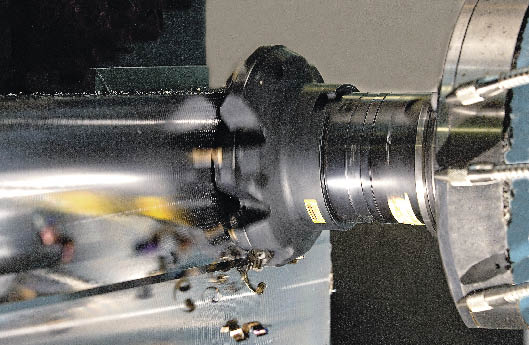
Courtesy of Sandvik Coromant
A CoroMill 345 cutter facemilling steel. The cutter accepts double-sided inserts with eight cutting edges. The tool offers full cutting-edge backing and insert-seat stability through shims with strategic support islands that match insert rake faces. These protect the cutter body should an insert break. By having a more positive axial inclination at small DOCs, the facemill offers a soft cutting action with low axial pressure on the workpiece, according to the company.
This article describes popular cutters for facemilling steel made by Sandvik Coromant Co., Fair Lawn, N.J., and Kennametal Inc., Latrobe, Pa. Calculations of the cutting force, torque and machining power requirements associated with these cutters are based on the tool geometry and the cutting data recommended by the two companies.
The following methods of calculating the required machining power are used for comparison and analysis.
1. The conventional method is based on the unit power values and the mrr as shown in the Machining Data Handbook from Metcut Research Associates Inc., Cincinnati.
2. Calculation methods recommended by Sandvik Coromant, which is based on the specific cutting force (not power), mrr, true rake angle and conversion factor.
3. Calculation method developed by the author and described in his book Engineering Formulas for Metalcutting, from Industrial Press Inc., New York. Kennametal used this method.
Sandvik Coromant Cutter
David Öhlund, milling development specialist, recommended applying the CoroMill 345 cutter and the following cutting data for rough facemilling.
Workpiece: AISI 4140 alloy steel (Coromant Material Classification No. 02.1) with a hardness of 200 HB.
Facemill cutter: catalog item number A345-102R38-13M
Cutter diameter (Dc) = 4.0 “
Number of inserts (Z) = 7
Indexable inserts: catalog item number 345R-1305M-PH
Carbide grade is GC4230 (ISO P25, ANSI C6)
True rake angle (γ) = 11°
Lead angle (κ) = 45°
Cutting Data:
Maximum DOC (ap) = 0.236 “
WOC (ae) = 0.7, or 70 percent of Dc, so ae = 4.0 ” × 0.7 = 2.80 “
Feed per tooth (fz) = 0.014 “
Chip thickness (hex) = 0.0099 “
Cutting speed (Vc) = 670 sfm
Kennametal Cutter
Osny Fabricio, senior product manager, global milling, recommended applying Dodeka 45° facemills and the following cutting data for rough facemilling.
Workpiece: AISI 4140 alloy steel (Kennametal Material Group P3/4) with a hardness of 200 HB.
Facemill cutter: catalog item number KSHR400HN5345C5
Cutter diameter (Dc) = 4.0 “
Number of inserts (Z) = 8
Indexable inserts: catalog item number HNGJ535ANSNGD
Carbide grade is KC725M
True rake angle (γ) = 16°
Lead angle (κ) = 45°
Cutting Data:
Maximum DOC (ap) = 0.178 “
WOC (ae) = 0.8 × 4.0 ” (Dc) = 3.20 “
Feed per tooth (fz) = 0.011 “
Chip thickness (h) = 0.0079 “
Cutting speed (Vc) = 520 sfm (first-choice starting speed)
Table 1: Type of drive and the efficiency factor.
| Type of drive | Efficiency factor (%) |
|
Direct drive (integral-motor spindle) |
94 to 95 |
|
Direct belt drive |
90 |
|
Back gear drive |
75 |
|
Geared head drive |
70 to 80 |
|
Oil-hydraulic drive |
60 to 90 |
Table 2: Comparison between the methods of calculations.
| Nomenclature | Machining Data Handbook | Sandvik Coromant | The author’s calculator |
|
Metal removal rate, in.3/min. |
41.4 |
41.4 |
41.4 |
|
Specific cutting force, lbs./in.2 |
N.A. |
246,500 |
N.A. |
|
Ultimate tensile strength, psi |
N.A. |
N.A. |
100,000 |
|
Cutting force, lbs. (sharp cutting edges) |
N.A. |
N.A |
949 |
|
Cutting force, lbs. (dull cutting edges) |
N.A. |
N.A. |
1,233 |
|
Torque, ft.-lbs. (sharp cutting edges) |
N.A. |
N.A. |
158 |
|
Torque, ft.-lbs. (dull cutting edges) |
N.A. |
N.A. |
206 |
|
Net power, hp (sharp cutting edges) |
N.A. |
23.0 |
19.3 |
|
Net power, hp (dull cutting edges) |
N.A. |
N.A. |
25.0 |
|
Efficiency factor |
0.8 |
0.8 |
0.8 |
|
Unit power, hp/in.3/min. (sharp tools) |
1.1 |
N.A. |
N.A. |
|
Unit power, hp/in.3/min. (dull tools) |
1.4 |
N.A. |
N.A. |
|
Required machining power, hp (sharp cutting edges) |
45.5 |
28.8 |
24.1 |
|
Required machining power, hp (dull cutting edges) |
58.0 |
N.A. |
31.3 |
Machining Calculations
The following calculations were performed based on the cutting data submitted by Sandvik Coromant and Kennametal.
The mrr (Q) is calculated by the commonly used formula:
Q = ae × ap × fz × Z × n (in.3/min.)
Where n is a spindle speed:
n = 12 × Vc ÷ (π × Dc)
Sandvik Coromant cutter:
Spindle speed,
n = 12 × 670 ÷ (π × 4.0) = 640 rpm
mrr,
Review the print ads from this magazine to continue
This quick advertiser review unlocks the rest of the article and keeps the full-screen reader focused on the ads instead of the page chrome.
Advertisers included in this article experience
Print placements connected to this article
endmill. Sandvik Coromant Co.’s tool balancing machine. Haimer
Advertorial
Introducing RIGIDEX Standard & Special Inserts Our custom special insert service grinds to your exact specification. CoroMill 316 “split tool” endmill system USA LLC’s Tool Dynamic Preset tool From simple modified TC is for diameters from 3/8" to 1". The tool’s balancing machine combines the benefits inserts, custom ground.
Advertorial Introducing RIGIDEX Standard & Special Inserts Our custom special insert service grinds to your exact specification. endmill. Sandvik Coromant Co.’s tool balancing machine. Haimer CoroMill 316 “split tool” endmill system USA LLC’s Tool Dynamic Preset tool From simple modified TC is for diameters from 3/8" to 1". The tool’s balancing machine combines the benefits inserts, custom ground
Visit endmill. Sandvik Coromant Co.’s tool balancing machine. Haimer View this placement in the issue recordPrint ads from this magazine
Introducing RIGIDEX Standard & Special Inserts Our custom special insert service grinds to your exact specification. CoroMill 316 “split tool” endmill system USA LLC’s Tool Dynamic Preset tool From simple modified TC is for diameters from 3/8" to 1". The tool’s balancing machine combines the benefits inserts, custom ground.
Advertorial Introducing RIGIDEX Standard & Special Inserts Our custom special insert service grinds to your exact specification. endmill. Sandvik Coromant Co.’s tool balancing machine. Haimer CoroMill 316 “split tool” endmill system USA LLC’s Tool Dynamic Preset tool From simple modified TC is for diameters from 3/8" to 1". The tool’s balancing machine combines the benefits inserts, custom ground
Continue reading
January 2009
Q = 0.236 × 2.8 × 0.014 × 7 × 640 = 41.4 in.3/min.
Kennametal cutter:
Spindle speed,
n = 12 × 520 ÷ (π × 4.0) = 497 rpm
mrr,
Q = 0.178 × 3.2 × 0.011 × 8 × 497 = 24.9 in.3/min.
The required machining power is calculated in two steps. First, the net power, or power at the cutter, is calculated. Then, the required machining power is calculated through the net power and the machine efficiency factor.
The Machining Data Handbook method does not provide a formula for calculating the net power, but allows calculating the required machining power (Pm) from the formula:
Pm = Q × P (hp)
Where P is the unit power.
When milling carbon, alloy and tool steels with a Brinell hardness from 85 to 200 HB at a feed rate from 0.005 to 0.012 ipt, the unit power values are: 1.1 hp/in.3/min. for sharp tools and 1.4 hp/in.3/min. for dull tools. Unfortunately, this handbook does not provide the unit power for a 0.014-ipt feed rate. Therefore, the previous values are used. The unit power values represent an 80 percent machine efficiency factor (η = 0.8). Having Q = 41.4 in.3/min. for the Sandvik Coromant cutter, and Q = 24.9 in.3/min. for the Kennametal cutter, the required machining power values are provided.
Sandvik Coromant Q, sharp tools:
Pm = 41.4 × 1.1 = 45.5 hp
Sandvik Coromant Q, dull tools:
Pm = 41.4 × 1.4 = 58.0 hp
Kennametal Q, sharp tools:
Pm = 24.9 × 1.1 = 27.4 hp
Kennametal Q, dull tools:
Pm = 24.9 × 1.4 = 34.9 hp
Sandvik Coromant customers must have a 50- to 60-hp milling machine if they applied the Machining Data Handbook method, whereas Kennametal customers must have 30- to 35-hp milling machine if they applied the Machining Data Handbook method.
The Sandvik Coromant method recommends the following formula to calculate the net power:
P = ae × ap × fz × Z × n × kc × Mγ ÷ 396,000 (hp)
Where ae , ap , fz , Z and n are the values described earlier, kc is the specific cutting force, Mγ is the multiplying factor for true rake angle, and 396,000 in.-lbs./min./hp is the conversion factor.
AISI 4140 alloy steel belongs to No. 02.1 group, according to the Coromant Material Classification (CMC). The specific cutting force of this steel at a Brinell hardness of 175 HB is: kc = 246,500 lbs./in.2, which represents a 5.0 “-dia. cutter and working engagement (ae) of 4.0 “. Because a specific cutting force of the same steel at 200 HB is not provided by the CMC, the same kc value is used to calculate the net power.
If the true rake angle of indexable inserts is 0°, then Mγ = 1. Because the true rake angle of the indexable inserts is γ = 11°, the multiplying factor Mγ = 0.89.
The net power is:
Pn = 2.8 × 0.236 × 0.014 × 7 × 640 × 246,500 × 0.89 ÷ 396,000 = 23.0 hp
The required machining power (Pm) depends on the machine efficiency factor (η) and is calculated from:
Pm = P ÷ η
The machine efficiency factors depend on the type of drives (Table 1).
Assuming that the milling machine has the oil-hydraulic drive of 80 percent efficiency factor and A345-102R38-13M cutter with new or just indexed inserts are used, the required machining power would be:
Pm = 23.0 ÷ 0.8 = 28.8 hp
Application of Sandvik Coromant A345-102R38-13M cutters at the recommended cutting conditions requires a 30- to 35-hp machine tool (η = 0.8 to 0.7 respectively). The required machining power could be reduced if a milling machine with higher than an 80 percent efficiency factor is used.
Any machine tool with a 90 percent efficiency factor will consume:
Pm = 23.0 ÷ 0.9 = 25.6 hp
The Author’s Method
The author’s method is based on the concept that the cutting force can be calculated through the ultimate tensile strength of a workpiece material, cross-sectional area of the uncut chip, the number of inserts (teeth) in the cut and the engagement factor, which depends on the ratio of cutter diameter to WOC and the type of work materials. The concept has been proven by numerous cutting tests employing a milling dynamometer. The accuracy in calculating cutting force is about ±20 percent or better. This method is described in Engineering Formulas for Metalcutting.
The net power calculation is based on the cutting force, cutting speed and conversion factor (33,000 ft.-lbs./min./hp), i.e., on the classic formula known in general mechanics for more than 100 years.
The relationship between the ultimate tensile strength of carbon and alloy steels and their Brinell hardness is expressed by a simple and accurate (±5 percent or better) empirical formula:
σ = 500 × Brinell hardness number
Because the hardness of AISI 4140 alloy steel in this case is 200 HB, the ultimate tensile strength is:
σ = 500 × 200 = 100,000 psi
All step-by-step calculations were performed on the author’s Advanced Milling Calculator, but are omitted here due to space limitations. Therefore, only the final results are provided.
Sandvik Coromant Cutting Data
Cutting force (Fc) and torque at the cutter (T) values are:
Fc = 949 lbs., T = 158 ft.-lbs.: A345-102R38-13M cutter with new or just indexed inserts (sharp cutting edges).
Fc = 1,233 lbs., T = 206 ft.-lbs.: A345-102R38-13M cutter, when indexing or replacing of inserts is required (dull cutting edges).
Based on the cutting force values, the net machining power, or power at the cutter, is calculated by the formula:
P = Fc × Vc ÷ 33,000 (hp)
P = 949 × 670 ÷ 33,000 = 19.3 hp (sharp cutting edges)
P = 1,233 × 670 ÷ 33,000 = 25.0 hp (dull cutting edges)
Required machining power (for adequate comparison, a milling machine has the same efficiency factor η = 0.8) is calculated as:
Pm = 19.3 ÷ 0.8 = 24.1 hp (sharp cutting edges)
Pm = 25.0 ÷ 0.8 = 31.3 hp (dull cutting edges)
If the author’s method of calculation is applied to the Sandvik Coromant cutter A345-102R38-13M for rough facemilling at the same cutting conditions described previously, a 30-hp machine would be sufficient. The required machining power could be reduced if a milling machine with higher than an 80 percent efficiency factor is used.
Any machine tool with a 90 percent efficiency factor would consume:
Pm = 19.3 ÷ 0.9 = 21.4 hp (sharp cutting edges)
Pm = 25.0 ÷ 0.9 = 27.8 hp (dull cutting edges)
Cutting parameters for the Sandvik Coromant A345-102R38-13M milling cutter calculated by the three different methods are summarized in Table 2.
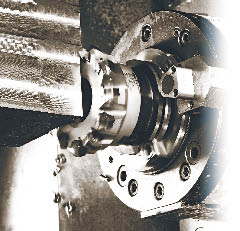
Courtesy of Kennametal
A Kennametal Dodeka facemill machining C-45 steel. When in contact with the workpiece, Kennametal says the facemill provides up to 30 percent improvement in cutting performance without increasing power consumption. The cutter accepts inserts with 12 cutting edges. The Dodeka has four different topographies, including a new wiper geometry.
Table 3: Comparison between the methods of calculations.
| Nomenclature | Machining Data Handbook | The author’s calculator |
|
Metal removal rate, in.3/min. |
24.9 |
24.9 |
|
Ultimate tensile strength, psi |
N.A. |
100,000 |
|
Cutting force, lbs. (sharp cutting edges) |
N.A. |
828 |
|
Cutting force, lbs. (dull cutting edges) |
N.A. |
994 |
|
Torque, ft.-lbs. (sharp cutting edges) |
N.A. |
138 |
|
Torque, ft.-lbs. (dull cutting edges) |
N.A. |
166 |
|
Net power, hp (sharp cutting edges) |
N.A. |
13.0 |
|
Net power, hp (dull cutting edges) |
N.A. |
15.7 |
|
Efficiency factor |
0.8 |
0.8 |
|
Unit power, hp/in.3/min. (sharp tools) |
1.1 |
N.A. |
|
Unit power, hp/in.3/min. (dull tools) |
1.4 |
N.A. |
|
Required machining power, hp (sharp cutting edges) |
27.4 |
16.3 |
|
Required machining power, hp ( dull cutting edges) |
34.9 |
19.6 |
Kennametal Cutting Data
Kennametal uses the author’s method for calculating cutting parameters when facemilling. Final results are based on the cutting data submitted by Osny Fabricio.
Cutting force (Fc) and torque at the cutter (T) values are:
Fc = 828 lbs., T = 138 ft.-lbs.: KSHR400HN5345C5 cutter with new or just indexed inserts (sharp cutting edges).
Fc = 994 lbs., T = 166 ft.-lbs.: KSHR400HN5345C5 cutter, when indexing or replacing of inserts is required (dull cutting edges).
The net machining power, or power at the cutter, is calculated as:
P = 828 × 520 ÷ 33,000 = 13.0 hp (sharp cutting edges)
P = 994 × 520 ÷ 33,000 = 15.7 hp (dull cutting edges)
Required machining power (for adequate comparison, a milling machine has the same efficiency factor η = 0.8) is calculated as:
Pm = 13.0 ÷ 0.8 = 16.3 hp (sharp cutting edges)
Pm = 15.7 ÷ 0.8 = 19.6 hp (dull cutting edges)
A 20-hp machine would be sufficient for the cutting conditions described earlier. The required machining power could be reduced if a milling machine with higher than an 80 percent efficiency factor is used.
Any machine tool with a 90 percent efficiency factor would consume:
Pm = 13.0 ÷ 0.9 = 14.4 hp (sharp cutting edges)
Pm = 15.7 ÷ 0.9 = 17.4 hp (dull cutting edges)
Cutting parameters for the Kennametal KSHR400HN5345C5 milling cutter calculated by the two different methods are summarized in Table 3.
An end user is able to achieve the highest mrr when rough facemilling compared to other milling operations, but it’s important to accurately calculate the power and torque requirements for a given machine tool to achieve the desired level of productivity. By using the author’s method to perform those calculations, an end user can achieve that level of productivity using a machine tool with less horsepower than when calculating the requirements using the conventional method provided by the Machining Data Handbook. CTE
About the Author: Edmund Isakov, Ph.D., is a consultant and writer. He is the author of several books, including “Engineering Formulas for Metalcutting” (Industrial Press, 2004) and “Cutting Data for Turning of Steel” (Industrial Press, 2009). He can be e-mailed at edmundisakov@bellsouth.net or reached at (561) 369-4063.
Contributors
Kennametal Inc.
(800) 446-7738
www.kennametal.com
Sandvik Coromant Co.
(800) 726-3845
www.coromant.sanvik.com/us
Glossary terms in this article
Related



Subscribers can use MFGAxis notes, saves and discussion tools with their innoNET account.


