

HSS tools in demand world-wide
To support growing demand, manufacturers have committed extensive resources to HSS tools, making them more reliable, with improved quality, lower production costs and shorter lead times.
HSS cutting tools are witnessing worldwide growth that shows no sign of slowing down. The increase is supported by steady demand from key segments, such as automotive and construction, as well as heavy electrical and industrial equipment.
Despite growing competition from solid carbide, HSS continues to be popular due to its high hardness and wear resistance at an affordable price. But its best feature is its toughness. HSS cutting tools are best-suited to job shop production environments where versatility and tool cost are most important. In these cases, the material plays a major part in the efficient, reliable machining of a variety of components. Product quality at a cost-effective price is proving attractive in the present global economic climate.
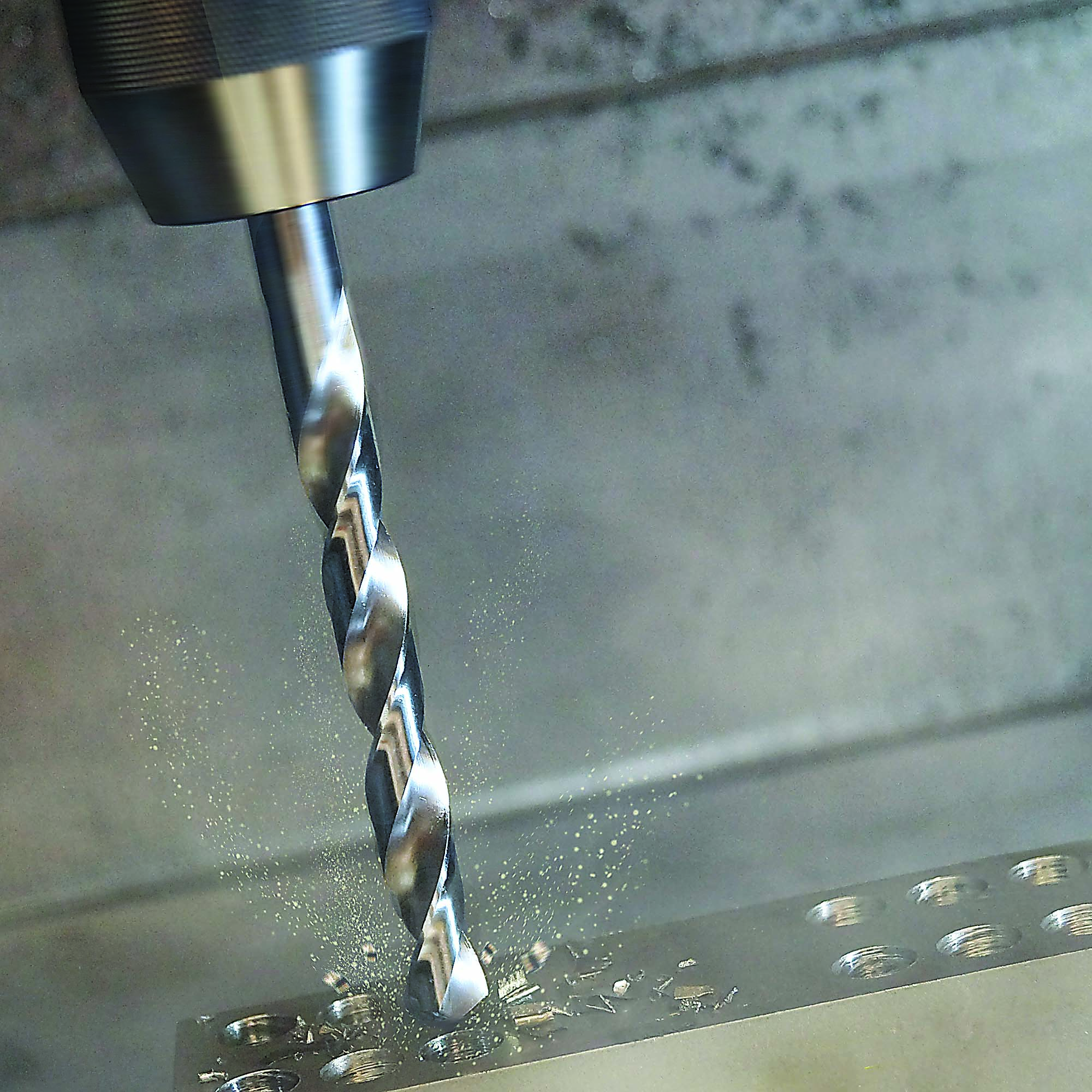
HSS continues to be popular at machine shops because of its toughness properties, as displayed by Precision Twist Drill’s R10P HSS drill with bright finish. Image courtesy of Dormer Pramet
To support growing worldwide demand for HSS, cutting tool manufacturers have committed extensive resources to this segment, including increased investment in R&D activities. These investments have led to HSS tools becoming more reliable, with improved quality, lower production costs and shorter lead times. The addition of improved substrates, including powder metallurgy and coatings, has been instrumental in further enhancing performance of HSS tools.
A typical HSS composition features chromium (4 percent), tungsten (6 percent), molybdenum (5 percent), vanadium (2 percent) and carbon (1 percent). The different grades depend on the varying levels of elements added. The result is a tool material with high toughness that isn’t likely to fracture or break.
A conventional HSS-E composition is slightly different due largely to the addition of cobalt (between 5 and 8 percent), an increase of molybdenum (up to 9 percent) and a decrease of tungsten (down to 1.5 percent). These differences give higher hot hardness and wear
resistance compared with HSS. Typically, tools made with the addition of more cobalt are for specific
applications.
HSS tools resist vibrations, whatever the type of machine tool, even if rigidity has been lost over time and regardless of workpiece clamping conditions. HSS prevents mechanical shocks at the tooth level when milling and copes with varying lubrication conditions that may result in thermal changes.
Also, thanks to the unique strength of HSS, tool manufacturers can produce extremely sharp cutting edges. This makes it easier to machine difficult-to-cut materials and reduces workhardening of austenitic stainless steels and nickel alloys.
Review the print ads from this magazine to continue
This quick advertiser review unlocks the rest of the article and keeps the full-screen reader focused on the ads instead of the page chrome.
Advertisers included in this article experience
Print placements connected to this article
Molemab
Vitrified CBN & Diamond for all Industries!
we shape your world Skillfully Manufactured FORTE 1D, 1B & PRO SERIES in Italy & the USA! NEW - FORTE PRO SERIES POROUS POLYGLOSS HD COME VISIT US AT BOOTH# N-236641 NEW - POLYGLOSS pHD POROUS Molemab USA Corp. 91 Carey Road, Queensbury, NY 12804 USA.
Vitrified CBN & Diamond for all Industries! we shape your world Skillfully Manufactured FORTE 1D, 1B & PRO SERIES in Italy & the USA! NEW - FORTE PRO SERIES POROUS POLYGLOSS HD COME VISIT US AT BOOTH# N-236641 NEW - POLYGLOSS pHD POROUS Molemab USA Corp. 91 Carey Road, Queensbury, NY 12804 USA
Visit Molemab View this placement in the issue recordPrint ads from this magazine
we shape your world Skillfully Manufactured FORTE 1D, 1B & PRO SERIES in Italy & the USA! NEW - FORTE PRO SERIES POROUS POLYGLOSS HD COME VISIT US AT BOOTH# N-236641 NEW - POLYGLOSS pHD POROUS Molemab USA Corp. 91 Carey Road, Queensbury, NY 12804 USA.
Vitrified CBN & Diamond for all Industries! we shape your world Skillfully Manufactured FORTE 1D, 1B & PRO SERIES in Italy & the USA! NEW - FORTE PRO SERIES POROUS POLYGLOSS HD COME VISIT US AT BOOTH# N-236641 NEW - POLYGLOSS pHD POROUS Molemab USA Corp. 91 Carey Road, Queensbury, NY 12804 USA
Continue reading
August 2018
With the proper cutting geometry, the workpiece material is sheared and not pushed, which extends tool life and reduces cutting-edge temperatures. The right geometry also lowers cutting forces, which ultimately means less power consumption from the machine tools.
From a tool life point of view, HSS performs very well with intermittent cutting applications. However, its limited cutting speed range is far lower compared with carbide tools. HSS-E and PM HSS substrates can be a good alternative for bridging the gap between HSS and carbide tools in terms of cutting speeds and
productivity.
HSS may be an established cutting tool material, but that does not mean that it has failed to be developed and improved since its first use in the late 19th century. The development of HSS-E grades with higher cobalt content and HSS-E with PM offers a higher content of alloy elements and a combination of unique properties that improve toughness, wear resistance and hardness. Using HSS-E-PM prolongs tool life, makes it more predictable, improves machining parameters and helps reduce chipping or fracture problems often experienced when using solid-carbide substrates.
Also, HSS-E and HSS-E-PM are excellent substrates for a variety of coatings, such as TiN, TiAlN and TiCN, as well as multilayer coatings.
Coatings considerably improve tool life. They further boost the performance of HSS tools in environments where productivity and speed and feed rates are high. This holds true when dry machining and when cutting challenging or hardened materials. Coatings offer increased surface hardness for higher crater wear resistance, reduced friction for better chip creation, less heat generation and improved surface quality. For example, TiAlN-coated HSS-E cutting tools are suitable for dry machining cast iron, as this helps resist high temperatures, whereas TiAlN-coated HSS-E-PM tools are suitable for machining medium-to-hard alloys.
In an age when users require reliable, consistent, versatile tools at a cost-effective price, HSS remains the ideal choice for many applications. As such, it can still hold its own in the marketplace against newer, more technically advanced materials. If anything, HSS has become stronger over many years by adapting with new coatings, adjusting its composition and adding technology, all helping to retain its position as a vital material in the metalcutting industry.
The cutting tool industry has always been a competitive landscape. HSS remains a key component that offers customers what has always been essential: choice.
—Gary Kirchoff and Jesus Nava, product managers at Dormer Pramet Inc., Elgin, Illinois
Glossary terms in this article
Related



Subscribers can use MFGAxis notes, saves and discussion tools with their innoNET account.


