

Gaining control of a blanchard grinder
Adding a CNC to a Blanchard grinder makes the machine easier to operate and maintain.
Developed more than 100 years ago, Blanchard grinding has typically been a manual process for many shops. The simplicity of a Blanchard makes operation of the machine easy to learn and run. The old dials and handwheels found on Blanchard grinders still work well and get the job done.
However, there’s an even easier way to run a Blanchard: by adding a CNC.
Blanchard began adding controls to its machines in the 1990s. These early controls were plagued with problems. Many shops shy away from Blanchard grinders that have the original controls because of their reputation for being complicated to operate and maintain.
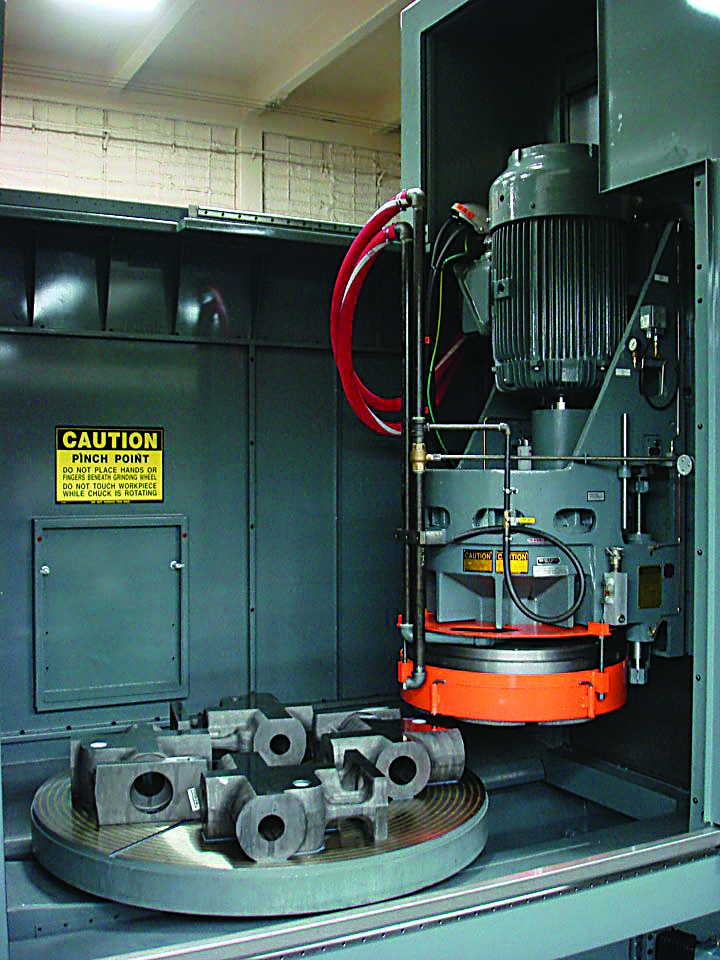
The work zone of a Blanchard 36HD-66 surface grinder,
which can grind parts up to 84″ in diameter. Image courtesy of Bourn & Koch
However, shops realize that Blanchard grinding is a highly efficient method of imparting an extremely flat surface to a workpiece made of virtually any material. The finish is produced by utilizing a vertical grinding spindle with a cylindrical grinding wheel and, generally, a flat magnetic chuck to hold ferrous material. As the magnetic chuck rotates, it carries the work under the first side and then the other side of the wheel face, which is fed down into the work to remove material. This action creates the characteristic crosshatch pattern that has come to be the best indication of a true “Blanchard grind.”
When Bourn & Koch Inc. acquired Blanchard in 2004, the machine tool builder immediately began building new Blanchard grinders and remanufacturing existing machines. Since then, Bourn & Koch has offered FANUC CNCs for the machines. The latest models have the FANUC 35i-Model B control. Bourn & Koch developed a human-machine interface to enable conversational programming. Therefore, programming a grinding process is a simple procedure.
The CNC controls both axes of the machine: X (horizontal table traverse) and Z (vertical grinding head travel). The addition of a CNC allows for precise control over the grinding head downfeed to increments of 0.0001″. Thus, extremely close tolerances can be held.
Adding a CNC to a Blanchard grinder also makes the machine easier to operate and maintain. Servomotors now drive the machine’s axes, eliminating the need for costly maintenance of noisy gearboxes. The grinders still have a heavy-duty lead screw to provide an adequate level of power behind the head downfeed.
Review the print ads from this magazine to continue
This quick advertiser review unlocks the rest of the article and keeps the full-screen reader focused on the ads instead of the page chrome.
Advertisers included in this article experience
Print placements connected to this article
Cutting Tool Engineering
SPARKING INTEREST
SPARKING INTEREST Visit ctemag.com to learn more.
Visit Cutting Tool Engineering View this placement in the issue recordPrint ads from this magazine
SPARKING INTEREST Visit ctemag.com to learn more.
Continue reading
June 2018
For repetitive jobs, conversational programming in the HMI or standard M and G code is used to program machine cycles. A standard grinding program, which is provided with all CNC Blanchard grinders, can be easily edited by the operator or programmer. Numerous programs can be written and saved for later use. For high-mix, low-volume work, the manual-pulse-generator handwheel allows operators to run the machine manually just as they would with the big, old handwheel that Blanchard operators are used to.
A unique function offered for Blanchard grinders is the teach mode. It allows for fast programming of auto-cycle by “teaching” the machine where the start of the grinding cycle is. The operator moves the grinding head to the start position manually, then programs in an offset to compensate for wheel wear. The auto-cycle performs rough and finish grinding, along with a programmed spark-out cycle and automatic demagnification of the chuck. Once the workpiece is taught to the machine, the program can be run simply by pressing “cycle start” on the control after the workpieces are loaded onto the chuck.
Another beneficial function of the CNC is a programmable spindle load meter—a standard feature. The meter displays the load on the grinding spindle as a percentage. The meter can be programmed in two different modes: feed hold at a programmed spindle load and auto-retract at a programmed spindle load.
Feed hold allows the operator to maximize production without damaging the workpiece. Once the programmed spindle load is reached, the machine will hold its position until the spindle load drops below the programmed spindle load. The machine will then resume feeding the grinding head down until the spindle load is reached or the workpiece is ground to size.
Auto-retract mode allows the operator to program the head to retract once a desired spindle load is reached. This is particularly helpful for ensuring that parts are ground to size in automatic or programmed cycles. For instance, the load meter can be programmed to retract the head once an idle spindle load is reached. At an idle spindle load, the machine is no longer grinding and the workpiece is ground to size.
Of the nine standard Blanchard models, the 22AD-42, which can grind parts up to 48″ in diameter, is the most popular. Bourn & Koch is redesigning the grinder to provide up to 100 hp on a direct-drive head. This effort will effectively double the grinding power without going to a geared head. The redesign also involved converting the X-axis drive to a servo cylinder so it will be a positional cylinder.
—Bourn & Koch Inc., Rockford, Ill., www.bourn-koch.com
Glossary terms in this article
Related


 MFGAxis Discussion
Be part of the shop-floor conversation
Like, save, or comment on this CTE story.
MFGAxis Discussion
Be part of the shop-floor conversation
Like, save, or comment on this CTE story.


MFGAxis Discussion