


Part-to-part consistency key to shop’s success
When prompted by requests from customers for products that their existing manufacturing supply chains were not producing, Dan Olsen made the leap into manufacturing.
Dan Olsen never intended to open a machine shop. Not after completing his undergraduate degree in mechanical engineering. Not after he graduated from Northeastern University with an MBA in 2008. Not even when he sold aftermarket marine components—zinc anodes, primarily—something he’d been doing throughout college.
But when prompted by requests from customers for products that their existing manufacturing supply chains were not producing, Olsen made the leap into manufacturing. “I thought, ‘This is ridiculous. Being first to market with these replacement parts is of strategic importance to a company’s success. I can make these parts myself,'” he said.
Mach Machine Inc., Hudson, Mass., had humble beginnings. Anyone who’s tried to open a machine shop knows that it requires plenty of capital investment. In Olsen’s case, however, he started with a laptop, a 1991 Hamill CNC milling machine—which, at the time, already was considered antiquated—and $10,000 from his savings. He taught himself to develop, read and write G code; machine parts; and build fixtures. “I probably wouldn’t have bought that machine if I’d known any better,” he said. “But it got us off the ground.”
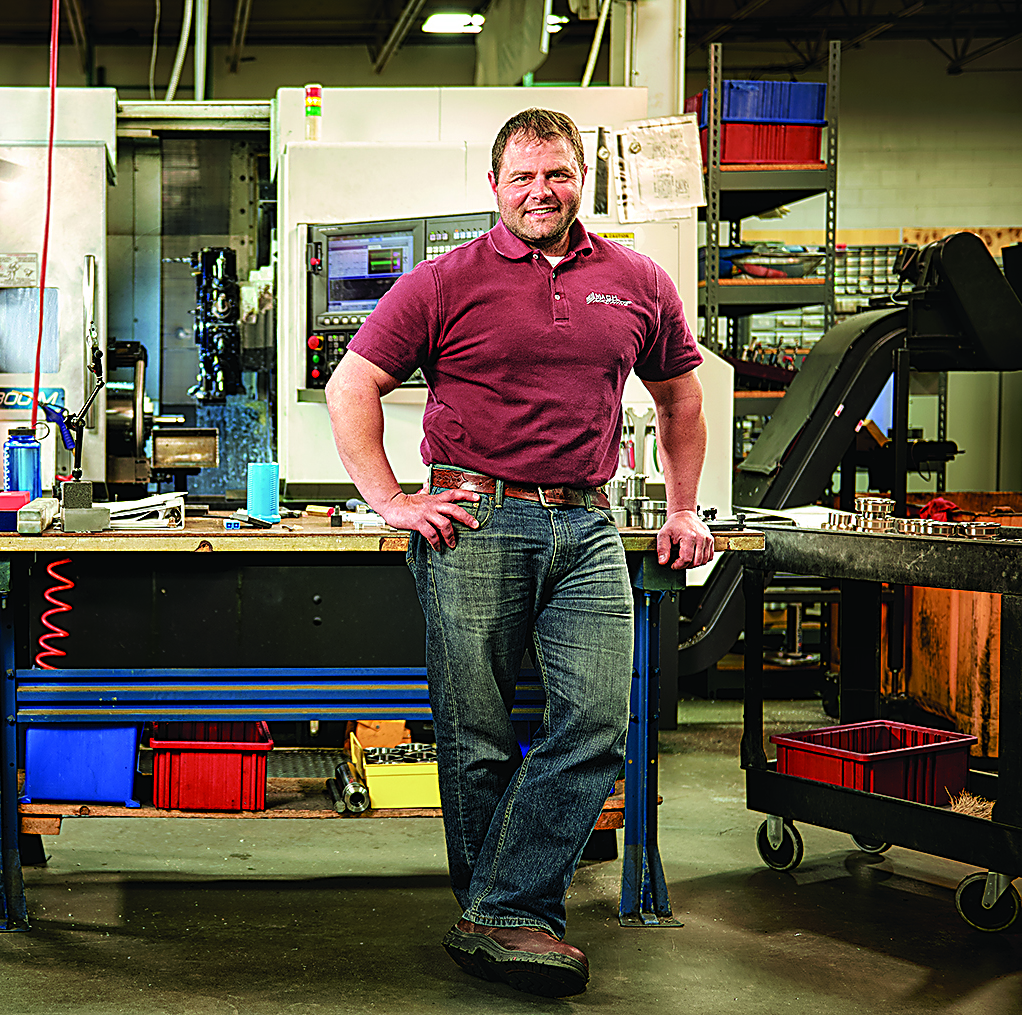
Dan Olsen, president of Mach Machine, started the shop in 2011 with one machine. Mach Machine was one of the first manufacturers in Massachusetts to receive ISO 9001:2015 certification. Image courtesy of Mach Machine.
His initial goal was to support his marine business. However, it wasn’t long before his customers, including friends, began asking him to make parts for them. That was when Olsen realized he could make a go of it as a manufacturer, and he knew exactly which direction to take. The year was 2011.
“The vision for the business was repeat production work,” Olsen said. “Today, the majority of our business comes from blanket purchase orders, many of them dock-to-stock agreements. It’s that need to deliver high-quality products on a predictable basis that led us to our current equipment mix.”
The shop’s most recent machine tool acquisition was an Okuma MB-5000H horizontal machining center with a 12-pallet flexible manufacturing system (FMS), a surprising sight for a machine shop barely 7 years old. Together with a mix of Haas vertical machining centers, Okuma mill-turn lathes, TIG and MIG welders and a Sodick wire EDM, there’s little that Mach Machine can’t make.
It’s admittedly an eclectic mix but one that Olsen and his team of 12 keep running 24 hours a day, 6 days a week. Mach Machine serves a range of industries, including optics, medical, defense and aerospace. Olsen said each machine serves a purpose, adding that he’s noticed a big improvement to the bottom line since acquiring the FMS last year. It runs nonstop.
“We’re actually about to add another pallet system and probably a second horizontal,” Olsen said. “It’s truly become the heart of our business.”
Olsen said the FMS stabilizes Mach’s ability to ship on time, as well as ensure part quality, consistency and a steady cash flow. He added that there’s no setup time. Now when a customer calls to see if there’s any way the shop can rush an order by the next week, Olsen can tell the customer that it will receive parts the next day and the balance the following week.
“Between tool life management, tool breakage detection, redundant tooling and all of the capabilities advanced manufacturing provides,” Olsen said, “we keep the spindle turning. We have a lot of confidence that we can make even the toughest of parts successfully and unattended. The FMS was a great investment.”
Olsen has also invested in augmenting his other machine tools. Each CNC lathe is equipped with a bar loader and parts conveyors. When he realized how much time he was losing on his verticals, Olsen designed and built his own vacuum-powered, quick-change pallet system. “It was easily taking us several hours to set up a job, even on repeat work,” he explained. “Now, we literally just change the program, drop the fixture plate in and push ‘cycle start.’ That worked out really well for us.”
The result is that Mach Machine often enjoys 90 percent spindle utilization, especially on the HMC. Olsen’s focus on repeat work means he can run 50 pieces as efficiently as he can run 1,000—without sacrificing parts or wasting time on setup.
“Our mantra is this: Whether it’s the first piece, the 10th or the 10,000th, they need to be exactly the same,” Olsen said. “I don’t want any deviation from lot to lot.”
He pointed out that the horizontal has helped in that respect. It made his company competitive on price, and the failure rate has dropped to nearly zero. In addition, he doesn’t have nonconforming parts, and there’s no longer a need for setup pieces, scrap allowance or any of the other waste of traditional manufacturing.
“We spend time learning our customers’ parts, optimizing the machining process, reducing cycle times by utilizing advanced tooling technology and being highly aggressive with pricing,” he said. “That’s how we make money.”
For more information about Mach Machine Inc., call (978) 274-5700 or visit www.machmachine.com.
Glossary terms in this article
Related



Subscribers can use MFGAxis notes, saves and discussion tools with their innoNET account.