Don’t hack away at chatter problems
When chatter rears its ugly head, it's a good idea to look at your cutting tools. Selecting material-specific cutting tools is certainly part of the solution.
Machine shops go to great lengths to eliminate chatter.
Dan Maloney, one of the writers of the blog Hackaday (www.hackaday.com), even went so far as to modify the electronic drive unit on his engine lathe to automatically oscillate the spindle speed in hopes of breaking up vibration. Maloney’s approach—attaching a 555 timer board that drives a relay to toggle the IO pins on and off—was somewhat successful, but it’s not practical for CNC equipment.
Also, his statement that “vibration is a fact of life in almost every machining operation” is questionable. Perhaps he’s right, but if you can’t hear it, who cares?
Still, when chatter does rear its ugly head, something must be done. Before breaking out the soldering iron and a 555 timer, it’s a good idea to look at your cutting tools.
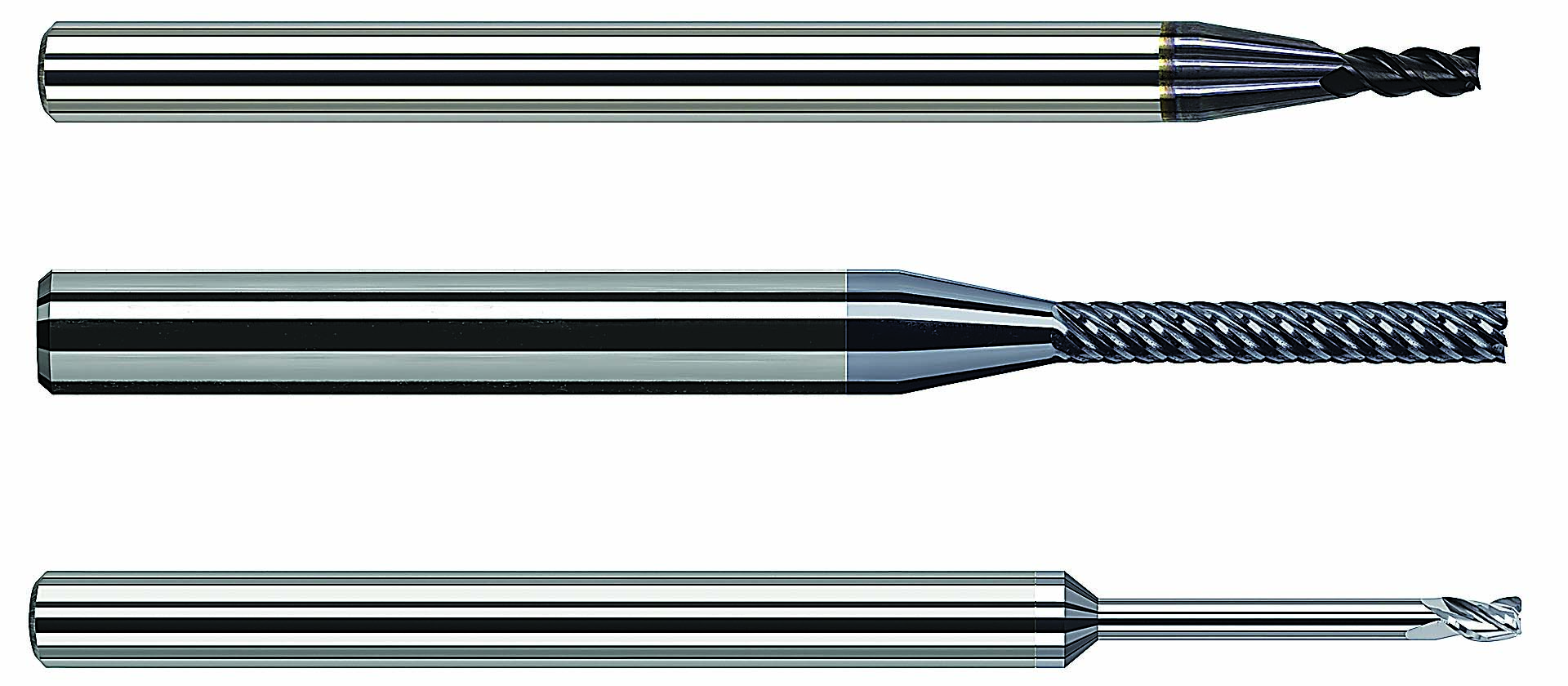
A sampling of the many variable-helix endmills available to manufacturers. Image courtesy of Harvey Performance.
Another blog, this one from Harvey Performance Co. LLC, Rowley, Mass., suggests that material-specific cutting tools are part of the answer.
For example, Chris Palmieri, production development engineer at Harvey Performance, said the geometry of an endmill designed for stainless steel differs from one used to machine aluminum. However, the same basic approach to chatter reduction applies in either instance—namely, varying the flute spacing and helix angles to break up the harmonics that lead to chatter.
“A variable-pitch tool assures that the time interval between two successive flutes contacting the material is never the same,” Palmieri said. “This actual amount of flute spacing is more a factor of endmill size rather than the material it’s designed for, however. A similar phenomenon occurs with variable-helix endmill geometry, where changing the angle slightly from flute to flute likewise serves to reduce chatter.”
Palmieri explained that, in either case, the geometry must also be based on the workpiece material—increasing the helix angle to allow for the aggressive feed rates used when cutting nonferrous metals, for instance. “That’s why it’s important to choose a cutter specifically designed for your machining application, especially where chatter is an issue.”
Review the print ads from this magazine to continue
This quick advertiser review unlocks the rest of the article and keeps the full-screen reader focused on the ads instead of the page chrome.
Advertisers included in this article experience
Print placements connected to this article
Komaprecision
www.komaprecision.com | [email protected] | 1.800.249.5662
www.komaprecision.com | [email protected] | 1.800.249.5662
www.komaprecision.com | [email protected] | 1.800.249.5662
Visit Komaprecision View this placement in the issue recordPrint ads from this magazine
www.komaprecision.com | [email protected] | 1.800.249.5662
www.komaprecision.com | [email protected] | 1.800.249.5662
Continue reading
March 2018
Palmieri said increased tool rigidity, tool balancing and minimal runout also contribute to chatter reduction. He recommends using a modified tool shank, like the Helical Solutions ToughGRIP shank. It offers a higher coefficient of friction, compared to a polished carbide shank, and eliminates any chance of movement within the holder.
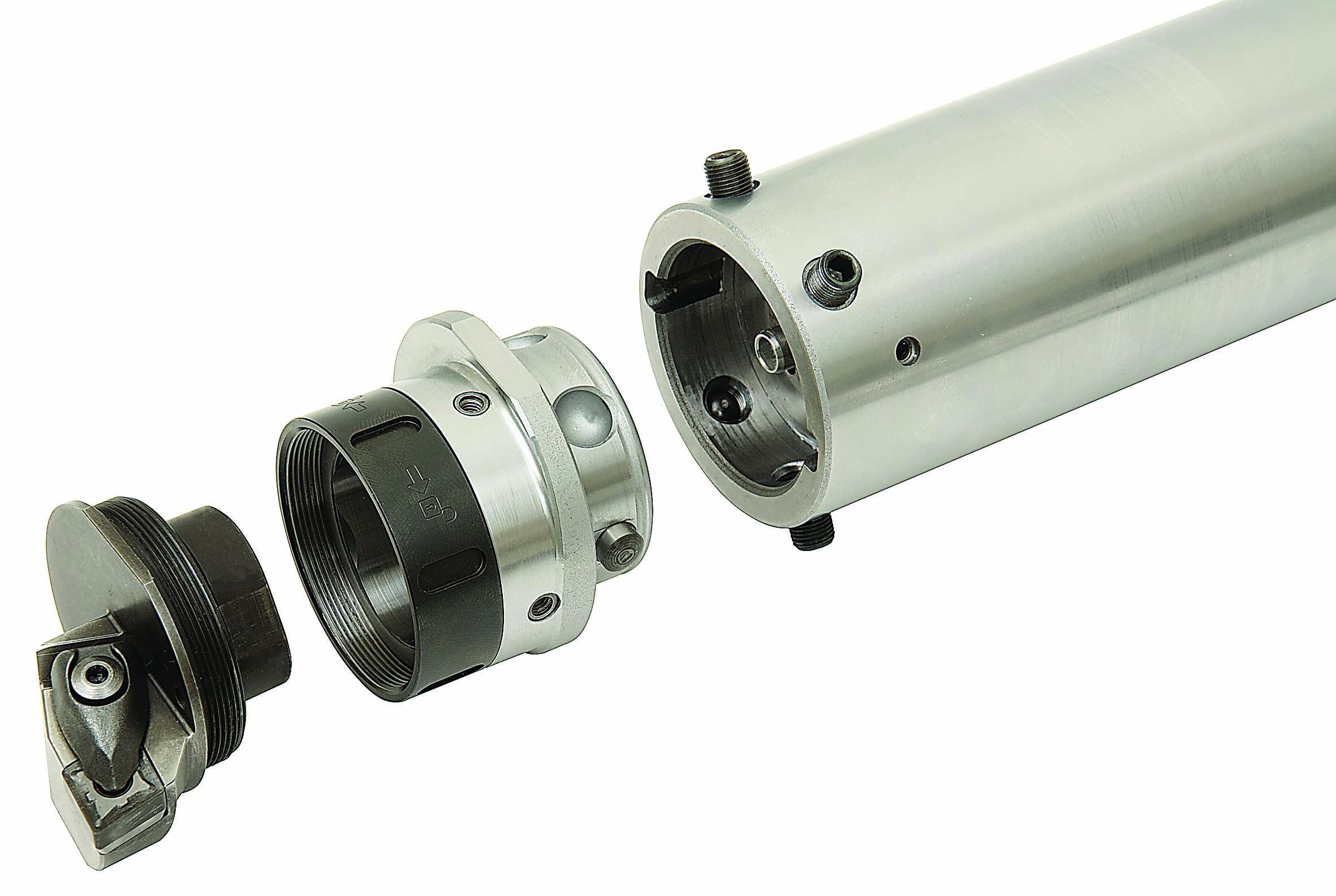
Seco Tools’ Steadyline dynamic-vibration-control tooling reportedly damps the harmonics that produce chatter, allowing a tool to be run at a higher feed rate. Image courtesy of Seco Tools.
It’s also important to consider the toolpath. “For harmonics to occur, cutting forces have to be in sync,” he said. “The spiral cutting paths used with trochoidal and other high-efficiency programming methods cause cutting forces to be exerted in different directions as the tool makes its way into and out of the workpiece. This does reduce vibration somewhat, but it’s still a good idea to use a variable-pitch, variable-helix tool to ensure that chatter is minimized as much as possible.”
Seco Tools LLC, Troy, Mich., refers to this type of chatter reduction as passive, in that proper machine construction, tool selection and, to a lesser extent, part design can go a long way toward eliminating chatter. When that’s not enough, dynamic vibration control must be applied.
That’s according to a recent white paper by Seco Product Manager Pierre Zunino and R&D Engineer Yannick Groll. In it, the two state that a “pretuned vibration damper consisting of a heavy-metal mass suspended inside the toolholder bar” enables long-overhang operations to be performed at least twice as fast as those using nondamped toolholders, with better part finish and tool life to boot.
In one example, Seco engineers tested the effectiveness of dynamic-vibration-control toolholders when side milling. Using one of the company’s nondamped Combimaster holders, they machined CK50 high-carbon steel with a 0.787″-dia. (20mm) endmill spinning at about 5,000 rpm (a cutting speed of 1,023 sfm, or 312 m/min.), a feed rate of 0.118 ipt (0.3 mm/tooth) and a 0.035″ (0.9mm) DOC.
When the same test was performed using Seco’s Steadyline system, it was possible to “increase cutting depth by 2.3 times, to 0.087″, without unwanted vibration,” the authors wrote.
Similar results were obtained when boring 42CrMo4 chrome-moly steel, where the boring time was reduced from 12 to just 2 hours, more than an 80 percent reduction. The study further recommends that damped bars be mounted directly to the machine without intermediary extensions or reductions and that a dual-contact mounting system, such as Capto, be used for optimal results. In some cases, an increased feed rate may be needed to “trigger” the device’s damping effect.