

Shop Profile: From pewter to ultraprecision CNC machine tools
Craftsman Jasper Röders set up shop during the early 1800s to make pewter tableware for his neighbors in Soltau, Germany. Six generations later, his descendants still produce pewter but have expanded into blow molds and CNC machine tools.
Craftsman Jasper Röders set up shop during the early 1800s to make pewter tableware for his neighbors in Soltau, Germany. Six generations later, his descendants still produce pewter but have expanded into blow molds and CNC machine tools.
G.A. Röders GmbH & Co. KG’s RXP line of high-speed milling and grinding machines are available in North America from Roeders of America Inc., Valley Cottage, N.Y.
Roeders president, Victor Pfister, said the 3-, 4- and 5-axis machining centers can impart optical-quality finishes and achieve extreme accuracy. “The company has extensive experience in moldmaking and was unable to find machine tools that would do what we needed,” he said. “So around 25 years ago, we started building our own equipment. We use only linear-drive and direct-drive torque rotary motors, so there are no issues with wear components or backlash.”
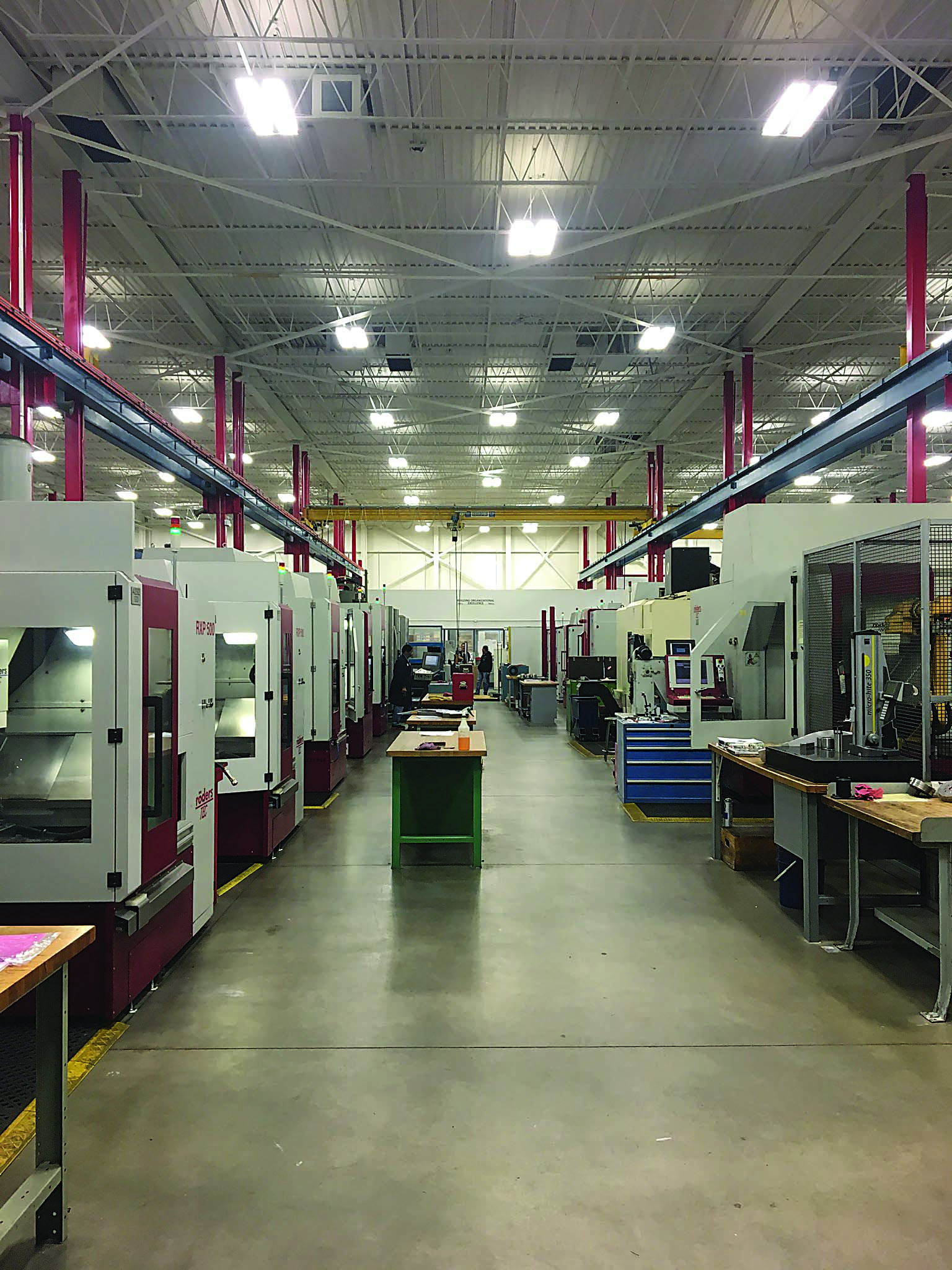
Roeders machines offer spindle speeds up to 90,000 rpm and are capable of imparting surface finishes finer than 0.01μm Ra. This image shows the shop floor at injection mold manufacturer StackTeck, Brampton, Ontario, which has 11 Roeders machines and another on order. Image courtesy of Roeders of America.
The spindle and other key machine components are temperature-controlled, he added, and some machines are available with 60,000-rpm and 90,000-rpm air-bearing spindles, which are suited for optics machining. These spindles have about a tenth the runout of hybrid ceramic-bearing spindles, according to Pfister, but are limited to light-duty work, so the company also offers many other spindle options for hard milling. Some machines have dual spindles to rough and finish injection molds and optics in the same setup.
“For metals much harder than the low-60s HRC, we have a jig grinding option,” he said. “We use our own proprietary control and 32-kHz drive technology, with 10,000-block look-ahead and 0.1-millisecond block-processing time.”
Pfister said the goal is to produce injection molds that don’t require polishing. Also, optical surfaces benefit when they are machined without being touched afterwards.” In either case, the ability to machine surfaces to within ±0.00004″ (1.02µm) and finishes to finer than 0.01μm Ra is a high standard against which Pfister said competing machine tools must measure themselves. “We’re very specialized,” he said, noting the company doesn’t offer EDMs or commodity machines. “In terms of building machines, we’re focused exclusively on high-speed milling. That is all we do, and it gives us a tremendous technological advantage.”
Glossary terms in this article
Related




Subscribers can use MFGAxis notes, saves and discussion tools with their innoNET account.


