6 tips for improving turning operations
There's plenty of good application advice available from cutting tool specialists and equipment providers. This article offers six best-practice tips you might not have heard of yet, ones that will help you improve throughput and reduce costs.
Lathe machinists have always had it tough. There’s the risk of cut fingers that comes with long, stringy chips. Bar feeder-induced noise and vibration—leading to problems with surface finish and premature hearing loss. The endless bending over to change inserts and drills, often in tight quarters, and never mind rooting around in the chip pan for parts that went flying during cutoff. Plus, with the advent of multitask machines, lathe operators must now learn about milling.
Fortunately, there’s plenty of good application advice available from cutting tool specialists and equipment providers. Following are six best-practice tips you might not have heard of yet, ones that will help you improve throughput and reduce costs.
Stay Cool
High-pressure coolant (HPC) isn’t a gimmick. It’s been proven to greatly extend tool life and dramatically boost productivity. That’s because HPC is extremely effective at removing heat from the cutting zone. The result is that cutting parameters can, and should, be increased to generate sufficient heat for the metal-removal process to function properly. On the surface, this may seem counterintuitive—why eliminate heat just to create more? But when you consider that cutting speeds with HPC are often five times that of conventional flood coolant, it’s a no-brainer.
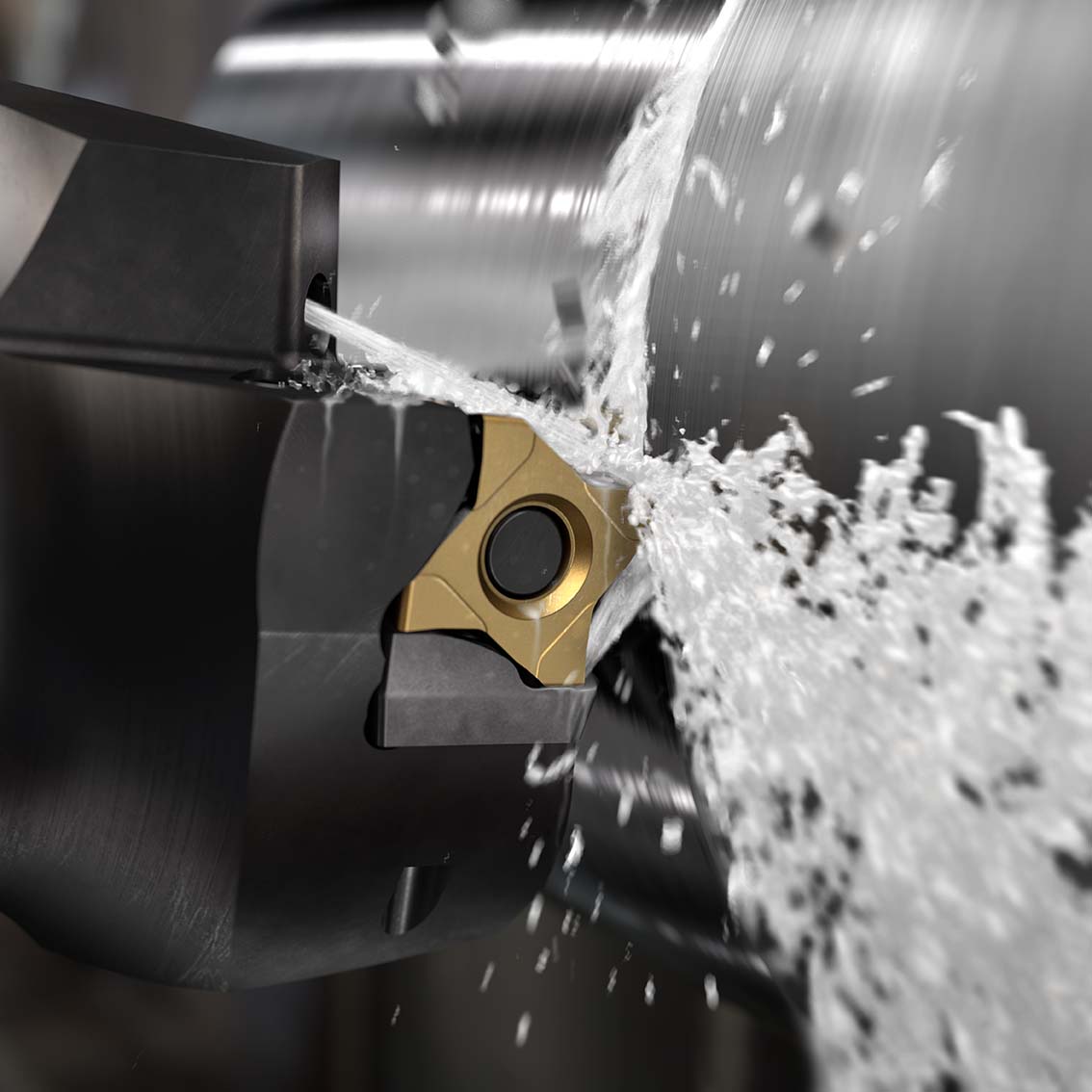
High-pressure coolant is extremely effective at removing heat from the cutting zone.
The Sandvik Coromant CoroTurn 300 (shown) is ported to supply high-pressure cutting fluid directly
above and below the cutting zone. All images courtesy of Sandvik Coromant.
If your shop lacks the funds for an HPC system, don’t despair. Surprising gains are still there for the taking if the cutting fluid—even applied at low pressure—is properly directed. A number of cutting tool providers have recognized this and are producing tool bodies, or holders, with integrated cutting fluid ports. These holders can be ported to supply cutting fluid directly above and below the cutting zone, dramatically reducing heat. Goodbye, plastic hoses and copper lines!
Control the Crib
Cost per edge is important, but it’s not the end game. Choosing the right turning tool for the job is. Yet many metalworking professionals are concerned about out-of-control toolcribs, where the number of insert brands and grades seems to grow with each passing year, with some of those inserts probably dating back to the shop’s first CNC machine. Adding to inventory bloat are enthusiastic sales people who stop by with the latest tool body and pack of inserts and add another handful of part numbers for the crib to manage.

An effective tooling strategy requires working closely with suppliers
in a controlled manner, bringing in new technology to address specific challenges.
Granted, these ad-hoc solutions often bring improvement to tool life or productivity, but an effective tooling strategy requires working closely with suppliers in a controlled manner, bringing in new technology to address specific challenges.
That upcoming order of Inconel shafts, for example, is sure to cause you grief. Rather than applying a general-purpose 80° diamond-shaped insert, because you’re trying to avoid adding to the cutting tool roster, invite your trusted tooling adviser(s) for some test cuts early on—and document the results.
Optimize, Don’t Maximize
Once you’ve found the desired turning tool, don’t run it into the ground. Achievement of maximum tool life is a worthwhile goal, but not at the cost of process stability. If an insert can be pushed to produce 30 pieces before it wears or breaks, change it at 25 pieces, even if the edge still looks like there’s some life left. In addition, if you have a cutting tool that seems to last forever, kick up the feeds and speeds. The most cost-effective lifespan for any tool is 15 minutes when running with the recommended speeds and feeds for a particular workpiece material. So, if tools are lasting hours, you’re losing money.
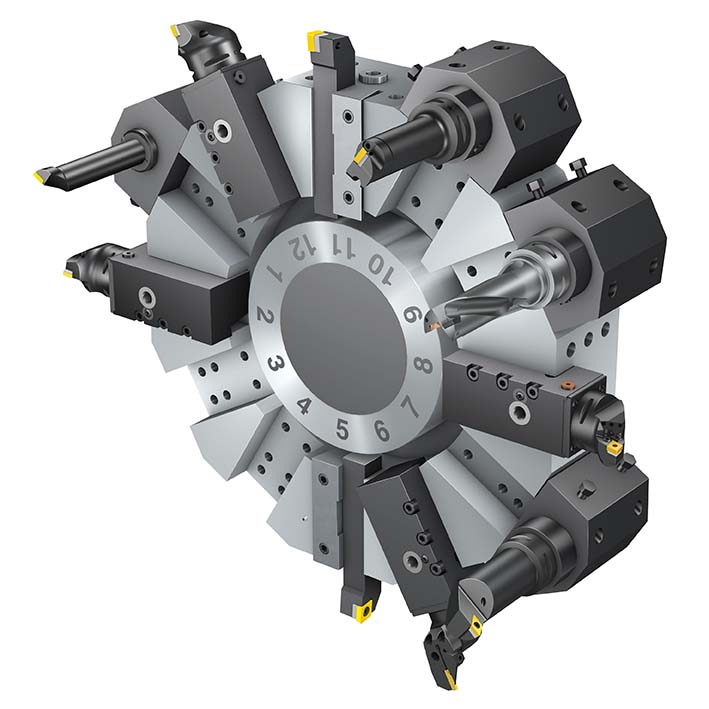
If possible, change all the tools in the turret
at the same time, at regularly defined intervals.
ne often overlooked bit of fine-tuning is to change all the tools in the turret at the same time, at regularly defined intervals. This minimizes the amount of door opening and, properly implemented, provides predictable lengths of time where an operator can leave a machine unattended to do other work. Of course, this requires careful planning and documentation of anticipated tool life and the cutting parameters that have been tried so far.
Some tools are in the cut much longer than others, and no amount of feed or speed tweaking will get them to wear out at the same time. They can, however, be scheduled for coordinated changeover.
If, for example, the rougher looks ready to fail at 18 minutes, the finisher at 67 and the grooving tool at 39, then:
A) change the roughing tool at 15 minutes;
Review the print ads from this magazine to continue
This quick advertiser review unlocks the rest of the article and keeps the full-screen reader focused on the ads instead of the page chrome.
Advertisers included in this article experience
Print placements connected to this article
Carrlane
New Corrosion-Resistant
Swivel Hoist Rings New swivel hoist rings from Carr Lane Manufacturing have an electroless nickel plating that is ideal for many corrosive and outdoor environments. ISO 9001 CERTIFIED Carr Lane Manufacturing offers over 20 different types of pivoting, swivel, and side-pull hoist rings, from economical, low profile versions to load capacities up to 250,000 lbs
New Corrosion-Resistant Swivel Hoist Rings New swivel hoist rings from Carr Lane Manufacturing have an electroless nickel plating that is ideal for many corrosive and outdoor environments. ISO 9001
Visit Carrlane View this placement in the issue recordPrint ads from this magazine
Swivel Hoist Rings New swivel hoist rings from Carr Lane Manufacturing have an electroless nickel plating that is ideal for many corrosive and outdoor environments. ISO 9001 CERTIFIED Carr Lane Manufacturing offers over 20 different types of pivoting, swivel, and side-pull hoist rings, from economical, low profile versions to load capacities up to 250,000 lbs
New Corrosion-Resistant Swivel Hoist Rings New swivel hoist rings from Carr Lane Manufacturing have an electroless nickel plating that is ideal for many corrosive and outdoor environments. ISO 9001
Continue reading
March 2017
B) replace the rougher and groover at 30 minutes;
C) change the rougher again at 45 minutes; and
D) swap all three tools at the 1-hour mark.
Keep It Clean
We’ve all been scolded about not keeping our work areas clean enough at one time or another. Wipe down the sheet metal, top off the way oil and empty the chip tray. Proper machine tool maintenance should be a priority in any shop. Yet one often-overlooked maintenance item is the tool bodies themselves. When neglected, inserts may shift during cutting, often leading to disastrous results.

Regular inspection of the insert pocket is critical to ensuring effective turning.
Regular inspection of the insert pocket is paramount. Check for signs of wear and deformation. Look for dimples or cracks in the shim, and ensure the clamp, screw and pin are still securely holding the insert. Tool bodies should
also be taken apart on a regular basis—perhaps once every 20 to 30 tool changes—depending on use. Remove any metal fines that might be lodged in the seating areas, apply a small amount of grease to the moving parts, smooth small deformations and dents with a file, and don’t be afraid to recycle a tool body when wear becomes unacceptable.
Write It Down
What’s your documentation strategy? If you’re still scribbling things down on tool setup sheets, it’s time to get digital. Shops of all sizes can afford to scatter a handful of PC workstations or tablets across the production floor, if not placing one at each machine.
Job “diary” templates should be established to keep track of events, and employees should be encouraged to use them. Doing so helps eliminate the risk of tribal-knowledge loss the next time a top employee moves on.
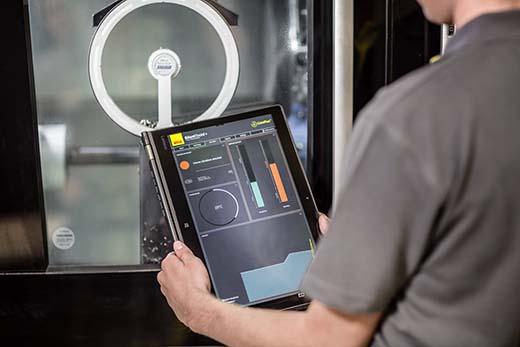
Shops of all sizes can afford to scatter a handful of PC workstations or tablets
across the production floor, if not one at each machine, to enable proper documentation.
Even for those shops that haven’t taken the step of implementing a centralized tool-management database, apps that calculate productivity, provide educational materials, identify inserts and perform other functions are available to help make a machinist’s life easier. And making cloud-based tool libraries available streamlines setup and programming operations, and gives machinists ready access to application information.
Continuously Train
With today’s competition comes an increased need for lean. Some manufacturers have responded by eliminating their process-engineering function, relying instead on the shop floor to do the job planning, programming, tool selection and other process-development activities once done in the front office.
Lathe operators—indeed, all manufacturing folks—bear a heavy burden these days. They need all the tools, techniques and advice available to them.
They also need continuous training. Most cutting tool manufacturers and many machine tool distributors
offer online, in-house and on-premise educational programs, as do many vo-tech schools and community colleges. If shops are to realize maximum efficiency, management must budget for training to help employees reach their full potential—and, most importantly, to retain them.
There’s plenty more. The Sandvik Coromant website, for example, suggests the following turning application advice:
- Minimize tool pressure by using a cutting depth larger than the tool nose radius.
- Always run at the highest possible surface speed to extend tool life.
- Use wiper inserts when finishing to impart fine surface finishes at maximum feed rates.
- Large lead angles reduce notching, thin the chip and allow for high feed rates.
Also, don’t forget to pick the brains of cutting and machine tool application engineers. They visit hundreds of job shops each year and are a great source of information.