

A mountain (bike) of chips
END USER: North Bucks Machining Ltd., +1908-611-669, www.northbucksmachining.co.uk. SOLUTION PROVIDER: Open Mind Technologies USA Inc., (888) 516-1232, www.openmind-tech.com. CHALLENGE: Efficiently rough-machine a mountain bike frame from a solid piece of aluminum stock. SOLUTION: A CAM software's high-performance roughing module.
END USER: North Bucks Machining Ltd., +1908-611-669, www.northbucksmachining.co.uk
SOLUTION PROVIDER: Open Mind Technologies USA Inc., (888) 516-1232, www.openmind-tech.com
CHALLENGE: Efficiently rough-machine a mountain bike frame from a solid piece of aluminum stock.
SOLUTION: A CAM software’s high-performance roughing module.
Machining a bicycle frame from solid stock instead of welding hollow tubes together enhances the frame’s strength and structural integrity. This is because the frame doesn’t have the weaknesses that welding or otherwise joining two or more pieces can create. That’s according to Stewart Palmer, engineer at North Bucks Machining Ltd., a five-employee parts subcontractor started in 2011 by his parents, Dave and Rose.
And he should know, because, to date, Milton Keynes, U.K.-based NBM has machined two 4.5kg (9.92 lb.) prototype bike frames from a 100kg (220.5 lb.) 608 aluminum billet in connection with a mountain bike Palmer designed and built. “We used solid aluminum billets and I-beam technology to scallop out the sides of the frame to reduce mass,” Palmer said, noting the aim was to prove the concept and make the best possible product. “We calculated that we could machine our rib thicknesses down to 5mm while retaining structural integrity.”
In addition to the frame, the bike design consists of two other core features: the seat post and the swing arm that connects the frame to the rear wheel and suspension. The seat post starts as a 15kg (33.1 lb.) billet and ends as a 250g (0.6 lb.) part, and the swing arm is machined from a 50kg (110.2 lb.) billet down to a 2kg (4.4 lb.) part.
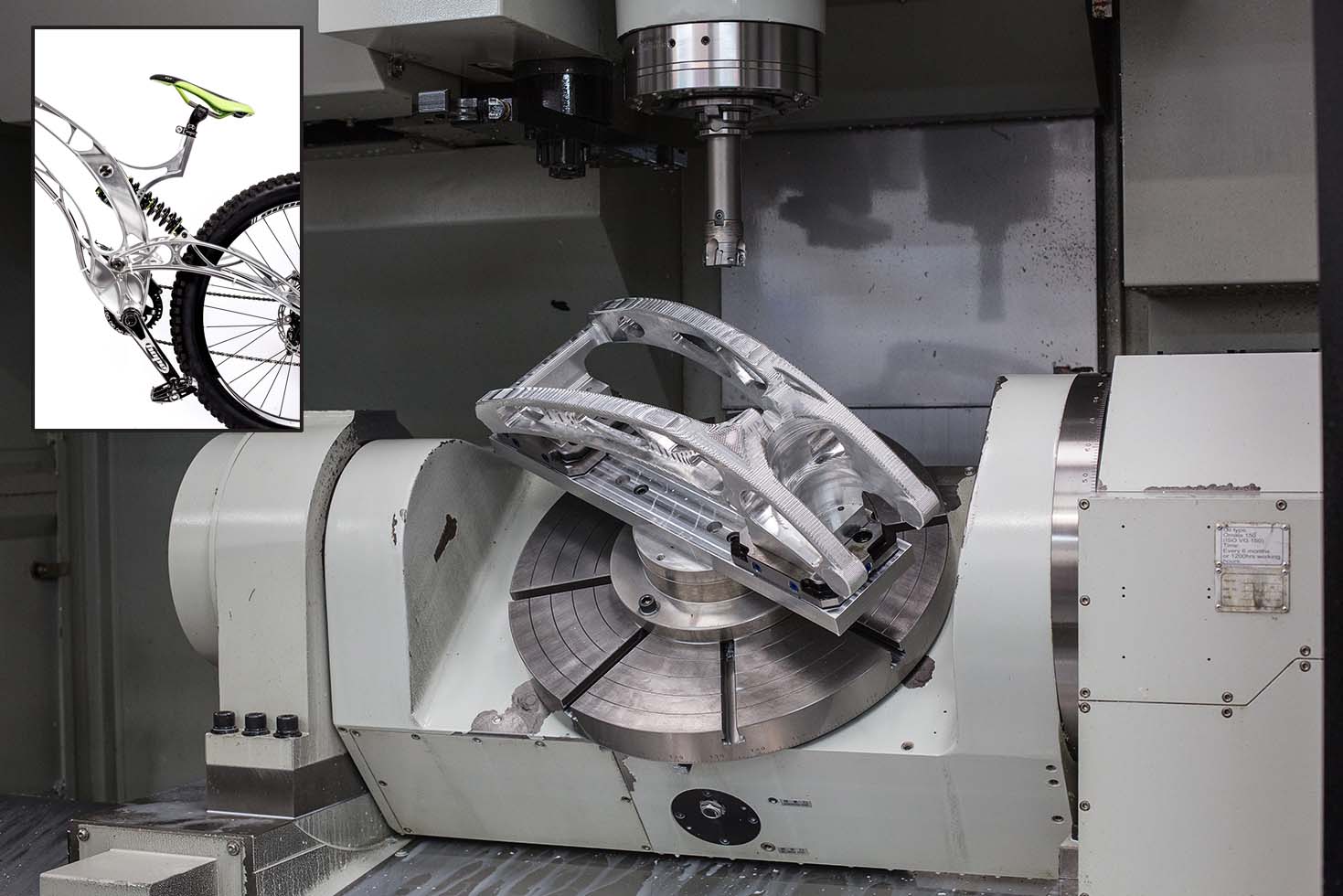
North Bucks Machining machines an aluminum swing arm for a mountain bike (inset)
in a Quaser MF630 U-type 5-axis vertical mill. Image courtesy of North Bucks Machining
Although NBM has a Quaser MF630 U-type 5-axis vertical mill, which has a maximum swing of 630mm (24.8″), Palmer explained that the frame is too large to machine in that machine, so the company used a Haas 3-axis machine, which required 10 to 12 setups. “If it could have been manufactured on the 5-axis, we would have greatly reduced that number,” he said.
Palmer added that NBM uses hyperMILL CAM software from Wessling, Germany-headquartered Open Mind AG (Open Mind Technologies USA Inc. is located in Needham, Mass.) to make more efficient use of its machine tools. During a trial to produce the second frame, NBM incorporated the roughing module in the hyperMILL MAXX Machining performance package. “When we switched to the hyperMILL MAXX Machining strategies, the engineering technology group at Quaser lent us a 3-axis machine to do the test on,” he said, adding that the initial switch was done in connection with a live cutting demonstration at a trade show where the Quaser machine was allocated to NBM. “All we did was change the cycles and change the way we look at roughing.”
According to the software developer, the roughing module creates spiral and trochoidal toolpaths that significantly increase material-removal rates. This reportedly enabled extremely fast machining while reducing stress on the cutting tools and machine.
Review the print ads from this magazine to continue
This quick advertiser review unlocks the rest of the article and keeps the full-screen reader focused on the ads instead of the page chrome.
Advertisers included in this article experience
Print placements connected to this article
Kyoceraprecisiontools
VULCAN
Compression End Mills for Routing Composites Composite Routing with the VULCAN The VULCAN compression end mill is designed with up cut and down cut flutes to compress the composite material preventing delamination. The spiral flute design creates a shearing action to cleanly cut the fibers. Utilizing a positive rake angle, the compression end mill makes quick sharp.
VULCAN Compression End Mills for Routing Composites Composite Routing with the VULCAN The VULCAN compression end mill is designed with up cut and down cut flutes to compress the composite material preventing delamination. The spiral flute design creates a shearing action to cleanly cut the fibers. Utilizing a positive rake angle, the compression end mill makes quick sharp cuts minimizing heat and preventing the formation of resin burrs. Prevents Resin Burring Compresses
Visit Kyoceraprecisiontools View this placement in the issue recordPrint ads from this magazine
Compression End Mills for Routing Composites Composite Routing with the VULCAN The VULCAN compression end mill is designed with up cut and down cut flutes to compress the composite material preventing delamination. The spiral flute design creates a shearing action to cleanly cut the fibers. Utilizing a positive rake angle, the compression end mill makes quick sharp.
VULCAN Compression End Mills for Routing Composites Composite Routing with the VULCAN The VULCAN compression end mill is designed with up cut and down cut flutes to compress the composite material preventing delamination. The spiral flute design creates a shearing action to cleanly cut the fibers. Utilizing a positive rake angle, the compression end mill makes quick sharp cuts minimizing heat and preventing the formation of resin burrs. Prevents Resin Burring Compresses
Continue reading
February 2017
With that change, NBM reduced one of the roughing cycles on the main frame from 2 hours and 20 minutes to less than 1 hour and 30 minutes—a 40 percent reduction.
“Furthermore, the frame requires a lot of pocket machining, so naturally there is a radius left at the bottom of each pocket by the cutting tool,” Palmer said. “To resolve this, hyperMILL has a ‘pencil milling’ feature that can isolate all the remaining fillets for remachining. The machine then selects a small tool, which removes the excess material in the corner of each pocket.”
Effectively finishing the frame is also critical to craft a mountain bike that’s “aesthetically perfect” without painting or otherwise coating the aluminum, as well as eliminating secondary manual finishing operations, Palmer explained. “All the directions of the toolpaths flowed to create a pattern across the finished frame,” he said, noting the step-overs were tight. “There are hardly any flat surfaces, so everything was 3D-machined.”
Efficiency was not on Palmer’s mind when machining the components, as machining consumed 40 hours for the frame, 18 hours for the swing arm and 15 hours for the seat post. “Because it was a showcase product, there was no point in trying to cut corners and shave time,” he said. “The quality of the finished article was the key factor.”
Of course, that wouldn’t be the case if the bike went into production. “It was spec’d and designed with all the intention of being a useful product,” he said.
“The bike is either for someone who really loves the engineering of it and would never ride it because it’s almost a piece of art or someone who wants an absolutely top-of-the-range piece of equipment,” Palmer added.
If it went into production, the bike would cost a pretty pound. Converted to U.S. dollars, he estimated the price at about $12,000 to $15,000. In addition to obtaining an awesome ride, those customers would receive a consistently manufactured product. “The first bike is going to be exactly the same as the last bike,” Palmer said, “because it’s all made by the machine.”
Related

 MFGAxis Discussion
Be part of the shop-floor conversation
Like, save, or comment on this CTE story.
MFGAxis Discussion
Be part of the shop-floor conversation
Like, save, or comment on this CTE story.


MFGAxis Discussion