

Telescope to look for earliest light
Although the James Webb Space Telescope isn't scheduled to be launched on an Ariane 5 rocket from French Guiana until October 2018, NASA announced that the 18th and final primary mirror segment was recently installed on what will be the biggest and most powerful space telescope.
Although the James Webb Space Telescope isn’t scheduled to be launched on an Ariane 5 rocket from French Guiana until October 2018, NASA announced that the 18th and final primary mirror segment was recently installed on what will be the biggest and most powerful space telescope. Each segment required almost a year to process, including 6,600 hours of machining time, heat treatment and inspection. The infrared telescope has a 6.5m (21.3′) primary mirror and a 0.74m-dia. (2.4′) secondary mirror, and, compared to 2.4m-dia. (7.9′) Hubble Space Telescope, the JWST will have nearly three times higher resolution in the infrared.
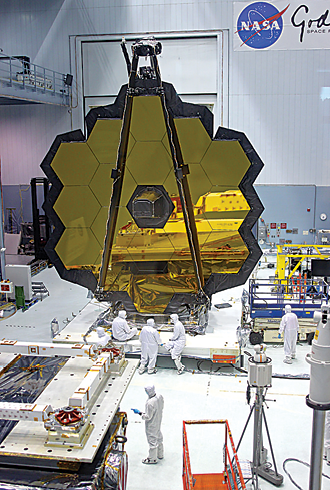
Technicians perform optical tests on the James Webb Space Telescope. Image courtesy NASA.
The stated mission goals of the JWST are to:
- Search for the first galaxies or luminous objects formed after the big bang;
- determine how galaxies evolved from their formation;
- observe the formation of stars from the first stages of the formation of planetary systems; and
- measure the physical and chemical properties of planetary systems and investigate the potential for life in those systems.
The mirror segments are made of ultralightweight beryllium and will unfold and adjust to shape after launch, NASA reported. Each hexagonal-shaped segment measures about 1.3m (4.2′) across and weighs about 40kg (88 lbs.). Once polishing is completed for each segment, a 100nm-thick coating of gold is applied via vacuum vapor deposition to improve the mirror’s ability to reflect infrared light. About 3g (0.106 oz.) of pure gold, total, is deposited on the mirrors.
Review the print ads from this magazine to continue
This quick advertiser review unlocks the rest of the article and keeps the full-screen reader focused on the ads instead of the page chrome.
Advertisers included in this article experience
Print placements connected to this article
Ceratizitpromos
RELIABILITY
MATTERS Depend on carbide solutions from CERATIZIT: For an extensive range of standard sizes and cut-to-length rods As a dependable source of superior carbide rods and preforms For quick quote turnaround For high percentage of on-time delivery For innovative custom solutions with ROI you can trust To view the catalogs and video.
RELIABILITY MATTERS Depend on carbide solutions from CERATIZIT: For an extensive range of standard sizes and cut-to-length rods As a dependable source of superior carbide rods and preforms For quick quote turnaround For high percentage of on-time delivery For innovative custom solutions with ROI you can trust To view the catalogs and video,
Visit Ceratizitpromos View this placement in the issue recordPrint ads from this magazine
MATTERS Depend on carbide solutions from CERATIZIT: For an extensive range of standard sizes and cut-to-length rods As a dependable source of superior carbide rods and preforms For quick quote turnaround For high percentage of on-time delivery For innovative custom solutions with ROI you can trust To view the catalogs and video.
RELIABILITY MATTERS Depend on carbide solutions from CERATIZIT: For an extensive range of standard sizes and cut-to-length rods As a dependable source of superior carbide rods and preforms For quick quote turnaround For high percentage of on-time delivery For innovative custom solutions with ROI you can trust To view the catalogs and video,
Continue reading
January 2017
As reported in CTE’s May 2007 issue shortly after Axsys Technologies Inc., Cullman, Ala., completed production of the mirror segments, Axsys purchased eight Model HS6A horizontal machining centers from Mitsui Seiki USA Inc., Franklin Lakes, N.J., to machine the segments.
According to the machine tool builder, machining began when a 540-lb. (245kg) beryllium billet was fixtured vertically onto an angle plate on one of the machines. The six-sided billet was 4″ (101.6mm) thick, 54″ (1,371.6mm) across and 62″ (1,574.8mm) from point to point. The reverse side of each mirror segment has 600 2.5″-square (63.5mm) pockets. There are also 22 mounting pads and 249 lightweighting holes. Producing the pockets, pads and holes took about 2 months to complete.
After pocket milling on the reverse side, a billet weighed about 275 lbs. (125kg), Mitsui Seiki said. The segment was heat-treated to relieve machining stresses and then the mirror side was roughed before another heat treatment. Roughing followed a circular path that started in the center and worked outward, removing another 50 to 60 lbs. (22.7kg to 27.2kg) of material. Next, the pocket side was finish-milled during a 10-week process.
After finish and chemical milling, the pocket wall measures from 0.020″ to 0.299″ (0.508mm to 7.595mm) thick. The mirror surface itself has a specified thickness of 0.098″ (2.489mm). The final machining operation was for (30) 0.250″-dia. (6.35mm) holes and slots on the edge; a tolerance of +0.0002″/-0.00″ (0.0051mm) was specified. Tooling balls were placed in these holes for reference purposes during mirror polishing.
Glossary terms in this article
Related



Subscribers can use MFGAxis notes, saves and discussion tools with their innoNET account.


