Benefits of micromachining with lasers
Lasers are good for far more than slicing sheet metal and defending against alien space invaders. Without them, many of today's high-tech products would be impossible to manufacture. Microfluidic devices, integrated circuits, medical stents and catheters, automotive fuel injector nozzles are all drilled, milled, surface-textured and ablated via laser micromachining.
Lasers are good for far more than slicing sheet metal and defending against alien space invaders. Without them, many of today’s high-tech products would be impossible to manufacture. Microfluidic devices, integrated circuits, medical stents and catheters, automotive fuel injector nozzles are all drilled, milled, surface-textured and ablated via laser micromachining.

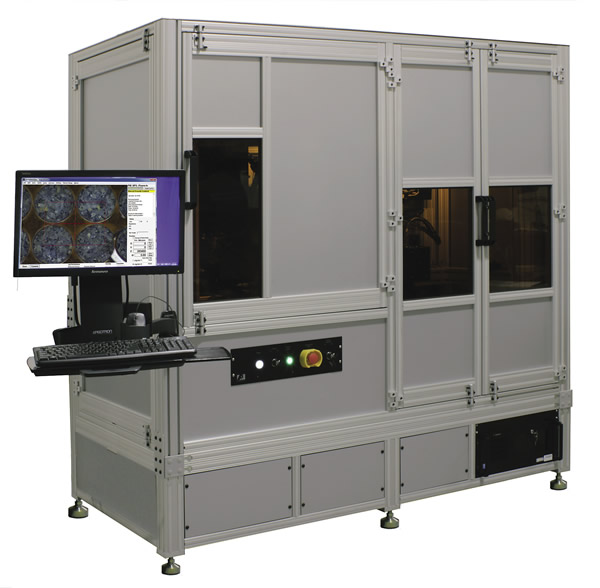
PhotoMachining’s three-wavelength, ultrashort-pulse micromachining system can drill high-density holes in polymers. Image courtesy PhotoMachining.
Nor are lasers only used for subtractive manufacturing. Laser microwelding joins many parts that would otherwise remain forever separate, and most 3D printing systems incorporate lasers, including direct metal laser sintering and similar metals-based additive processes.
Much of this is because of a laser’s versatility. For starters, there’s virtually no limit to what they can cut—glass, ceramic, metal, polymers, silicon and even diamond yield before a laser’s high-energy photons. In addition, those materials are readily machined into highly accurate and, in some cases, unbelievably small parts and part features.
Ronald Schaeffer, CEO of laser machining company PhotoMachining Inc., Pelham, N.H., said people turn to laser micromachining when they’ve run out of other options. “We go much smaller than chipmaking or EDM processes and are faster and more accurate besides. Also, we’re not limited to electrically conductive materials as is [the case with] EDM, which opens the door to a much wider range of machining applications.”
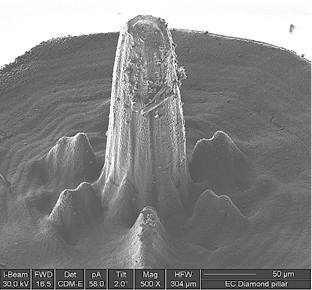
Machining the hardest known substance, diamond, is possible with lasers. Here, a pillar is built by removing the surrounding area. Image courtesy Newson USA.
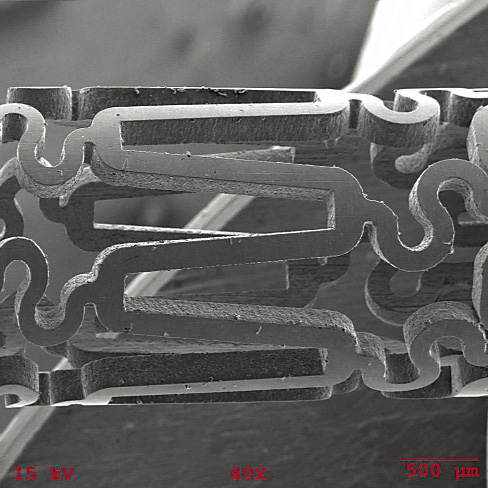
The cross sections of this laser-machined Nitinol stent measure 150µm (0.0059″) across. Image courtesy LPL Systems.
Schaeffer said laser micromachining routinely cuts parts and part features measuring 1mm (0.0394″) and smaller, and extremely small holes and channels 1µm (0.00004″) across are possible—if not always practical. Depending on a number of factors, including the type of laser, amount of applied power and its pulse rate, wavelength and duration, material can be either stripped away with pulses of energy or “tickled” just enough to break its molecular bonds.
Some laser shops, PhotoMachining included, offer laser machining systems and machining services. Alex Schreiner, general manager of Newson USA LLC, Hillsboro, Ore., said this is because many customers start out by subcontracting their micromachining work to a laser specialist, but then as part volumes grow, they decide to bring the work in-house.
“So, what frequently happens is we’ll develop a laser machining process for a customer, make parts for a while, and then they ask for the recipe of optical components and laser type that we’re using,” Schreiner said. “Because of this, we essentially have two businesses: job shop work and delivery of laser modules.”
For many job shop owners, giving away the company’s knowledge assets in this way might seem like cutting their own throat, but Schreiner said that’s not the case at all. “They always come back to us with new projects. The laser business is a small world, so if you treat somebody well, they’ll come back and use you again and again.”
Schreiner added that the key to a successful lasing application, whether done in-house or outsourced, depends on development of a robust laser machining process. It might seem that lasers are like flashlights: either on or off, cutting or not cutting. Nothing could be further from the truth, he explained. He said laser machining is similar to chipmaking in that appropriate “feeds and speeds” must be established, except with lasers there’s also material interaction to consider, heat loading, power level and pulse widths—all of which contribute to the quality of the cut.

Contributors
Newson USA LLC
(503) 686-9220
www.newsonusallc.com
PhotoMachining Inc.
(603) 882-9944
www.photomachining.com