

Here comes the sun: Inspection Efficiency
Machining components for solar power generation systems can be a renewable source of business.
Machining components for solar power generation systems can be a renewable source of business.
With less than 1 percent market share, solar is hardly a shining star in the U.S. energy production firmament. But the future looks bright for this renewable energy source as the country tries to reduce its reliance on fossil fuels.
Numerous “green” initiatives focus on finding nonpolluting and economical renewable sources of energy, particularly for the generation of electricity. According to the congressionally funded Energy Information Administration (EIA), renewable energy sources were responsible for about 9 percent of U.S. electricity generation in 2008. The largest share of renewable power was generated by hydroelectric sources at 67 percent, followed by biomass and wind at about 15 percent, geothermal at 4 percent, and solar at just 0.2 percent. However, the amount of power generated by solar sources in 2008 grew by 38 percent compared to 2007. The EIA predicts that renewable power production will represent almost 16 percent of U.S. power generation by 2030.

Opportunity Knocks
Growing use of renewable energy will require accelerated sales of the equipment used to produce it, presenting a significant opportunity for manufacturers. However, according to Michele Soderstrom, market analyst for NextEnergy, a Michigan-based nonprofit corporation created to aid commercialization of renewable energy technologies: “These industries are very new here. We don’t have established supplier networks or a firmly established hierarchy of different tiers and OEMs, as in the automotive industry. There is a lot of opportunity, but companies need to know where to look to determine what role, if any, they can play in this new industry.”
NextEnergy is one of several organizations nationwide involved in the development of renewable energy technology and manufacturing. In its case, NextEnergy facilitates collaborative R&D, venture development and manufacturing development/supplier diversification in four renewable energy technologies: wind, solar, bioenergy and advanced batteries. Its mission is to accelerate the commercialization of alternative energy technologies, with a focus on Michigan companies.
NextEnergy’s R&D portfolio includes working with universities and government agencies to design and engineer new alternative energy technologies.
As part of its venture development work, NextEnergy supports technology developers and startups by reviewing their ideas and then facilitating commercialization by connecting the groups with venture capital, siting resources and financial incentives. NextEnergy also matches the new companies with Michigan-area design, engineering and manufacturing providers to aid the progression from prototype production to higher volumes.
Courtesy of Dept. of Energy/NREL, Warren Gretz
Technology applications company Science Applications International Corp. installed this prototype dish/engine solar concentration power generation system, rated at 25kW, at the National Renewable Energy Laboratory Thermal Test Facility in Golden, Colo.
NextEnergy is also involved in manufacturing development and supplier diversification, in which the organization assists Michigan manufacturers interested in manufacturing renewable energy components. NextEnergy’s extensive database of those companies enables Tier 1 and OEM energy suppliers to find qualified manufacturers; the service is free for both the Michigan manufacturers and the energy suppliers.
Another aspect of manufacturing development is business development training that ranges from market and product information to in-depth analysis of a manufacturer’s capabilities to identify potential business opportunities and suggest actions required to fully exploit them. NextEnergy provides the training in partnership with the Michigan Economic Development Corp., Lansing, which can supply grants to cover up to 70 percent of training costs.
In addition to offering specific manufacturing capabilities, product and process engineering skills can also help a shop find work in the growing solar energy arena. “Because this industry is growing so quickly, there is a great deal of innovation in product design and manufacturing processes.” In those cases, Soderstrom said, “It is advantageous for companies to offer design and engineering services as well as tooling and manufacturing capabilities.”
Although a shop may not have direct experience in making parts for alternative energy applications, its capabilities may enable it to participate. However, the industry poses distinct challenges, according to Soderstrom: “Succeeding in a new industry requires flexibility. Companies have found that the solar industry places a greater premium on speed than they are used to. The lower volumes of solar vs. automotive manufacturing may also require a new approach.”
From GM to Stirling Engines
A combination of flexible manufacturing capability and a willingness to participate in manufacturing process development enabled a longtime Michigan automotive shop to win work in solar power manufacturing. Wolverine Machine Products Co., Holly, Mich., was founded in 1923 and earned success by screw machining auto parts. To its stable of Acme-Gridley bar machines and New Britain vertical boring machines, Wolverine added its first CNC machine in 1989, and now has 11 lathes and 9 mills. In 2006, the shop acquired a 8 ‘×13 ‘, three-head WARDJet waterjet cutter to permit production of a 12 “-long General Motors engine flange that required both waterjet cutting and CNC milling. As a result, the shop now offers both machining and waterjet services, noted Blaine Walker, special projects manager.
Courtesy of BP Solar
The 1.2mW solar power array at Colorado State University-Pueblo (CSU) covers 4.3 acres and consists of more than 6,800 photovoltaic panels. It is capable of generating approximately 1,800mW hours of electricity per year, and eventually will provide more than 10 percent of CSU-Pueblo’s power needs. Project funding was provided by BP Solar and supplemented by Black Hills Energy, CSU-Pueblo’s local electric utility company, as part of its solar rebate program. BP Solar installed and will operate and maintain the system, selling electricity to the university.
To maximize utilization of the waterjet equipment and possibly expand the shop’s customer base, Walker posted the company’s capabilities on a Web site listing of waterjet job shops. Wolverine subsequently received an inquiry from a supplier to a maker of solar concentrator power generation systems comprised of a Stirling heat engine mounted in a concentrator dish (see sidebar below).
Wolverine was originally contracted to make three different parts for the engines. Two parts, one about 6 ” in diameter and the other 7 ” square, are 0.040 ” thick, and the third part is 0.098 ” thick and about 7 ” in diameter. Recently, a fourth part, 0.040 ” thick and 6 ” in diameter, was added. The part material is a proprietary stainless steel prehardened to 50 HRC. Each engine requires 33 units of the first part, 16 of the second and nine of the third.
To handle anticipated part volumes, in June 2009 Wolverine added a 13 ‘×30 ‘, four-head WARDJet machine. Walker noted that although those original production estimates have not yet been realized, volumes are increasing. “We’ve been involved with this project since January 2009,” he said. “We spent several months producing prototypes, working to find the most effective way to produce these parts. The tolerances are quite tight. On two parts we are holding a ±0.002 ” on a ¼ “-dia. hole. It has taken time to get to the point of being able to hold those tolerances with a waterjet.”
Process development work included finding a garnet waterjet abrasive that would impart the desired surface finish, and designing and building rigid workholding. “Keeping the material secure was a big part of it because the parts are very thin,” Walker said. Wolverine fabricated special fixtures to hold the material, and thereby gained the ability to produce other parts of the same or lesser thickness.
Courtesy of Wolverine Machine
Longtime Michigan automotive supplier Wolverine Machine Products added waterjet cutting to its screw machine and CNC machining capabilities and now uses the equipment to make parts for General Motors as well as components for Stirling engines, used in solar concentration power generation systems.
Process development, Walker said, “has been quite a journey.” Some of the engine components flex 60 times a second in operation, and they have been redesigned a number of times to maximize performance and reliability. “We have done a lot of work to improve the edge finish of the parts,” Walker said.
In full production, the two thinner parts will be manufactured by stamping. However, using waterjet cutting technology for prototypes and early production enables design updates to be implemented via changes in the waterjet program rather than by making new dies. The third part is not a candidate for stamping and should continue to require waterjet processing.
“We’ve known all along that eventually they want to stamp the 0.040 “-thick parts,” Walker said. “However, we are a supplier that is willing to help our customers with their prototype and trial-run parts. We want to show we are on the leading edge.”
Product Repositioning
Some companies have found they can reposition and modify their existing products to take advantage of the expansion of solar energy production.
Review the print ads from this magazine to continue
This quick advertiser review unlocks the rest of the article and keeps the full-screen reader focused on the ads instead of the page chrome.
Advertisers included in this article experience
Print placements connected to this article
IMTS.com
I ; F J ' ) # ' . 9 > ? 9 7 = E
IS #12 M > 7J M ? B B ? J I F7 H A ? D OE K 5.
I ; F J ' ) # ' . 9 > ? 9 7 = E IS #12 M > 7J M ? B B ? J I F7 H A ? D OE K 5 IMTS.com
Visit IMTS.com View this placement in the issue recordPrint ads from this magazine
IS #12 M > 7J M ? B B ? J I F7 H A ? D OE K 5.
I ; F J ' ) # ' . 9 > ? 9 7 = E IS #12 M > 7J M ? B B ? J I F7 H A ? D OE K 5 IMTS.com
Continue reading
February 2010
Patriot Solar Group, Albion, Mich., is an outgrowth of Patriot Antenna Systems, a manufacturer of antennas, including parabolic dishes from 60cm to 12m in diameter. The company’s manufacturing capabilities include laser and waterjet cutting, welding, machining, pressing and sawing. For a typical round satellite or solar dish, panels are cut on a laser or waterjet and stamped to final shape in dies. Patriot Solar also builds pole mounts for the antennas from galvanized A-500 steel, and manufactures support frames from anodized 6061-T6 aluminum C-channels.
When Patriot Solar took a prototype solar collector to an alternative energy trade show, the company garnered a great deal of interest in its comprehensive manufacturing capabilities. Solar energy providers sought help manufacturing prototypes of their systems, as well as support and tracking systems. “They wanted to know all of our capabilities; we can do it all in-house,” said Ken Sexton, business development and marketing manager.
Courtesy of BP Solar
Individual residential photovoltaic solar energy systems can help homeowners control energy costs while avoiding CO2 emissions.
At first, a company seeking a stable foundation for a 25kW photovoltaic system partnered with Patriot Solar to design supports and a system to move the solar panels and track the sun across the sky. “That’s how we got into the solar business. We designed their tracking system and frame, and built it in our shop here in Albion,” Sexton said. Work with that company has expanded to include assembling solar panel modules.
Recently, in addition to manufacturing structural supports and tracking systems, Patriot Solar has engineered complete solar power systems it will market on its own. “We designed 2.5kW and 3.5kW systems for people who want to help take a bite out of electrical use in their homes,” Sexton said. The 3.5kW system features a dual-axis tracker, which follows both the elevation and horizontal movement of the sun.
Sexton pointed out that another boost to solar equipment manufacturers are mandates requiring that utilities supply a certain percentage of renewable energy, with the promise that they will receive grants if a portion of the equipment used to produce the power is manufactured in Michigan.
Sexton said the prospects for solar power are “looking really well” for energy generation as well as other applications; “Customers are coming in wanting to test parabolics for solar cookers, things like that.” One concept involves installing solar-generated electricity as a complement to wind generation. “A lot of our installers say it’s about time we see photovoltaic power merge with wind power,” he said. Neither technology can supply power at all times, so supplying solar- and wind-generated energy together can help fill the gaps.
Sexton said Patriot Solar is working on an arrangement where it will manufacture a dish reflector for a 7kW Stirling engine solar concentrator, and added that he sees solar power use eventually becoming “like the TV satellite dishes in people’s backyards.”
Growth Potential
Production of solar cells employs a wide variety of manufacturing technologies and thereby requires a range of engineering expertise. Solar Power Industries Inc., Belle Vernon, Pa., is a vertically integrated manufacturer of photovoltaic collector cells. “We buy silicon, cast ingots, make bricks and wafers and produce cells from the wafers,” said Greg Hildeman, director of engineering, process R&D. “We also produce modules and some solar power systems, although most of what we do is produce cells for others.”
Hildeman came to SPI from the aluminum industry 3½ years ago when he saw that solar power represented a growth opportunity. He noted that presently there is a need for solar power engineering skills. “There aren’t enough people who know all about solar energy to grow the industry,” he said.
The production process at SPI involves a set of manufacturing steps unique to the solar cell industry. First, raw silicon is melted and formed into 265 kg ingots in electric 3,000° F direct solidification system furnaces.
Each ingot is cut into approximately 24 bricks measuring 156 sq. mm × 24 cm tall and weighing 11 kg with an HCT Shaping Systems (now Applied Materials) wire saw. The million-dollar machine passes a 400km-long, 120µm-dia. steel wire through the ingot at 14 m/sec., immersed in an abrasive slurry of silicon carbide and glycol, which cleanly cuts the granite-hard silicon.
After the bricks are cleaned and inspected, bandsaws with diamond-coated blades square off the bricks’ tops and bottoms, which are then ground to a smooth finish with a diamond grinding wheel. “We don’t want to polish them per se, but instead produce a very smooth ground surface,” Hildeman said. The bricks are glued on glass beams, two bricks to a beam. Four beams at a time are put through another wire saw that slices the bricks into 200-micron thick wafers; eight bricks can yield approximately 3,000 wafers.
The wafers pass through a series of automated and manual steps that includes etching and texturizing to maximize the amount of light the material can absorb, and a phosphorus diffusion process to create the wafer’s ability to produce photovoltaic electricity. Silver buss strips and an aluminum rear-side coating are applied on an automated printing line. A series of inspection and testing steps assures consistent quality and reliability. Finally, the wafers are assembled into cells in multiples determined by their intended output and application.
Subsidies Help
Much of the growth in solar power generation is driven by federal tax credits and a loan guarantee program that was part of the February 2009 American Recovery and Reinvestment Act. In addition, more than half of U.S. states have set renewable portfolio standards and mandates that require utilities to generate or acquire a certain percentage of power from renewable sources.
Hildeman said the federal and state incentive programs will help U.S. power-component producers. However, he emphasized: “Some people think that renewable energy efforts will need permanent subsidies. They won’t. They just need incentives for consumers to use more, to allow manufacturers to increase scale, which then will lower the cost for everyone. You need to have plants, whether they are wind turbine plants or solar plants or whatever, on the order of the automotive industries throughout the world to make enough renewable energy from these sources. For the next 100 years or more we’ll still have to rely on coal and natural gas and nuclear [power] to provide some base mode for electrical energy, but over time, renewable energy will pick up more of a share of the power.” CTE
About the Author: Bill Kennedy, based in Latrobe, Pa., is contributing editor for Cutting Tool Engineering. He has an extensive background as a technical writer. Contact him at (724) 537-6182 or by e-mail at billk@jwr.com.
Courtesy of Sandia National Laboratory
Solar concentration power generation systems typically use curved or flat mirrors to focus the sun’s heat to make steam that spins a turbine that runs a heat engine that turns a generator. At the 150mW power generation facility owned by the Kramer Junction Co. in California’s Mojave Desert, mirrors are arranged in linear troughs.
2 roads to solar power
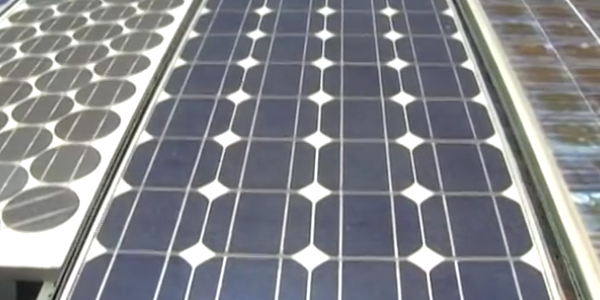
Solar power generation technologies can be divided into two basic categories; photovoltaic and solar concentration. Photovoltaic power generation employs the phenomenon discovered by 19th-century French physicist Alexandre-Edmond Becquerel that certain materials release electrons when exposed to light. The original photovoltaic cells were selenium-based, and silicon-based cells were developed in the mid-1950s. The photovoltaic process produces DC current, which must be put through an inverter to create AC power for home use. Photovoltaic power systems are made up of separate cells collected into modules, which in turn are grouped in arrays. A typical single-home arrangement might consist of one panel rated at 3kW, while the largest photovoltaic commercial power systems contain tens of thousands of panels and produce up to 50mW or more.
Solar concentrators, on the other hand, typically use curved or flat mirrors to focus the sun’s heat to make steam that spins a turbine or to run a heat engine that turns a generator. The mirrors can be arranged in a linear trough to heat a tube filled with fluid or placed in a flat array that reflects sunlight to the top of a tower to heat fluid.
In a dish/engine solar concentrator, a parabolic dish focuses sunlight on a thermal receiver that accumulates heat and sends it to a heat-driven engine that turns a generator. The most common heat engine technology is the Stirling engine, in which alternating heating and cooling of a fluid moves pistons that spin the engine shaft.
Where sun is strong and direct, such as in the southwest U.S., solar concentrators are popular and used in utility-scale power generation. Where sunlight is not as direct and constant, as in the northeast U.S., photovoltaic generation is more widely used, often on a smaller scale. A photovoltaic panel doesn’t require direct sunlight; even sunlight scattered by clouds can produce power.
“Solar energy may not be the most obvious choice as an energy source in the Midwest,” said NextEnergy’s Michele Soderstrom, “but, in fact, we have a significant solar resource here. Even more importantly, we have immense potential to take part in the manufacture of these products. As one of the few industries with expanding manufacturing needs, solar energy offers a major bright spot for our future.” —B. Kennedy
Contributors
NextEnergy
(313) 833-0100
www.nextenergy.org
Patriot Solar Group
(517) 629-5990
www.patriotsolargroup.com
Solar Power Industries Inc.
(724) 379-6500
www.solarpowerindustries.com
Wolverine Machine Products Co.
(800) 397-8446
www.wolverinemachine.com
Glossary terms in this article
Related



Subscribers can use MFGAxis notes, saves and discussion tools with their innoNET account.


