


A world class act: General Industry Coverage
END USER: Specialty Saw Inc., (860) 658-4419, www.specialtysaw.com; CHALLENGE: Increase the size of the saws it manufactures and resharpens while reducing turnaround time. SOLUTION: Two saw grinding machines.
————-
END USER: Specialty Saw Inc., (860) 658-4419, www.specialtysaw.com; CHALLENGE: Increase the size of the saws it manufactures and resharpens while reducing turnaround time. SOLUTION: Two saw grinding machines. SOLUTION PROVIDER: Vollmer of America Corp., (412) 278-0655, www.vollmer-us.com
————–
Like any world-class manufacturer, Specialty Saw Inc. knows it needs to continually improve and add more value to remain competitive. Established in 1952, the Simsbury, Conn., company manufactures and resharpens saw blades primarily for metalcutting, sells sawing machines, provides machinery support and even recommends the equipment a customer needs to buy to optimize its efficiency. “The blades are no better than the machines they’re on,” said Dave Nagy, owner of Specialty Saw.
Specialty Saw has a solid reputation for quality from its customers, which include ferrous and nonferrous primary metal producers, metal service centers, paper producers and plastics manufacturers. Nonetheless, the company needed new saw grinding machines to increase the size of the saw blades it produces and resharpens and to achieve tighter tolerances. To find the appropriate equipment, Nagy and General Manager Dave Medeiros traveled to Germany to visit several machine tool builders at their facilities, as well as those at a trade show.
Courtesy of Vollmer
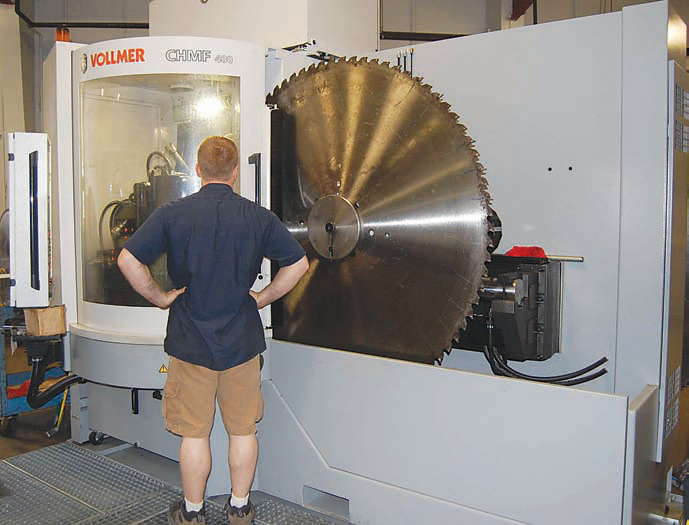
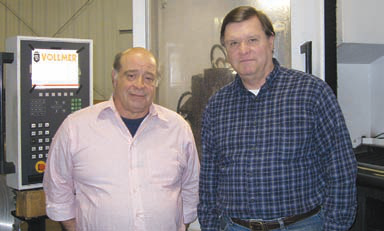
The Vollmer CHMF 400 dual-side grinder is for manufacturing and resharpening carbide-tipped saws up to 87 “. Inset: Specialty Saw’s Dave Medeiros (left), general manager, and Dave Nagy, owner.
Specialty Saw ultimately decided to purchase two saw grinding machines from Vollmer of America Corp., Carnegie, Pa. Those were the CHM 400 top and face grinder and the CHMF 400 dual-side grinder for saws up to 87 ” in diameter. “This newest generation of equipment was specifically made for the metalcutting saw industry,” Nagy said.
When the equipment arrived, Vollmer provided personnel for installation and training. “Because it was such new equipment, Vollmer didn’t have anybody in the United States who was familiar with it, so they flew engineers over from Germany for additional training,” Nagy said.
Previously, the largest carbide-tipped metalcutting saw Specialty Saw could produce and sharpen was 67 ” in diameter. In addition, the largest saws produced on the new machines are just as precise as the smallest saws that were produced on the company’s old machines, according to Medeiros.
Nagy added that tolerance is within ±0.005 ” on circumference for the large-diameter blades. “Blades have a center hole that’s probably 0.003 ” or 0.004 ” oversize so there’s enough slop there to fit it on the machine, meaning you’re out of round already,” he said, noting that those grinding such saws on older equipment to within 1⁄32 ” ±0.015 ” “would be dancing. For a big 60 ” saw blade, it’s unheard of to hold a concentricity of 0.002 ” to 0.004 “.”
Unlike the older machines, the new ones are able to fully enclose and seal the portion of the blade being ground, enabling a more effective application of grinding oil to achieve tighter tolerances, according to Nagy.
He added that the enhanced precision is also the result of the new generation of equipment from Vollmer being more rigid, in part because the casting is made of cast iron. That increased rigidity, along with the machines’ modern controls, improved turnaround time for blade production by a factor of three, Nagy noted.
The new saw grinders also enable lights-out machining. “In one setup, if it’s a 3- or 4-hour process for a blade, you can hit the reset button and go home, knowing the blade will be done in the morning,” Nagy said. “It grinds the facets of every tooth, and if it has to take five passes on a tooth, it does.”
Related


Subscribers can use MFGAxis notes, saves and discussion tools with their innoNET account.