


Swiss Army Knife: Turning Performance
Swiss-style turning can be complicated, so it helps to have an operator's 'tool kit' with multiple solutions.
View print ads from this spread
Review the ads on this magazine spread to continue reading. Each ad takes two seconds; a two-page ad counts once.
Advertisers on this magazine spread
Print placements on this magazine spread
Abrasive Tech
Aces.
Play your cards right. The stakes are higher than ever in today's business environment. Fortunately, the experts at Abrasive Technology can keep you from getting lost in the shuffle. Call or visit the web address below for more information about our finely crafted superabrasive products. With Abrasive Technology, you'll feel like the deck is stacked in your favor
Aces. Play your cards right. The stakes are higher than ever in today's business environment. Fortunately, the experts at Abrasive Technology can keep you from getting lost in the shuffle. Call or visit the web address below for more information about our finely crafted superabrasive products. With Abrasive Technology, you'll feel like the deck is stacked in your favor. GRIND SHARPEN POLISH DRILL IS #1 www.abrasive-tech.com/aces 800.964.8324
Visit Abrasive Tech View this placement in the issue recordPrint ads from this magazine
Play your cards right. The stakes are higher than ever in today's business environment. Fortunately, the experts at Abrasive Technology can keep you from getting lost in the shuffle. Call or visit the web address below for more information about our finely crafted superabrasive products. With Abrasive Technology, you'll feel like the deck is stacked in your favor
Aces. Play your cards right. The stakes are higher than ever in today's business environment. Fortunately, the experts at Abrasive Technology can keep you from getting lost in the shuffle. Call or visit the web address below for more information about our finely crafted superabrasive products. With Abrasive Technology, you'll feel like the deck is stacked in your favor. GRIND SHARPEN POLISH DRILL IS #1 www.abrasive-tech.com/aces 800.964.8324
Continue reading
April 2010
Courtesy of D. Nelson
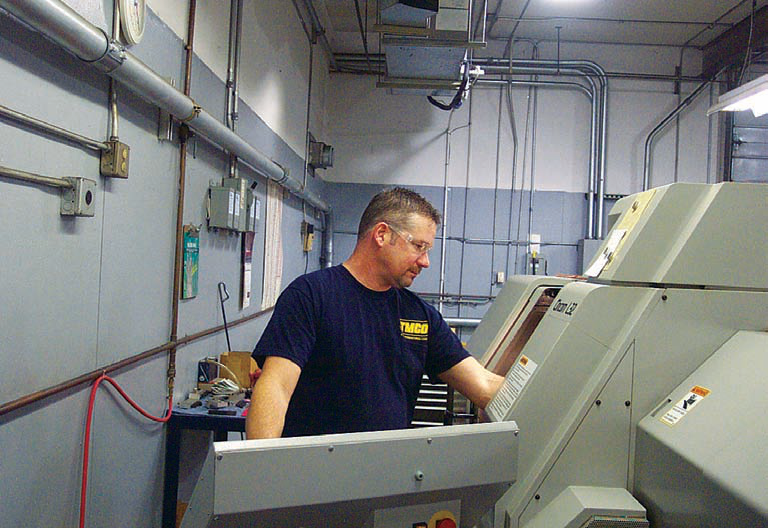
Scott Butts checks the setup of one of TMCO’s Citizen Swiss-style machines.
Swiss-style turning can be complicated, so it helps to have an operator’s “tool kit” with multiple solutions.
Swiss-style turning requires careful consideration of which tools to apply and toolpath strategies, and there is no one-size-fits-all solution.
For example, machinists must be aware that heavy DOCs are typically required for one-pass machining, and that the definition of “heavy” changes with each machine. Typically, machinists must use tooling with sharp edges, positive rake angles and lead angles must fall within a certain range. Also, Swiss-style turning can create chip management nightmares that require different strategies, such as taking multiple passes and using high-pressure cutting oil and Y-axis toolholders. Mastering these strategies—and knowing which one to use—can be challenging, but they can achieve success.
Why Swiss?
Swiss-style machines have an advantage over conventional lathes because they virtually eliminate workpiece deflection. For example, turning an 8 “-long, ¼ “-dia. workpiece—a 32:1 length-to-diameter ratio—would be a major challenge on a conventional lathe.
A Swiss-style machine’s guide bushing makes this possible. The workpiece is gripped in a collet in the main spindle on a sliding headstock that feeds the bar through the guide bushing collet and past the cutting tools. The mechanical advantage of applying cutting tools only a few millimeters from where the stock is supported allows Swiss-style machines to turn high length-to-diameter workpieces.
While the guide bushing provides a rigid setup, it requires different machining strategies and tooling than conventional turning operations. A turned diameter usually cannot be pulled back in the guide bushing collet. If this happens, the workpiece can fall out of the guide bushing.
Multiple roughing passes can be performed as long as the length of cut is not greater than the length of the guide bushing—typically ¾ “. Scott Butts, manager, Swiss department for TMCO Inc., Lincoln, Neb., runs many parts that permit multiple passes. When the length of cut increases past ¾ “, things get challenging because the “multiple pass” strategy will cause the workpiece to drop out of the guide bushing. “We cut a number of parts where we take radial depths of cut under 0.2 “,” Butts said. “These turns are possible if the lengths of turn are shorter than the guide bushing. If the lengths are longer, the turn must be done in one pass.”
The “one-tool/one-pass” strategy is common in Swiss turning operations. However, the pass may be quite heavy—as much as a 0.5 ” radial DOC. This kind of DOC would suggest a roughing pass. Because there are no clean up passes, surface finish requirements must be met in the first pass. “As the depth of cut increases, we find that specific tooling geometries are required,” Butts said. “Sharp edges and positive rakes are an absolute must with these turns.”
What’s Heavy?
What is a heavy DOC? An exact value is difficult to determine due to different workpiece materials and various machine tool power ratings. As a result, a heavy DOC may be as little as 0.1 ” or as much as 0.5 “. Whatever the DOC, selecting the proper cutting tool geometry is the most important success factor.
Using inserts with positive rake angles is one requirement, because such free-cutting tools reduce cutting force. To get an idea of how much the rake angle affects the tool pressure required to make a cut, think about using a pocketknife. If the edge of the blade is angled to make a cut into the wood, the blade will cut easily. If the blade is turned perpendicular to the surface to produce a scraping action, far more force must be applied to the knife to take the same DOC.
A tool with positive rake angles makes a more efficient cut because it requires less power and force to make the cut than a tool with a negative or neutral rake angle. In addition, chips are pulled rather than plowed away from the cut surfaces, helping impart the required surface finish.
Another important characteristic of a turning tool used for heavy DOCs is the edge preparation, or hone. A hone—typically not greater than a 0.001 ” radius—dulls a turning tool, which strengthens the edge and protects it from chipping and wear. However, applying a honed edge requires more horsepower because of the increased force applied to the tool.
Hones are commonly used on conventional lathes to rough carbon steels. All molded inserts have some form of edge preparation. Inserts used to make heavy cuts on Swiss machines, however, shouldn’t have hones in order to minimize forces on the tool and to maximize the DOC.
The nose radius also has an effect similar to a hone. As the radius increases, tip dullness increases, and so then do the forces needed to make the turn. Inserts used to make heavy cuts on Swiss machines should use nose radii smaller than 0.031 “.
Choosing Lead Angles
Inserts are only part of the geometry equation. The lead angle on the toolholder is the most important thing to consider when selecting a tool for heavy turning, according to Brian Such, customer support group manager for Marubeni Citizen-Cincom Inc., Elk Grove Village, Ill. “When you take a heavy depth of cut, say 0.3 ” to 0.5 “, you might see something that looks like chatter on the workpiece,” he said. “You may think the tool is broken.”
The lead angle commonly used in conventional turning is 3° to 5°. This allows a tool to both turn and face, but the lead also changes the forces the cut exerts on the cutting tool. Feed forces are redirected by the lead angle into radial forces, pulling the tool into the cut in a radial direction. When turning less than 0.1 ” radial DOC, these radial forces are minimal. But Swiss turning can produce extreme cutting conditions.
Such illustrated extreme turning operations with two applications, each with heavy radial depths of cut. “To explain the concept, we used a one tool/one pass strategy with a 0.5 ” radial depth of cut on 17-4 stainless, 1.25 “-dia. stock. We turned it down to 0.25 ” over an 8 ” length.”
Such went on to describe a rectangular workpiece, measuring 0.75 “×0.25 ” and placed 0.25 ” off center using a special guide bushing and collets. This cut was more extreme because it was highly interrupted. “These are pretty tough turns and the principles of using the correct cutting tool geometry all apply. If you were to use a toolholder with a 3° to 5° lead in these heavy cuts, you might see chatter on the workpiece.”
If the turning tool has anything but a 0° lead, the X-axis servo has to pull back to compensate—a back and forth oscillation caused by the radial force on the tool creates this finish problem. “Put in a neutral toolholder and the problem goes away,” Such said.
High-Pressure Cutting Oil
Making the heavy turn might just be the easy part. Because the tool has a positive rake and a sharp edge, an efficient cutting action is created, but this leads to long, stringy, unbroken chips. As a result, chip management is one of the biggest issues Swiss-style machine operators face.
The chip must curl to break, and making a chip curl is partly dependant on the feed rate. When making heavy turns on a Swiss-style machine, feed rates rarely exceed 0.001 ipr. Under these conditions, a chip might not ever break, so the goal is to control the chip. There are a few methods to accomplish this.
Courtesy of D. Nelson
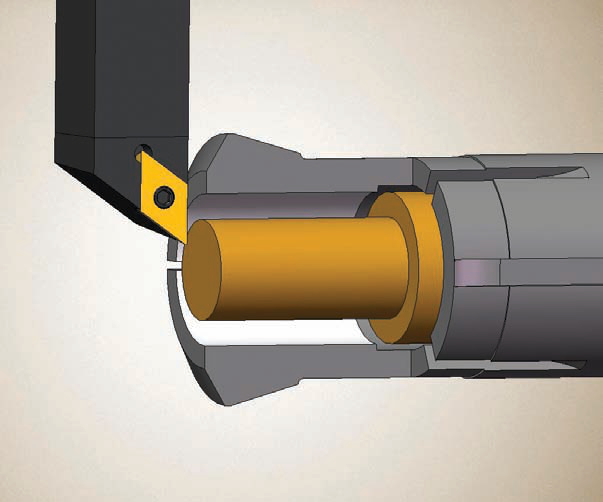
Multiple-pass turning is possible on Swiss-style lathes only up to a length where the guide bushing still supports the stock diameter. If that length is exceeded, the workpiece will drop out of the guide bushing as shown.
Courtesy of D. Nelson
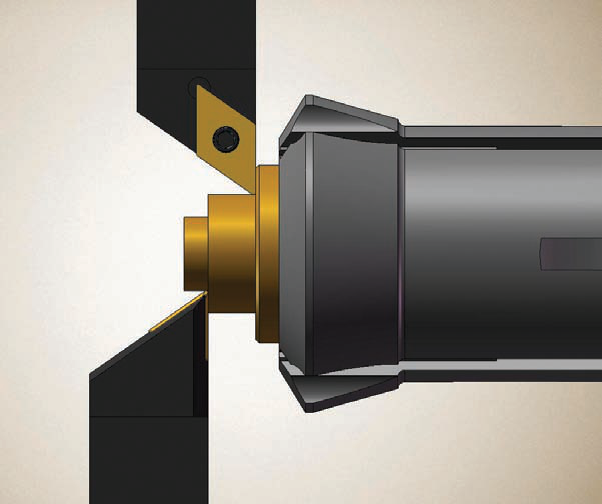
When pinch turning, the upper turning tool makes a rough pass. The lower tool makes a finish pass at or below the feed rate of the roughing tool to assure no interference between the tools.
Courtesy of D. Nelson
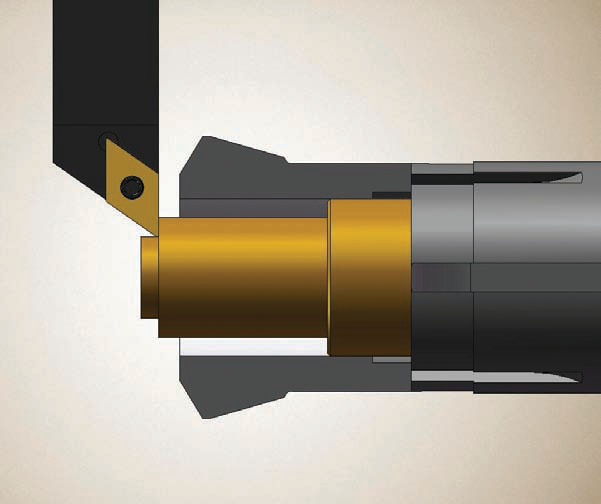
The second pass of a multiple-pass operation. Note that a small chamfer is machined during the first pass to allow the workpiece to reenter the guide bushing. In theory, a turn of any length can be cut with this strategy, but witness lines will be seen at each crossover between segments.
One strategy is to take multiple passes. While that may not be possible in many circumstances, there are several ways it can be done. Some parts can be segmented, a process where multiple passes are broken up into several segments along the length of the turn. Karl Davis, shop supervisor at Midwest Screw Products Inc., Omaha, Neb., did this recently.
“We had a difficult time breaking the chip but I found the tolerances of the part were loose enough to allow me to use a roughing insert and take several passes down the length of the part,” Davis explained. “The lighter cuts made it possible to feed harder—about 0.008 ipr.”
Segmenting requires very specific part geometries. Features that break up the turn may allow for segmenting, such as grooves evenly spaced along a turn. The process would be to multiple-pass turn for a ¾ ” length up to a groove, cut the groove and then resume turning for another ¾ ” length to the next groove and so on until the end of the workpiece.
Multiple passes are also possible through pinch turning. In this case, two tools are used: one to cut an intermediate diameter and another to finish. Both tools cut simultaneously, and the finishing tool follows a little behind the roughing insert. While the roughing insert may be programmed to remove slightly more material, it is common for both tools to remove roughly equal amounts of material. This equality helps to balance the load on the workpiece as it is cut, reducing part deflection. Because the DOCs are reduced, feed rates can be increased to 0.005 ipr or higher, making it possible to curl and break the chip.
To pinch turn, the machine must have the ability to have the two turning tools on different slides so two diameters can be turned at potentially two different feed rates. Not all Swiss-style machines have this capability.
Since segmenting requires specific part geometries and pinch turning is not an option on many machines, the Swiss operator is often left with the one-tool/one-pass strategy.
Chip Management
In one-pass/one-tool applications, the insert may not be able to break the chip without an external force being applied. High-pressure cutting oil systems of at least 1,000 psi can help manage chips in these situations.
One idea is to use the force of a high-pressure blast of cutting oil to break the chip as it forms in the cutting zone. When it is not possible to break the chip with this approach, it may be sufficient to have a high-pressure coolant system simply direct the continuous chip away from the workpiece and cutting tools to prevent chip wrapping. This prevents chip clogging and keeps coolant flowing to the cutting zone. Note that the nozzles used in such a system to direct the chip down into the chip bin must be strong enough to keep them from being moved by the chips. Typically, the nozzles must be made from steel tubing.
Y-Axis Toolholders
NTK Cutting Tools, Wixom, Mich., has another option for directing chips. Its Y-axis control toolholder line serves to direct chips down into the chip bin as they are created. Turning tools typically control diameters using the X-axis. The NTK toolholders turn the insert so it is oriented along the Y-axis.
Swiss-style machines are often used gang style. All the turning tools are lined up along the Y-axis. A tool call in the program moves the Y-axis to position the tool on centerline, but because the machine has a Y-axis, a Y-axis toolholder takes advantage of the Y-axis. If you think of standard turning tools as being at 0°, the Y-axis tool is positioned at 90°. A standard turning tool is moved in the X-axis to control the cutting diameter. Y-axis tools are programmed in the Y-axis. From this position, the insert is facing down into the chip bin, which causes the chips to be directed down and away from the workpiece and tool.
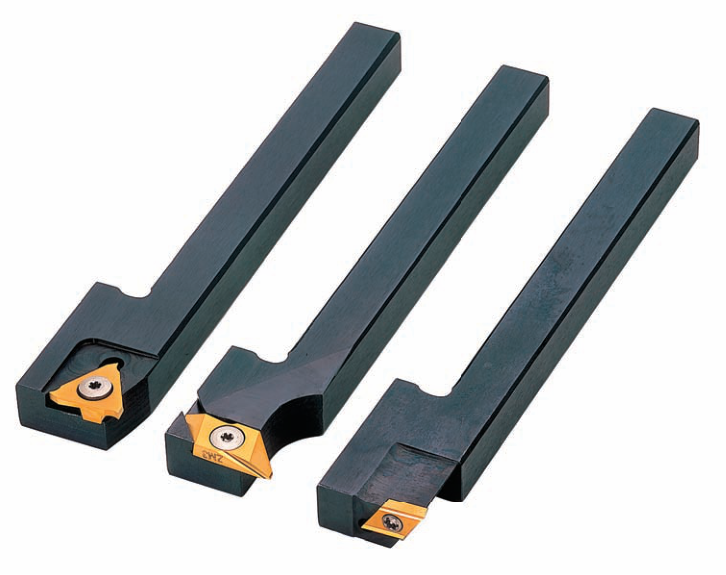
Courtesy of NTK Cutting Tools
Y-axis control toolholders from NTK Cutting Tools. In addition to front turning tools, grooving and back turning tools are available in this type of configuration.
These toolholders have one additional benefit. The inserts are more accessible to the machinist. Because cutting tools are often positioned close to each other in a Swiss-style machine, it is often difficult to get access to index inserts without taking standard toolholders out of the gang. Because Y-axis toolholders position the insert face down and away from the adjacent turning tools, it is much easier to put a wrench on these toolholders to remove the insert.
For machinists tangling with Swiss turning—or just trying to avoid a tangle of chips—it helps to have the machining equivalent of a Swiss army knife: proven tips and strategies that can keep the machines humming. Knowing the best ways to apply them is also critical to success. CTE
About the Author: Dave Nelson is a freelance writer and an application engineer in the Omaha, Neb., office of Productivity Inc., a machine tool distributor based in Minneapolis. Contact him by e-mail at dnelson@productivity.com.
Contributors
Marubeni Citizen-Cincom Inc.
(201) 818-0100
www.marucit.com
Midwest Screw Products Inc.
(402) 333-6611
www.midwestscrewproducts.com
NTK Cutting Tools
(866) 900-9800
www.ntkcuttingtools.com
TMCO Inc.
(402) 476-0013
www.tmcoinc.com
Glossary terms in this article
Related


Subscribers can use MFGAxis notes, saves and discussion tools with their innoNET account.