


Competitive technology: General Industry Coverage
Every segment of manufacturing faces unique challenges. Tool and die makers, however, seem to endure an outsized number of challenges.
View print ads from this spread
Review the ads on this magazine spread to continue reading. Each ad takes two seconds; a two-page ad counts once.
Advertisers on this magazine spread
Print placements on this magazine spread
Abrasive Tech
Aces.
Play your cards right. The stakes are higher than ever in today's business environment. Fortunately, the experts at Abrasive Technology can keep you from getting lost in the shuffle. Call or visit the web address below for more information about our finely crafted superabrasive products. With Abrasive Technology, you'll feel like the deck is stacked in your favor
Aces. Play your cards right. The stakes are higher than ever in today's business environment. Fortunately, the experts at Abrasive Technology can keep you from getting lost in the shuffle. Call or visit the web address below for more information about our finely crafted superabrasive products. With Abrasive Technology, you'll feel like the deck is stacked in your favor. GRIND SHARPEN POLISH DRILL IS #1 www.abrasive-tech.com/aces 800.964.8324
Visit Abrasive Tech View this placement in the issue recordPrint ads from this magazine
Play your cards right. The stakes are higher than ever in today's business environment. Fortunately, the experts at Abrasive Technology can keep you from getting lost in the shuffle. Call or visit the web address below for more information about our finely crafted superabrasive products. With Abrasive Technology, you'll feel like the deck is stacked in your favor
Aces. Play your cards right. The stakes are higher than ever in today's business environment. Fortunately, the experts at Abrasive Technology can keep you from getting lost in the shuffle. Call or visit the web address below for more information about our finely crafted superabrasive products. With Abrasive Technology, you'll feel like the deck is stacked in your favor. GRIND SHARPEN POLISH DRILL IS #1 www.abrasive-tech.com/aces 800.964.8324
Continue reading
April 2010
Moldmakers use teamwork and advanced manufacturing software to compete in a tough global market.
Every segment of manufacturing faces unique challenges. Tool and die makers, however, seem to endure an outsized number of challenges.
Machining molds typically involves creating complex contours and fine surface finishes. Molds are high-value items usually produced in single-digit volumes, making gradual process development and scrapping parts a costly exercise. Moldmakers’ customers generally want to get their products to market as fast as possible, so lead times can be short and inflexible. Finally, overseas competition puts added pressure on U.S. shops.
Moldmakers are facing the challenges with a combination of technology and teamwork, and CAD/CAM software is a key competitive tool.
Standardize to Customize
Speed-to-market pressures mean prototype or preproduction molds have even tighter deadlines than production molds. “Our customers demand that we produce tooling and parts rapidly and to production standards of accuracy and quality,” said Mark Heckman, manager of rapid tools and injection molding at Paramount Industries Inc., Langhorne, Pa. Paramount is a prototype manufacturer and provider of product development services, including design and engineering, rapid prototyping, rapid tooling and new direct digital rapid manufacturing technology that produces custom parts directly from digital input.
“Our tools are often used as bridge tools, while the production tool is being built,” Heckman said. Instead of constructing multicavity tools to produce mass quantities of parts, Paramount makes prototype and production single-cavity molds that yield production-quality parts. Depending on the material to be molded, the number of parts required and the parts’ complexity, the mold may be machined from tool steel or aluminum.
Heckman said nearly every mold is a custom design. “Every customer’s geometry is different, it’s always new,” he said. To produce custom designs economically, Paramount standardizes as many aspects of the mold production process as possible prior to customization. “We have our own standard mold bases, with standard inserts that go into them. We match the part with a mold base, then machine our customer’s geometry into the insert.”
All Paramount toolmakers are CAD and CNC programming literate and each has a seat of Mastercam CAD/CAM software from CNC Software Inc., Tolland, Conn. The toolmakers “are using the software to design the mold inserts and write the CNC programs,” Heckman said.
Heckman noted that a Paramount customer typically provides an IGES or STEP file of the final part, then the toolmaker applies a shrink factor to the model dictated by the characteristics of the plastic material from which the part will be molded. From that model, the toolmakers create the geometry of the mold components and then the toolpaths to machine them.
It is important that the software can create good geometry as well as good toolpaths. The ability of Mastercam software to handle both surface and solid models is also crucial. While surface models are often preferred in the design of complex aesthetic contours, solid models provide a “clean” engineering view of the entire part, Heckman said. “A lot of our personal-products customers do free-form surface modeling using packages like Rhino. Mastercam allows me to work with both surface geometry and solids. It gives me more options when we are doing some fairly complex surfaces.”
The software’s surface design capabilities permits geometry creation, modeling and editing, and has design analysis tools and 2-D and 3-D associative dimensioning, according to CNC Software. An integrated add-on solids modeler provides construction techniques for solids and permits combination of solids and surfaces in the same model.
Heckman said Mastercam is easy to learn, an important consideration when Paramount hires experienced moldmakers who are not CAD/CAM experts. The shop also uses the software in its training program. “In 2007, we restarted our moldmaker apprentice program,” Heckman said. “We realized our group’s growth could not be solely dependent on hiring experienced moldmakers.”
Balanced Resources
Maintaining mold quality and meeting short lead times while maximizing shop resources is a familiar balancing act for moldmakers. Die Technology Inc., Osseo, Minn., often has a week to complete what used to be a 3-week job machining die and fixture components. The shop designs and builds stamping dies, tools and fixtures for the medical, electronic, defense and telecommunication industries. It also performs wire and sinker EDMing and designs and builds special machines, including a line of hole-punching machines for catheters used in the medical industry.
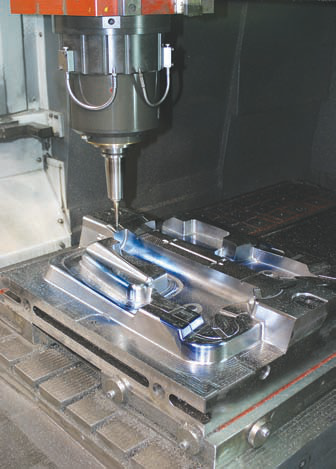
Courtesy of B. Kennedy
Molds are high-value items, usually produced in single-digit volumes, and machining mold tooling typically involves creating complex contours and fine surface finishes.
To overcome the volatility of the manufacturing market, Die Technology maximizes productivity by providing its employees with advanced technology that enables the company to do more with fewer people, according to Wyatt Neubauer, toolmaker. A key element of that effort is ESPRIT CAM software from DP Technology Corp., Camarillo, Calif., an integrated 3-D system.
Neubauer considers the 3-D aspect of toolmaking to be its major challenge. For example, the shop makes pins as small as 0.003 ” in diameter with 0.003 ” or 0.002 ” profiles on top of them. “Everything has to be formed in 3-D, all the contours,” he said. “With a 2-D CAM system, we couldn’t produce the shapes and functionality we needed with any kind of speed; 3-D CAM enables us to make it all without using special-order tools.”
ESPRIT software offers 20 different milling strategies, including a variety of roughing, finishing and surface contouring and engraving methods, according to DP Technology. Users can combine the techniques to maximize efficiency. The newly introduced ESPRIT 2010 software release incorporates capabilities that were formerly included in the ESPRIT Mold add-on package.
The shop has used ESPRIT software for nearly 20 years, initially for wire EDMing. Recently, additional capabilities and enhanced ease of use have prompted Die Technology to apply the software throughout the shop. “It runs everything from the mill for making electrodes to the wire EDM to the sinker EDM,” Neubauer said.
The software also has automation capabilities that save time when handling repetitive operations. As an example, Neubauer cited the machining of 20 electrodes in sets of four that are similar but feature different offsets. “Instead of reprogramming every part, we just program one electrode and save it. We then lay that saved process on top of the other part models, and the software programs them automatically. It’s a one-click process.”
Technology Plus Teamwork
Moldmakers can maximize their competitiveness by combining advanced technology with teamwork. “To compete we need to use technology to our best advantage and build our molds not only quicker but cheaper, and still have the same quality,” said Dennis Wood, tooling manager at the Constantine, Mich., division of Vaupell Inc.
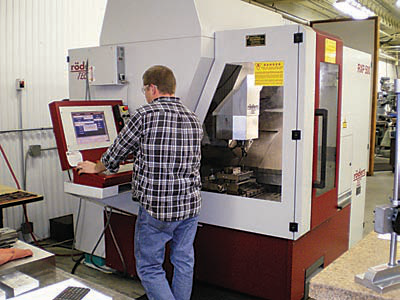
Courtesy of Vaupell
At Vaupell, high-tech metal-removal equipment includes Röders high-speed CNC machining centers. With Cimatron CAD/CAM software on the shop floor, operators can determine part dimensions and machine directly from the 3-D model.
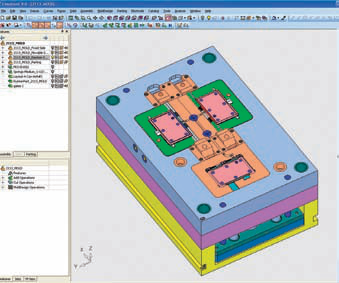
Courtesy of Vaupell
Integrated CAD/CAM software systems engineered for moldmakers address all mold components and enable shops to consolidate and streamline the mold design and machining process.
Headquartered in Seattle, Vaupell supplies prototype and production injection molded products and assemblies. Wood said the Constantine operation is a “one-stop shop” for mold design and construction, as well as plastic part production. The facility’s in-house tooling capability permits immediate response to in-production change orders and also facilitates tool maintenance and repair. About 65 to 70 percent of the facility’s output consists of medical products, including instrumentation and bioresorbable implants. The plant is currently expanding its work in aerospace and defense products.
In many cases, Vaupell competes with small shops that have low overhead. “They can take a job on for very little profit just to keep their lights on when times are tough,” Wood said. “We are competing against that, so we have to work smarter. We need to get rid of any extra work that is not value added to the customer, and eliminate any excess overhead that we can to bring the cost of our tools down.”
Cost reduction includes “as much unattended machining as possible,” he said. Metal-removal equipment at the shop includes Röders high-speed CNC machining centers, Charmilles CNC sinker EDMs and Agie wire EDMs.
Advanced manufacturing software is another tool for enhancing competitiveness. In 2006, facility management decided to switch from 2-D manufacturing software to 3-D. Eric Wagner, senior design engineer, said a desire to streamline the mold production process prompted the change. “All of our CNCs are driven off 3-D models. We were having to do things twice. We’d design a whole tool, detail it in 2-D, then I’d have to take it and model it in 3-D to be able to program the machine.” Use of integrated 3-D CAD/CAM software eliminated the double work; the molds are designed in 3-D and toolpaths are applied directly to the model.
The designers who would use the software researched several products and recommended Cimatron E CAD/CAM software from Cimatron Ltd., Novi, Mich. An important factor in the choice was Cimatron’s knowledge base in moldmaking, according to Wagner. “They understood injection molds, and their support people have designed injection molds and done the kind of work that we do,” he said.
Courtesy of DP Technology/ESPRIT
In addition to conventional machining processes, sinker EDM and wire EDM (pictured) are key elements of die and mold manufacturing. CAM software, such as ESPRIT, can simplify a shop’s work flow by handling all of a facility’s metal-removal operations.
Cimatron software, the use of which was expanded throughout the shop in 2009, features full associativity throughout the design and machining processes. Prior to the changeover, the facility employed six different software packages in the toolroom and design areas, creating the potential for translation errors and making engineering updates difficult. “Now, if one of my guys makes a change on an already-programmed part, I can go in, pull up the part and update it, and all I have to do is re-recognize things and then I’m flying again,” Wagner said. “Prior to that, if there was a change I would have to bring in the model and do all the work again.”
Wood said the main catalyst for consolidating software was a 2009 Kaizen process improvement effort. “We did a full Kaizen, including team members from the toolroom, design group, production personnel and our COO and GM. We restructured how we build and design tools. We did it because the market is changing constantly, and if you don’t change, you are going to go under. We had to change and make ourselves better.”
In the Kaizen effort, Wood said: “We looked at everything. We built new processes for the way we need to build tools to be competitive in the future. We set our shop up in separate teams, and as much as possible created a lean environment.”
Wagner said the Kaizen effort helped the shop focus on its goals, motivating the staff to “get all of our ducks in a row.” One of the results was expanding application of software and machining seats of Cimatron on the shop floor. After initially adopting the 3-D software, but before the Kaizen effort, “when we did our designs, we went back and made a full set of detailed and dimensioned prints for the toolmakers,” Wood said. Now, with CAD and CAM together on the shop floor, “everybody can view a model of a tool, pull off any dimension and machine directly from the model. They can also go back and look at the model of the actual part that the customer sent in. The change saved us 2 to 3 days in the design phase because the designer did not have to dimension out prints. We send data directly by wire out to the floor. We don’t have paper prints any more.”
Commitment by the Kaizen team, which includes 13 employees in the toolroom and design departments, was critical. “The biggest key to making a shop function is having buy-in from the people on the shop floor,” Wood said. “They have to be the leaders. They come up with ideas, they will hash them around amongst themselves, and it will work very well.” CTE
About the Author: Bill Kennedy, based in Latrobe, Pa., is contributing editor for Cutting Tool Engineering. He has an extensive background as a technical writer. Contact him at (724) 537-6182 or by e-mail at billk@jwr.com.
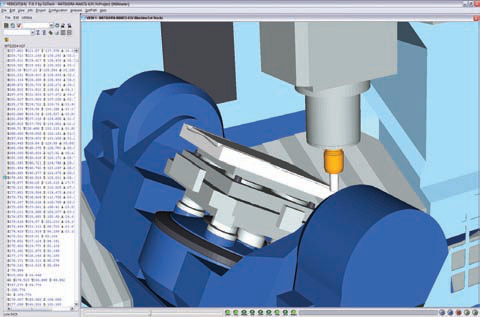
Courtesy of CGTech
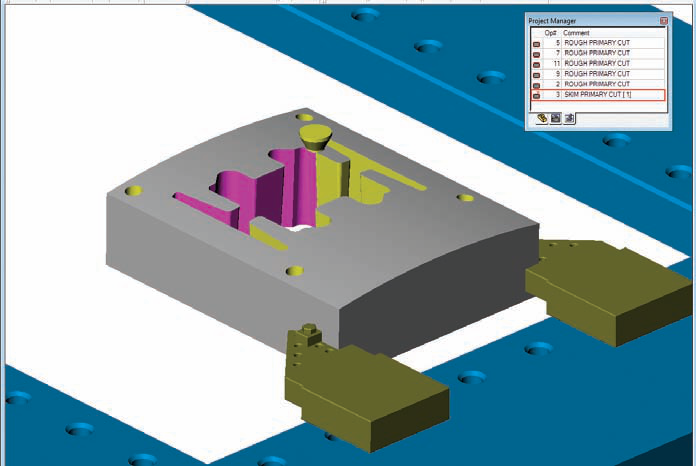
Premachining simulation of CNC cutter paths, as illustrated by VERICUT software, enables a user to virtually machine parts on a computer screen before actual cutting occurs. Such verification can be of crucial importance in the short-lead time, single-digit-production environment of moldmaking.
Virtual verification makes mold mistakes disappear
Just as the “reset” button erases mistakes in a video game program and starts the game anew, so does NC verification software by eliminating programming errors—and their much more costly results—in machining.
CGTech Inc., Irvine, Calif., maker of VERICUT CNC simulation and verification software, says simulation enables a user to virtually machine parts on a computer before cutting, and detect and eliminate errors that could ruin the part, damage the fixture, break the cutting tool or crash the machine. Such verification can be crucial in the short-lead time, single-digit-production environment of moldmaking. Starting over after a crash or gouge of a high-value mold is not only expensive, but missed deadlines and poor surface finishes will sour a shop’s relationship with its customer.
Unlike the verification feature built into many CAM packages that check the internal CAM file before post-processing, VERICUT’s external simulation verifies the post-processed NC code as sent to the machine tool, according to CGTech. Also, a program optimization module, OptiPath, creates toolpaths that maintain consistent chip load and cutting pressure, benefiting surface finish and reducing bench work finishing for moldmakers.
Development of the OptiPath module was largely driven by the mold and die industry. It reduces the long machining times common with large, complex dies and molds. OptiPath retains knowledge of the amount of material removed and the amount remaining, and thereby can determine ideal feed rates, slowing feed during heavy material removal and increasing the rate when cuts are lighter.
In addition to facilitating mold machining, simulation software can assist in mold design before machining begins. Dennis Wood, tooling manager for Vaupell Inc., said his facility employs Moldflow injection molding simulation software from Autodesk Inc.’s Moldflow unit in Waltham, Mass., to analyze the part to be molded and predict the course of the molding process.
The software examines the part structure and highlights possible problems. For example, Wood said, molded plastics perform best when wall thickness is consistent; inconsistencies can lead to sink, warp and cooling problems with the molded part. A Moldflow analysis indicates where part design changes enhance molding results.
“We can change things around before the mold design phase,” Wood said. “We use it to help with part manufacturability. [The software] is a powerful tool and it has a lot of variables.” He cautions that, for accurate predictions, “the variables have to be correct, or it’s garbage in, garbage out.”
Wood added that if a mold is not producing good parts, a Moldflow analysis can enable the shop to “go back and reverse engineer after the fact. You can put in variables and start playing with different things: open a runner up, open a gate, change the cooling and see what it will do. There are an infinite amount of things you can do with the software. We create a results file that we give to our process technicians. That’s where they start, and it is very, very close.”
—B. Kennedy
Contributors
Autodesk Inc.
(781) 464-5471
www.moldflow.com
CGTech Inc.
(949) 753-1050
www.cgtech.com
Cimatron Ltd.
(877) 596-9700
www.cimatron.com
CNC Software Inc.
www.mastercam.com
(800) 228-2877
Die Technology Inc.
(763) 424-9677
www.dietechnology.com
DP Technology Corp.
(800) 627-8479
www.dptechnology.com
Paramount Industries Inc.
(888) 778-6657
www.paramountind.com
Vaupell Inc.
(269) 435-8414
www.vaupell.com
Glossary terms in this article
Related



Subscribers can use MFGAxis notes, saves and discussion tools with their innoNET account.