


Shop navigates recession, moves ahead
Talking Shop column for the August 2010 issue of Cutting Tool Engineering.
Courtesy of All images: Stark Industrial
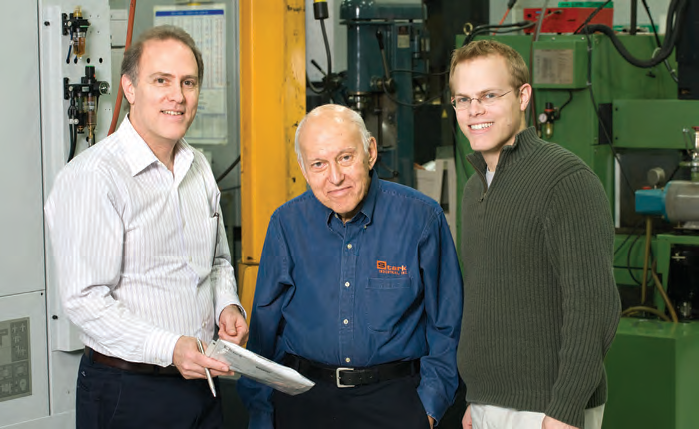
Three generations of the Wilkof family work at Stark Industrial LLC. From left: Sam, Raymond and Jonathan.
The following is an interview with Sam Wilkof, vice president of Stark Industrial LLC, North Canton, Ohio. The family-owned and -operated company has 34 employees, including three generations of Wilkofs: Sam’s father, Raymond, is president; his son, Jonathan, is a manufacturing engineer, and his wife, Susan, is director of corporate relations.
Stark Industrial operates several Mazak turning centers, a Citizen Swiss-style machine and manual lathes; five cylindrical grinding machines; six tool and cutter grinders, including two 5-axis Walter units; four Mazak milling machines; three EDMs; and a variety of inspection equipment and fabricating and finishing equipment. More than 97 percent of its equipment was purchased new; 80 percent or more is less than 10 years old.
The shop celebrated its 50th anniversary in 2009 and weathered the recession in better shape than many shops its size. The interview, by Editorial Director Alan Rooks, focuses on how the shop accomplished that.
Rooks: What was your strategy for riding out the recession?
Wilkof: If, for example, you are heavily invested in automotive, you may have many ups and downs. We try to not focus on any one industry, which helps even out those blips. The top three industries we serve are steel processing, food processing and combustion control (environmental monitoring) equipment, but we serve many more.
However, what happened over the past 24 months could hardly be called a blip. No one escaped. Our business was strong through June of last year, but July through September was very bad. We closely monitored orders and backlogs and reduced hours accordingly across the board. We didn’t have to lay anyone off.
Rooks: How do you maintain a diversified customer base?
Wilkof: It is difficult to manage but it helps to stay on top of trends in various industries. If you are doing business with a larger company, like General Electric or Motorola, it’s a good idea to subscribe to news flashes from those companies’ Web sites. We also keep an eye on legislation that may affect the companies. That information can alert us to possible business opportunities.
Rooks: Does your shop make piece parts or finished products?
Wilkof: We make everything from single parts to assemblies containing as many as 250 parts where we are responsible for testing and shipping to the end user on behalf of our customer. We’ve even taken on entire product lines.
Rooks: What is the biggest strength of your operation?
Wilkof: I’m not sure anybody would accuse us of being the lowest cost. It may be a cliché, but we offer value-added service; our strengths are our skilled staff, strong engineering capability, broad machining capability and ability to process, package and ship complex orders. We can provide a complete solution rather than subcontracting portions of the jobs we do. We rarely buy used equipment, not because it isn’t good quality, but because we want to have the latest technology. That’s important not only to manufacture the parts that require it, but also to show customers and employees that we are reinvesting in the company. We want to challenge our staff with new technology and see what they can do with it.
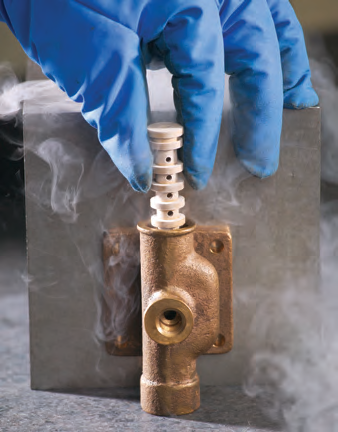
Stark uses a liquid nitrogen-based shrink-fit process to assemble certain parts.
Rooks: What’s an example of an investment in new technology?
Wilkof: There have been many developments in high-speed machining, particularly milling. You have to have a very rigid machine to take advantage of that and we are getting some incredible results with our new Mazak Nexus machining centers.
We want to push the envelope as far as feeds and speeds. Say we find out about a new solid-carbide endmill or a new insert geometry. We’ll test those tools and it’s often a real eye-opener for the operators participating in those tests. Sometimes the tests don’t work, but more often than not we end up with an improved or new process.
Rooks: What’s an example of a process you’ve developed?
Wilkof: We’ve become very good at shrink-fitting two parts that need an interference fit by freezing one of the parts in liquid nitrogen so it shrinks ever so slightly. When you mate them, the frozen part warms to room temperature—which takes a few seconds—and it’s better than a press fit. They will never come apart. One application is in assembling valves where a stem goes inside a sleeve. We often recommend the process to customers where the fragile nature of the part or its geometry make it important not to stress it, as would happen in a press fit.
Rooks: You’ve been able to recapture some jobs that were offshored. What’s an example?
Wilkof: We had a job making thousands of stainless steel parts for a company nearby. The customer held a reverse auction and we lost the part to a producer somewhere in the Pacific Rim. We didn’t hear anything from the customer for several months. Then I got a call. They said, ‘We took your parts out of inventory and they just don’t fit together very well.’ I said, ‘We’re really sorry—bring the parts over and we’ll see what’s up.’ I had some of the original parts, and the parts they brought over were made in the Pacific Rim. I was very happy to show them a good part we made that assembled well. We were able to get that job back. The moral of the story is, it doesn’t matter how low the price is if the part doesn’t work.
Rooks: Your shop is a long-term member of the Canton community. What is your relationship with the town?
Wilkof: We interface with the community on a number of levels, whether it’s sponsoring our local symphony or working with our local schools. With school budgets at a bare minimum, we’ve helped to sponsor school programs and special projects. We’re fortunate to have a great community here, and it’s important for those who can give back to do so.
—Alan Rooks, Editorial Director
Glossary terms in this article
Related



Subscribers can use MFGAxis notes, saves and discussion tools with their innoNET account.