


Flexible camshaft deburring: General Industry Coverage
END USER: Honda of America Manufacturing Inc., (937) 498-4545, www.honda.com. CHALLENGE: Deburr camshafts to keep pace with engine production while enhancing workpiece flexibility. SOLUTION: A special deburring machine that's suitable for more than one size of camshaft combined with a magnetic conveyor to remove the fines.
————–
END USER: Honda of America Manufacturing Inc., (937) 498-4545, www.honda.com. CHALLENGE: Deburr camshafts to keep pace with engine production while enhancing workpiece flexibility. SOLUTION: A special deburring machine that’s suitable for more than one size of camshaft combined with a magnetic conveyor to remove the fines. SOLUTION PROVIDERS: Cinetic Automation Corp., (248) 477-0800, www.cineticusa.com
—————
The automotive industry needs component deburring equipment that can keep pace with engine production. When Honda of America Manufacturing Inc., Anna, Ohio, developed a line for its L4 camshaft in addition to its V6 camshaft line, the automaker found that it not only needed deburring machines that provided fast cycle times, but also had the flexibility to deburr different camshaft lengths of up to 420mm and 433mm, as well as future designs.
For the V6 line, the automaker deburrs camshaft ODs in two machines and removes ID burrs in a separate machine, which also washes camshafts to remove oils and residues. Each machine, which uses abrasive brushes, has a 20-second cycle time, including part load/unload.
“On the V6 line, all the camshafts are basically the same length,” said Brian Willeke, L4 camshaft engineering coordinator for Honda. “But on the L4 line, we’re producing multiple-design camshafts.” The L4 line includes single- and double-overhead camshafts, he noted.
Courtesy of Cinetic Automation
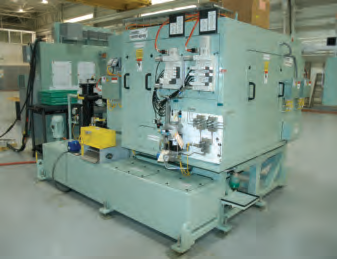
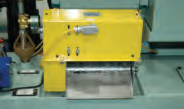
Top: A deburring machine from Cinetic allowed Honda to deburr camshafts faster and process different part lengths. Below: A magnetic separator from Storch Magnetics removes chips and fines from the coolant that washes camshafts after deburring.
To keep up with engine production, Honda required a deburring machine with a cycle time of 45 seconds, including a 6-second load/unload cycle. The machine had to remove the all the burrs, which are left at drilled cross-holes and the edges of machined surfaces. That includes burrs in the valve timing control oil holes, and the edges of bearing surfaces and ground lobes. Burr size varies from about 1mm on the lobe edges to up to 2mm to 3mm on cross-holes, Willeke noted.
Based on recommendations from the purchasing department, four companies presented proposals for the deburring equipment. After evaluating them, Honda selected Cinetic Automation Corp., Farmington Hills, Mich., which develops machines and systems for light-vehicle and heavy-truck manufacturers, equipment suppliers and integrators. “We have several of their machines for washing applications, but we never used Cinetic for a deburring process,” Willeke said. He added that a Cinetic washer cleans the L4 camshafts after deburring.
Once the two companies agreed on a design that achieved the needed cycle time and deburred more than one camshaft length, Cinetic built three Centri-Spray-brand Model BD-7737 machines for the L4 line. Cinetic delivered the machines in 9 months after receiving the purchase order.
A 3-axis overhead-gantry robot loads camshafts into the machine, where a chuck holds a camshaft end to end. A stack of 16 rotating steel brushes up to 355mm in diameter then moves in from one side of the camshaft and deburrs while the camshaft rotates around its axis. The brushes, which have Osborn nylon abrasive filaments, run the length of the camshaft. Willeke noted that those brushes last more than 50,000 deburring cycles.
At the ends of each camshaft are drilled holes for oil lubrication. Nylon abrasive-filament brushes as small as 4mm in diameter deburr those holes. To reach some holes, the machine automatically rotates the camshaft around its centerline to one of four positions using a servodrive. “Those brushes are replaced about every 300 cycles,” Willeke said.
Cinetic-developed software controls the deburring operation’s cycle time and indicates to the deburring machine which type of camshaft is placed in the machine for proper motion contour control.
Coolant is sprayed on the parts during deburring, which flushes the metal fines (formerly burrs) from the camshaft through the machine into a catch tank. The fines are then funneled towards the rear of the machine into a small opening. From there, the fines go to a rare-earth magnetic chip and coolant conveyor from Livonia, Mich.-based Storch Magnetics. The conveyor removes the fines before the coolant goes to a settling tank.
Once separated from the coolant, Honda recycles the chips at the Anna engine plant’s ferrous casting foundry, where the camshafts are cast along with cylinder sleeves and drivetrain parts.
“We’ve dealt with Storch Magnetics on conveyors before, and have used the company’s chip coolant integrated conveyor separators in the past,” said Craig Duncan, Cinetic project engineer.
After the coolant settles, a filter station traps any fines missed in the first separation process. The coolant is then reused.
If fines are continuously removed and the coolant is not cleaned for recirculation, the coolant can become heavily contaminated with fines that eventually plug the coolant system or cause other problems. According to Storch Magnetics, the magnetic separator provides nonmedia separation and significantly reduces disposal and media cartage costs.
Duncan noted that if any fines get by the Storch magnetic separator, a twin filtering bag setup collects the remaining fines. If one filter becomes dirty, it can be bypassed during the operation to another filtration unit. Then, the operator can switch to the secondary filter without having to shut down the machine for cleaning.
Glossary terms in this article
Related


Subscribers can use MFGAxis notes, saves and discussion tools with their innoNET account.