


Small-Scale Thinking: Drilling Performance
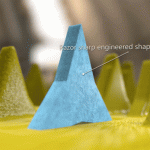
Courtesy of NanoMech Nanotechnology opens up new coating possibilities, performance."Nanotechnology" has been a buzzword in a variety of industries for some time now. But what does it mean when it comes to coating materials for cutting tools, and what's the current state of nanostructured tool coatings?Defining nanoscale might be a good place to start.
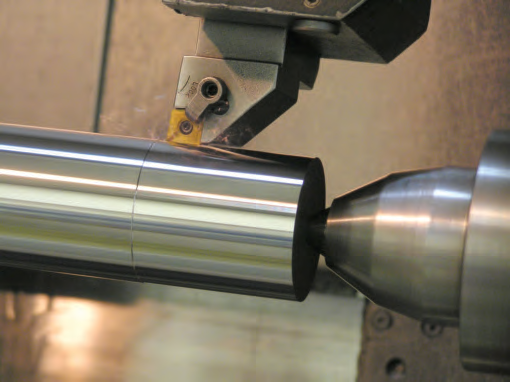
Courtesy of NanoMech Nanotechnology opens up new coating possibilities, performance.
“Nanotechnology” has been a buzzword in a variety of industries for some time now. But what does it mean when it comes to coating materials for cutting tools, and what’s the current state of nanostructured tool coatings?
Defining nanoscale might be a good place to start. A consensus defines nanoscale as features on the order of 100 nanometers or smaller (a nanometer is one billionth of a meter).
For cutting tool coatings, however, it’s not that simple. Although feature sizes of nanocoating materials certainly fit the 100nm or smaller scale, development of new coating processes and materials is producing tools for difficult machining applications that, in some cases, can far exceed the performance of conventional tools in both life and machining capability.
According to Dr. Ajay Malshe, founder and chief technology officer of NanoMech, Springdale, Ark., using nanotechnology to develop tool coatings requires a different mindset than the chemical composition-based thinking that has driven materials science for the past century or longer.
“Basically, we are exploiting size as opposed to exploiting chemistry,” he said. “Conventional thinking about properties doesn’t apply at nanoscale. For tool coatings, for example, that may mean materials that are both harder and tougher than conventional materials, or it may mean creating new surface textures on the coating that can act as a kind of microchipbreaker during machining.”
CBN Coating Update
NanoMech is the parent company of Duralor, a Springdale-based company that developed and is commercializing a nanotechnology process for depositing CBN composite coatings on cutting tools. (see “Coating’s Holy Grail,” October 2008). The CBN nanocomposite coating was then in its infancy. Over the ensuing 2 years, Duralor has focused on finding applications for CBN-coated tools and working with selected customers—about a dozen, according to Duralor president Bob Reed—to commercialize CBN-coated tools.
Courtesy of Platit
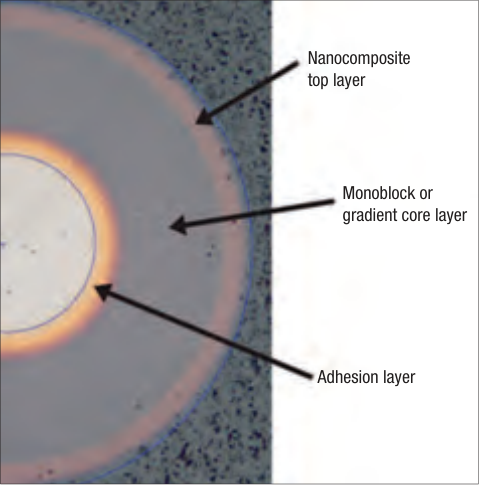
Platit’s current generation of nanocomposite coatings feature an adhesion layer, a monoblock or gradient core layer and a nanocomposite top layer. Total thickness of the coating system is 2.72µm.
“We are currently focused on machining steels hardened up to 54 HRC,” Reed said. “The coating is also very good in machining of prehardened steels and powder metallurgy materials.” Reed said Duralor’s current work is mainly in uninterrupted turning applications, although the company expects to ramp up development of CBN-coated inserts and round tools for interrupted cutting in the coming months.
Developed with researchers at the University of Arkansas, Duralor’s Tufftek process consists of first electrostatically depositing submicron grains of CBN on the carbide substrate, then infiltrating the CBN grains with TiN, TiCN, TiC or other traditional tool coating materials using chemical vapor deposition. The technology is capable of depositing relatively thick (100μm or more) coatings, but a more typical thickness is less than 20μm.
Reed said the CBN-coated tools offer a significant cost advantage over PCBN-tipped tools, and, because of potential tripling or quadrupling of tool life, also are competitive on a cost basis with conventional multilayer coated inserts.
Courtesy of Rushford Hypersonic
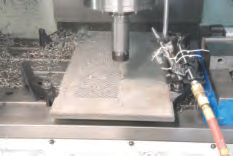
In testing, a ¼ “-dia. jobber drill coated with Rushford Hypersonic’s HPPD SiC coating produced 1,546 holes in ½ “-thick 304 stainless steel with no coolant. Diameter of the last hole was 0.2495 “.
In addition to expanding to milling and possibly drilling applications, Duralor research is focused on using different materials to infiltrate the electrostatically deposited CBN grains. The company is working on CVD alumina as a potential matrix material, as well as on incorporating lubricants into the matrix.
“A tool coated in that way would combine CBN nanoparticles with a lubricant, such as molybdenum disfulfide, that would be supplied continuously to the cutting edge,” Malshe explained. “So our process really is a platform for combining materials and combining coating architectures in ways not possible using conventional CVD or PVD processes.”
Mach 8 and Beyond
Another nanocoating process is hypersonic plasma particle deposition (see “Flute Insurance,” October 2009).
“Basically, we disassociate molecules into their elemental state to create reactants in a plasma stream,” explained Daniel Fox, president of Rushford (Minn.) Hypersonic LLC. “We then reassemble them through a nucleation process and accelerate the reassembled molecules to speeds of more than Mach 8 (about 6,000 mph) to deposit them on the substrate.”
According to Fox, hitting the substrate at high speed causes the nanoparticles, which are 2nm to 20nm in size, to undergo a phase change and chemically bond to the substrate. The result is a thin, monolayer coating with excellent adhesion and high hardness and fracture toughness.
“Our coatings typically have a hardness of more than 37 GPa and fracture toughness of more than 3.1 MPa,” Fox said. “And, the better we can control our particle size distribution, the higher the fracture toughness and hardness. Within the next 6 months, we expect to have fracture toughness of 6 MPa and well above 50 to 60 GPa in hardness.”
Rushford is using HPPD to produce SiC coatings, but is preparing to add titanium and boron to the process. “That will allow us to produce TiC, TiN, boron-nitride and boron-carbide materials.”
Like Duralor, Rushford is working with customers to find applications for HPPD-coated tools. “We’ve been working with customers to coat a lot of HSS substrate materials mainly in the drilling area, but we are investigating turning and milling with carbide inserts as well,” Fox said.
The company is also still quantifying tool life increases and other benefits. Fox believes one of the main advantages of HPPD-coated tools will be their ability to expand dry machining applications. “The ability to run without coolant makes machining inherently greener,” he said. “That’s important in Europe right now, and it will become more important in the U.S. as well. We are working with customers to combine the coating with tool geometries and substrates optimized for dry machining.”
More Nanocomposites
NanoMech and Rushford use unconventional processes to deposit some relatively unconventional coating materials. However, the idea of combining two or more materials to form nanocomposite coatings with improved properties is also being applied with more traditional tool coating materials.
One of the main developers of such coatings, and the processes and equipment to produce them, is Platit Inc., Libertyville, Ill. The company’s nanocomposite PVD coatings combine nanocrystalline TiN, CrN, TiAlN or AlTiN materials with amorphous silicon nitride. The materials are said to be applicable for general-purpose use but particularly useful for high-performance cutting.
The coatings feature nanocrystalline TiAlN, AlCrN or AlTiCrN grains embedded in an amorphous silicon-nitride matrix. Platit says this arrangement prevents grain growth during deposition and maintains hardness greater than 50 GPa.
View print ads from this spread
Review the ads on this magazine spread to continue reading. Each ad takes two seconds; a two-page ad counts once.
Advertisers on this magazine spread
Print placements on this magazine spread
Walter Tools
Passion. Potential. Perfection.
TOUGHER. HARDER. SHARPER. Milling steel or cast iron? Increase output up to 75%! • Extremely stable cutting edge • Extremely smooth rake face Our passion. Your potential. • Easy wear detection thanks to Tiger·tec® Silver They drive us to create the perfect tool indicator coating for every application. The machining age is over. It’s time to Tiger
Passion. Potential. Perfection. TOUGHER. HARDER. SHARPER. Milling steel or cast iron? Increase output up to 75%! • Extremely stable cutting edge • Extremely smooth rake face Our passion. Your potential. • Easy wear detection thanks to Tiger·tec® Silver They drive us to create the perfect tool indicator coating
Visit Walter Tools View this placement in the issue recordPrint ads from this magazine
TOUGHER. HARDER. SHARPER. Milling steel or cast iron? Increase output up to 75%! • Extremely stable cutting edge • Extremely smooth rake face Our passion. Your potential. • Easy wear detection thanks to Tiger·tec® Silver They drive us to create the perfect tool indicator coating for every application. The machining age is over. It’s time to Tiger
Passion. Potential. Perfection. TOUGHER. HARDER. SHARPER. Milling steel or cast iron? Increase output up to 75%! • Extremely stable cutting edge • Extremely smooth rake face Our passion. Your potential. • Easy wear detection thanks to Tiger·tec® Silver They drive us to create the perfect tool indicator coating
Continue reading
October 2010
Courtesy of Swiss Tek
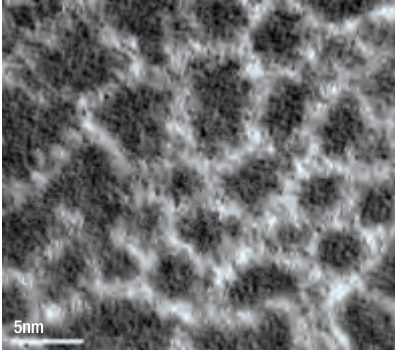
Transmission electron micrograph shows the structure of nanocomposite coating, consisting of dark AlTiN nanocrystals 3nm to 4nm in size surrounded by approximately 1nm of lighter-colored amorphous Si3N4.
Deposited in PVD units using the company’s lateral or central rotating cathode technologies, the materials have been extensively tested in milling, drilling, hobbing and other types of machining. According to the company, drilling has proven the most successful application due to the added thickness of the coatings.
In tests using a 5.2mm-dia., solid-carbide drill to produce holes in D-2 tool steel, tools with the nanocomposite coatings showed tool life improvements of 100 percent or more compared with conventional TiAlN-, AlTiN- and AlCrN-coated drills.
One contract coater using Platit equipment to deposit the coatings is Swiss Tek Coating Inc., New Berlin, Wis. Swiss Tek President Peter Bartos said the company deposits two nanocomposite coatings using its Nano-Tek and Nano-Tek/Cr processes. The former process deposits an AlTiN/Si3N4 material; the latter deposits AlCrN in a Si3N4 matrix. “In either case, the amorphous Si3N4 fills the voids between the AlTiN or AlCrN nanocrystals,” Bartos explained.
According to Bartos, nanocomposite coatings are used on solid round tools and inserts for threading, milling and turning, and they are accounting for an increasing share of his company’s business. “The main benefits are very high hardness and heat resistance,” he said. “With conventional AlTiN, we had pretty much hit the limits in terms of those properties, but these nanocomposite materials broke through those barriers.”
Bartos said oxidation temperatures—the point at which the coatings would combine with oxygen in the atmosphere and begin to break down—for the nanocomposite materials are in the range of 2,000° to 2,200° F. “That’s significantly higher than the best conventional PVD coatings, and very close to the original sintering temperature of the carbide substrate,” he said.
Such high heat resistance makes nanocomposite coatings useful in multiple high-performance or high-speed machining applications, he added. “What we have found is the chromium-based coating has a broader application range than the titanium-based material, which seems to be better for hard milling of steels.”
Users, however, can expect to pay more for nanocomposites than for conventional coatings. “There’s probably a 20 percent price premium for either of the nanocomposite materials compared to conventional AlTiN or TiAlN,” he continued. “Depending on the coating type, cost of the coating can range from 5 to 15 percent of total tool cost, so there’s not a huge difference in terms of up-front cost between nanocomposite and conventional coatings.”
Tool Supplier’s Perspective
Cutting tool suppliers and coaters have known for years that multilayer structures are stronger and more wear-resistant than monolayers. Carrying that idea into the nano realm are small-diameter endmills and drills manufactured by Harvey Tool Co. LLC, Rowley, Mass.
“Multilayers work to control crack initiation, and if there is any cracking or flaking it takes much longer to propagate through the entire coating structure,” said Jeff Davis, vice president of engineering for Harvey Tool.
Harvey Tool’s nanolayer coatings typically are 1µm to 4µm thick, compared with 2µm to 5µm or more for its conventional AlTiN material. Davis said the smaller crystal size of the nanocoating material enables production of a thinner coating layer with a more cohesive and uniform structure. “The nano part comes in when you’re putting on very thin layers of AlTiN, and the smaller the crystals the more cohesive and uniform the structure.”
According to Davis, the result of nanocrystalline deposition is higher hardness and heat resistance. Harvey Tool claims hardness of 45 GPa and maximum working temperature of 2,100° F for its nano AlTiN material, compared to 35.5 GPa and 1,400° F for its conventional AlTiN grades.
Those improved properties translate to tools that can last longer than conventionally coated tools in difficult applications, Davis said. “Probably the single best application is milling of hardened steels—materials starting at about 45 HRC and climbing to the top of the Rockwell C scale. Traditional TiN is not going to work there. AlTiN is a step in the right direction, but nanocoatings, coupled with the right edge prep, substrate and geometry, enable users to improve tool life from maybe seconds to minutes.”
Davis said his company sees future applications for nanocoatings in drilling as well. “If you’re making holes more than maybe 4 diameters deep, getting coolant down to the tool tip is always a critical issue. You can peck or do other things, but the ability of these coatings to take more heat would be beneficial in that kind of application.”
Still, Davis advises caution when applying tools with nanocoatings. “These coatings are not like TiN, where you put it on just about anything and you’ll see improved performance,” he said. “They are application-specific, and the field in which you use them is fairly narrow. We use them on hard milling tools, a couple of finishing tools and some variable-helix tools. And again, it’s not just the coating—it’s the edge prep, the substrate, relief and helix angles, core diameters—all these things come together to make tools live in very difficult applications.”
Swiss Tek’s Bartos, however, sees a wider application for nanocoatings. He said they are a significant step toward the mythical universal coating material that would improve tool life and productivity in all types of machining applications. “What everybody wants in a coating is a silver bullet—a single coating that can be applied to milling and drilling tools, turning inserts, carbide and HSS substrates, and works well in every application,” he said. “Of course, that simply doesn’t exist, but that’s the direction we’re heading with these materials.” CTE
About the Author: Jim Destefani, a senior editor of CTE and MICROmanufacturing magazines, has written extensively about various manufacturing technologies. Contact him at (734) 528-9717 or by e-mail at jimd@jwr.com.
Contributors
Harvey Tool Co. LLC
(978) 948-8555
www.harveytool.com
NanoMech
(479) 756-9999
www.nanomech.biz
Platit Inc.
(847) 680-5270
www.platit.com
Rushford Hypersonic LLC
(866) 730-4773
www.rushhypersonic.com
Swiss Tek Coating Inc.
(262) 784-6100
www.swiss-tekcoatings.com
Glossary terms in this article
Related


Subscribers can use MFGAxis notes, saves and discussion tools with their innoNET account.