



Veteran’s Assistance: 5-Axis Machining
New materials and improved part manufacturing help maintain and upgrade aging military aircraft.
New materials and improved part manufacturing help maintain and upgrade aging military aircraft.
The U.S. Defense Department spends a significant portion of its $700 billion annual budget on advanced technology. However, operating alongside stealth fighters, remotely piloted drones and space-based defense systems are aircraft that are more than twice as old as many of the pilots who fly them.
“The military has not modernized its Cold War fleet at the rate expected,” said Dr. Loren B. Thompson, COO of Lexington Institute, Arlington, Va., a defense and national security research center. “There are literally thousands of old bombers, tankers, fighters and cargo aircraft that have been kept beyond their originally planned lives.” Considerations of part obsolescence, fatigue and corrosion will “force the government to spend a great deal of money keeping them airworthy,” he added. “There is demand for tens of millions of dollars in replacement parts not available from traditional suppliers or OEMs.”

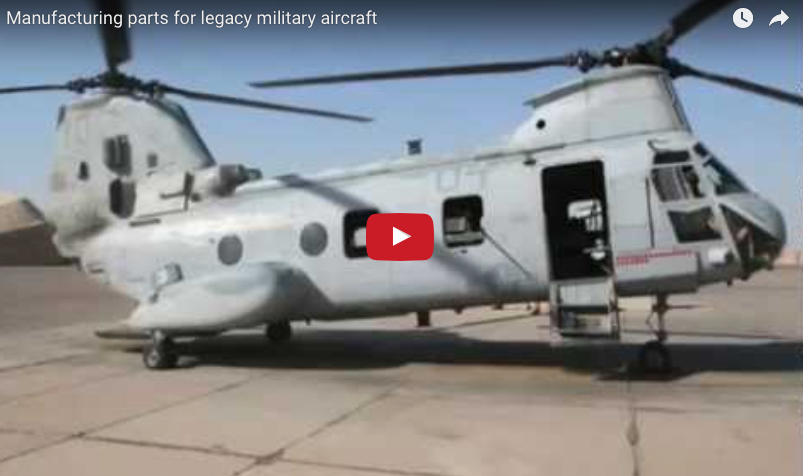
Posted with CTE’s October cover story are a few video reports—one on parts for legacy military aircraft, and two others on the KC-135 Stratotanker. Watch the video reports here.
Golden Oldie
A prime example of an aging but essential aircraft is the Boeing KC-135 Stratotanker, an aerial refueling tanker that expands the flight range of military aircraft around the world. The first flight of a KC-135 took place on Aug. 31, 1956, and it was introduced to service in June 1957. The last plane was delivered in 1965. Average age of the 417-plane fleet is about 48 years, according to Gaddis Gann, chief engineer, KC-135, for the Aerospace Sustainment Directorate at Tinker Air Force Base outside Oklahoma City.
At Tinker, KC-135 tankers go through a regularly scheduled overhaul, inspection and repair process called programmed depot maintenance. Services performed during PDM include replacement of worn or damaged parts, sometimes substituting new materials that enhance performance or offer better resistance to corrosion and metal fatigue.
KC-135 designers used the best materials and assembly techniques available in the 1950s. Over the years, however, it has become apparent that some of the high-strength-to-weight-ratio alloys of that time are prone to corrosion and stress- corrosion cracking, where corroded metals can fail suddenly when subjected to tensile stresses.
When stress-corrosion cracking occurs in a structural member, it must be replaced. “Typically, if it is an aluminum part we will look for new-generation aluminum,” Gann said. As long as the basic characteristics of the material are similar, it will not alter the aeroelastic characteristics of the airplane. “That way, it can be a form-fit-function, drop-in replacement, eliminating some qualification testing,” he said.
Break Time
A good example is a series of “production break” KC-135 parts that join the outboard wing to the main wing section. Each aircraft requires 12 of the fittings, some up to 6 ‘ long. After finding evidence of corrosion and stress-corrosion cracking on some of the legacy parts, Gann said, “we made a decision to change all the production breaks on the fleet.” The original production breaks were made of 7079 aluminum; in the new parts, 7050 aluminum, which is more resistant to stress-corrosion cracking, is used.
Courtesy of Air Force photo by Margo Wright
On the depot maintenance floor of the nearly mile-long Oklahoma City Air Logistics Center at Tinker Air Force Base, a KC-135 is stripped of paint, engines and much of its interior as mechanics overhaul the workhorse aircraft. The KC-135 was introduced in 1957 and last produced in 1965.
Courtesy of Air Force photo by Tech. Sgt. Angelique Perez
A KC-135 tanker aircraft refuels an F-15 Eagle fighter.
The original production breaks were forged, but the new parts are machined and not forged because the new alloy has enough strength. Cut from 800-lb. billets, the finished parts weigh just 35 lbs. The shop’s machine tools include Cincinnati and SNK 5-axis machines.
According to Danny Tornello, manufacturing machining section chief, 551st Commodities Maintenance Squadron, 5-axis technology is required to machine a production break “because there isn’t a flat surface on it.”
Gann said the replacement parts are not typically machined to original dimensions because the planes were manufactured in the days before CAM files and 5-axis machines. “They were basically hand built,” he said. “As you go from airplane to airplane, you find there is a little bit of difference for each one. In the old days, they installed a forged part and it was kind of hand-massaged in.”
As a result, when the shop manufactures a replacement part, it leaves extra material that the print would not necessarily call out. The part is then fit-checked and trimmed to match the individual aircraft. Holemaking takes place after the fit-check. “Holes on different airplanes are not going to match,” Gann said. “They may be as much as a quarter or half a hole off.” Accordingly, the parts are machined blank and holes are drilled to mate with existing holes on the individual aircraft.
Reverse Engineering
Glenn Berglan, maintenance flight chief, 551st Commodities Maintenance Squadron, said there is little documentation for many of the old parts and “we have to do a considerable amount of reverse engineering and develop the dimensions using an old part.”
“We don’t have any digital data on this airplane,” Tornello said. “To reverse engineer a part, we use a Leica laser tracker to scan an old sample and build a model for our Catia V5 programming to create toolpaths for our machine tools. [When the first production break was machined,] we did a destructive first article. We sawed one in half and made sure the grain structure was good. Then, engineering bought off on the first production item of every dash number (different version) that we made.”
Courtesy of Air Force photo by Margo Wright
On the depot maintenance floor of the Air Logistics Center, a wing production break on a KC-135 tanker is flagged for safety.
When a large quantity of parts are required, as in the case of the production breaks, the Defense Logistics Agency (DLA) calls for bids and contracts from outside shops. However, early in installation of the production breaks, there were delivery delays. “That is where Glenn and his folks jumped in and helped us with individual dash numbers,” Gann said.
“By machining the missing parts, we were a short-term bridge,” Berglan said. “We kept the aircraft moving until the parts started arriving from suppliers.”
The machining operations at Tinker also provide quick response to unanticipated needs. “With a 50-year-old airplane, you’d think we’d know everything,” Gann said. “But we still get surprises every day. Occasionally, we will run into a failure. We must have parts to get the airplanes out of here and we don’t always have time for the supply chain to react.”
Tornello cited the example of a 3 “-dia., 4340 steel shaft, about 6 ” long. The parts are installed in pairs in the tail section of the KC-135 aircraft, in the torque box component that holds the horizontal stabilizer.
During a PDM, Tinker staff discovered that all such shafts on incoming planes were corroded or worn. Waiting for delivery of the parts from contractors through the DLA would have delayed the PDM process. “So we started generating an emergency work order yesterday (in early August). We were able to find material and have it delivered to the shop this morning, and we are starting production on 50 of them that will last on the PDM line here through October,” Berglan said.
Keeping Them Healthy
Depending on the progress of tanker replacement programs and other factors, some KC-135s may still be in service in 2040. The first tanker replacement program began in 2002 and a contract was awarded to Boeing.
After an investigation revealed corruption in awarding the contract, it was canceled in 2005. Another replacement program, called KC-X, was awarded to a joint venture of Northrop Grumman and the European Aeronautic Defence and Space Co. (EADS), based on Airbus A330 tankers, in February 2008.
Courtesy of Air Force photo by Margo Wright
In the Oklahoma City Air Logistics Center shop, Mike Bow (right) and engineering technician Tom Lange examine a sample wing production break machined on the SNK.
Courtesy of Air Force photo by Margo Wright
Mike Bow, a machinist in the 552nd Commodities Maintenance Squadron, monitors machining of a KC-135 wing production break on a SNK RB-200F twin-column, bridge-type, 5-axis machining center in the Air Logistics Center.
However, Boeing protested the award, and the protest was upheld by the U.S. Government Accountability Office. In September 2009, the Air Force began the process of accepting new bids, but the contract still has not been awarded. No matter what happens, the Air Force will keep the current tankers flying until the fleet is replaced.
Gann said the KC-135 is one of the few aircraft in the Air Force maintained under both organic (performed at Tinker) and contract PDM lines, which provide additional capacity and a second source of repair. About 77 KC-135s go through PDM each year, Gann said. “At Tinker this year we did 54, and the rest went to contractors.”
Opportunity Flies
Regarding contract maintenance of the legacy aircraft, the Lexington Institute’s Thompson said the next 10 to 20 years could generate many opportunities for machine shops. For a contract machine shop, these jobs are “fairly lucrative as long as the company has the skills required to meet military specifications. That’s an important consideration. Military specs are typically more demanding than commercial specs,” he said.
To meet military specifications when making out-of-production parts, “the key is to research the part thoroughly,” said Kevin Gholston, vice president for business development at CVG Strategy LLC, Viera, Fla., a consulting company that helps small to mid-sized companies capitalize on opportunities in government contracting. In many cases, he said, equivalents for military specifications can be found elsewhere, such as in SAE specs.
Gholston cited the example of his company’s efforts to facilitate replacement of an oil filter originally released in the 1960s. Functional coatings on the filter were tied to an outdated military specification. “We had to chase the trail, like a scavenger hunt, to get all the way to the modern commercial specification that was tied to the cancelled military specification,” he said. The goal was to prove the modern coating chosen for the filter provided equivalent or better performance than the original. When engineering documentation or certification tests are required to gain end-user approval of a material change, CVG Strategy assists in production of the documentation or managing the tests for small machine shops, Gholston noted.
Change for the Better
Beyond simply maintaining the status quo when replacing a legacy part with a new material, such an update can also provide benefits in durability and cost savings. One example is the Marine Corps’ CH-46 helicopter, each of which goes through PDM every 4 years. The process includes refurbishing a series of eight sheet-aluminum covers on the top of the helicopter that protect the hydraulic lines, control cables and driveshafts that transmit power from the engines at the rear of the aircraft to the front rotor.
Courtesy of Marine Corps photo by Lance Cpl. Eric D. Arndt
The U.S. Marine Corps uses the CH-46 tandem rotor helicopter to transport troops, supplies, and equipment. It was introduced in 1964 and the Corps received its last new aircraft in 1971.
Until recently, refurbishing the covers required removing several hundred rivets that join the aluminum cover sections and their supporting stringers and ribs. Refurbishment was the only choice because the CH-46 went into service in 1964, was last produced in 1971, and no vendors for the covers exist. The covers invariably were bent and worn, so replacement required straightening them before reassembling and reriveting the cover sections.
According to Ray Jones, CEO of composites design and manufacturing company VX Aerospace Corp., Leesburg, Va., replacing the aluminum covers with carbon fiber components provided increased durability and corrosion resistance while reducing weight and saving the Marine Corps time and money.
Engineering for the CH-46, originally handled by Boeing, the helicopter’s OEM, is now the responsibility of the Naval Air Systems Command and engineers at the Marine Corps Air Station at Cherry Point, N.C. When staff there asked VX Aerospace about replacing the covers with carbon fiber components, the company produced a prototype part for a cover section located near the base of the helicopter’s rear rotor pedestal. The cover consisted of a multilayer carbon fiber shell tapering to about 1⁄8 ” thick at the edges, encasing a ½ “-thick base made of Rohacell rigid foam.
Old-School Prototype
Since the part was relatively simple, VX Aerospace acquired dimensions for the prototype via an “old-school” reverse engineering technique, according to Jones. “For this small piece, we did what in the composites world is called a splash. Using the existing part as a master model, you place successive layers of wet layup fiberglass over the part and let that structure harden to mimic the outside shape of the part. When you pull the hardened fiberglass structure away from the part, its inside surface conforms to the outside surface of the part. This creates the mold, or tool, needed to lay up a new carbon fiber part.” The “new-school” method, employed for more complex parts, would involve laser scanning, he added.
Courtesy of VX Aerospace
Bottom photo: To replace sheet-aluminum covers (right) for a tunnel atop the out-of-production CH-46 helicopter, VX Aerospace engineered and manufactured composite components consisting of a multilayer carbon fiber shell tapering to about 1⁄8 ” thick at the edges, encasing a 1⁄2 “-thick base made of Rohacell rigid foam. Top photo: A close-up view of an old sheet-aluminum cover (left) and a new composite component replacement.
Jones said reverse engineering of the aluminum covers was complicated by their condition. Decades of service had left the existing covers bent, stepped on and otherwise misshapen. “We had to interpolate a curve to get a nice shape all along the part line. We did a best engineering guess, made a demo part, then fitted it on the aircraft. If it was 1⁄16 ” high here and 1⁄32 ” low there, we changed the shape of the mold and came back and did it again.”
In certain aspects of its business, VX Aerospace engages partners and consultants. For advanced engineering analysis of the CH-46 covers, the company worked in conjunction with North Carolina A&T University. After VX Aerospace provided the initial design, “NC A&T conducted finite element analysis and stress, strain and strength calculations. We have also partnered with North Carolina State University for the science and analysis on other parts.”
Machining Guidance
Similarly, the composites company consults with the National Center for Defense Manufacturing and Machining, Latrobe, Pa., for guidance on finish-machining carbon fiber components. “We have to finish the parts and we have to drill holes for fasteners so we can attach the composite parts to the aircraft,” Jones said. “Because a carbon fiber component consists of multiple layers of fabric and resin, it can delaminate and fray when machined. “We are adept at engineering design and manufacturing composite parts; the expertise of the NCDMM is in machining, trimming and drilling them.”
As an example, Jones described stub wing upper access panels for the CH-46 comprised of 16 layers of carbon fiber, a protective layer of fiberglass and an outer layer of copper mesh for lightning protection.
“When you drill, trim or machine, you’ve got to take into account that you are going through copper, which has certain characteristics, fiberglass, with different characteristics, then 16 layers of carbon fiber, with still differentcharacteristics. We rely on NCDMM to provide us the feed rate, feed angle and tool geometry for the optimal process to machine or drill this part without producing burrs or delamination.”
Moving to carbon fiber replacements for the CH-46 tunnel covers reduced holemaking requirements. Only a few rivets secure the cam lock clips and hinges that attach the cover to the aircraft. The Rohacell foam core structure eliminates the need for stringers, significantly reducing the total part count required for refurbishing. In addition to the cost savings and the increased strength and corrosion resistance of the carbon fiber parts, they weigh about 10 percent less than the original aluminum setup, Jones said.
Courtesy of VX Aerospace
VX Aerospace technicians lay up carbon fiber fabric in molds to create composite replacements for sheet-aluminum covers.
The engineers at Cherry Point recognized that the prototype was sturdy, lighter and corrosion free. “They asked us to replace the whole set of eight tunnel cover sections, which are 21 ” wide and vary in length from about 12 ” to 40 “,” Jones said.
In production, the foam cores are initially shaped in a mold, then the edges are beveled with a router to create a smooth transition at the edge of the part. VX Aerospace technicians next lay down a few layers of carbon fiber material, put the core on top and cover it with more carbon fiber layers. The molds are vacuum-bagged (to compress the fabric into the mold), then cured in an oven. The composite materials were developed specifically for oven curing, rather than autoclave curing, to maximize production economy. The resulting part requires only edge trimming and drilling, followed by priming and painting.
Each individual section is identical to others of its size because they are pulled off section-specific molds. “If a carbon fiber part is damaged, they pull another one off the shelf and install a new one. The savings in time and labor make it less expensive to supply new carbon fiber parts than to refurbish the aluminum originals,” Jones said.
Material Issue
As is always the case in manufacturing, engineering considerations dictate what material is best to replace legacy parts. Many metal parts can be repaired or produced inexpensively in high volume and are not good candidates for composite materials. “But when you have curved surfaces or complex shapes, you can mimic that complexity in composite materials without all the rivets and bracing and internal structure, and then you can achieve significant cost savings,” Jones said. “Even though the composite material costs more, the finished part costs less overall because of the reduced subassemblies.” Depending on the application, the engineers may specify metal, composite or a part-composite, part-metal hybrid design.
The lengthy nature of the military funding cycle can be an issue in the drive to replace parts using higher-performance materials, especially for smaller manufacturers. “We are already looking at 2012-2013 budget cycles for the DOD,” Jones said. “Even if we come up with a great idea, the military may say ‘we do see an opening, but it is 2 or 3 years out.’ You have to be diligent and persistent to ensure you are part of those budgetary cycles. Everybody understands the advantages and disadvantages of composite parts, so it does come down to program support, available funding and then timing,” Jones said. “You have to be at the right place at the right time.” CTE
About the Author: Bill Kennedy, based in Latrobe, Pa., is a contributing editor for CTE. He has an extensive background as a technical writer. Contact him at (724) 537-6182 or by e-mail at billk@jwr.com.
Contributors
CVG Strategy LLC
(321) 253-9791
www.cvgstrategy.com
Lexington Institute
(703) 522-5828
www.lexingtoninstitute.org
Tinker Air Force Base
(405) 734-2171
www.tinker.af.mil
VX Aerospace Corp.
(703) 727-1233
www.vxaerospace.com
Glossary terms in this article
QR codes and videos from this issue
Print QR codes, video callouts, and in-magazine links for this article now point to the CTE video hub in the HTML version.
Related


Subscribers can use MFGAxis notes, saves and discussion tools with their innoNET account.


