



Multi-Axis Access: 5-Axis Machining
Simplified application of five machining axes produces big cost savings in routine part making.
Editor’s Note: Click here for a video demonstration of pinch milling.
Simplified application of five machining axes produces big cost savings in routine part making.
Many shop owners believe 5-axis machining is an expensive, difficult-to-program technique meant only for highly contoured parts like aerospace turbines. However, there are ways of using 5-axis machines that are simpler and, in some cases, better than simultaneous 5-axis machining. For a deeper look at Maxing out multitasking: 5-Axis Machining, see this supporting resource.
 Courtesy of Makino
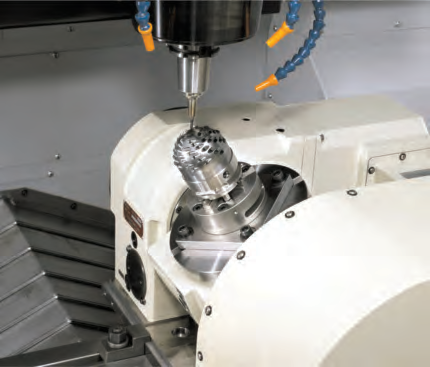
A trunnion/table arrangement, such as this one on a Makino F5-5XR VMC, permits drilling of angled holes without the need to employ a compound-angle drilling head.
For example, a more common application of 5-axis machines uses the two rotating axes to move or index the part into position, then performs the machining in the more familiar X, Y and Z axes. Compared to simultaneous 5-axis machining, “3+2,” or five-sided, machining can be accomplished without complex programming and can reduce labor cost and production time while maximizing quality, even when machining routine parts.
On a 3-axis machine, creating features on different sides of a part requires that a separate setup be performed for each side. In addition to consuming time and labor, changing setups increases the chances for fixturing errors. On a 5-axis machine, the part is clamped one time and then is rotated into a series of positions to machine each side without refixturing.
There are two basic 5-axis machining configurations: table or trunnion, in which tilting and rotating tables enable a fixed spindle to access more than one part side; and tilting spindle, in which using a tilting spindle and a rotating table together, or a fully articulated spindle alone, enables machining of multiple sides of a part.
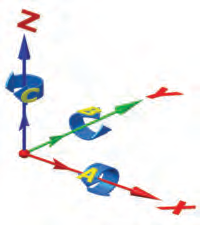
Michael Cope, senior applications engineer for Hurco Cos. Inc., Indianapolis, said the first step in understanding five-sided machining is getting a clear idea of how the additional rotating axes are related to the linear X, Y and Z axes of a basic 3-axis machine. Visualizing the X, Y and Z axes as lines, he explained, the A-axis rotates about the X-axis, the B-axis rotates about the Y-axis, and the C-axis rotates about or under the Z-axis. Accordingly, a trunnion or table setup adds rotation in the A and C axes, while a machine with a tilting spindle and a rotating table adds rotation in the B and C axes.
Jim Endsley, product specialist for machining centers at Okuma America Corp., Charlotte, N.C., said a typical shop owner hears the term “5-axis,” assumes simultaneous 5-axis machining is involved and says, “I don’t do 5-axis.” Consequently, Endsley said he avoids using the 5-axis term altogether and describes five-sided machining techniques as “universal machining.”
According to Endsley, only 5 percent of the shops with 5-axis-capable machines actually use them for full simultaneous 5-axis machining; the rest, “if they are smart,” employ them in universal machining, or “what we affectionately call point and shoot: X, Y, Z, roll an axis, drill a hole.”
5-Axis Access
Cope said potential beneficiaries of five-sided machining techniques include any “regular job shop that is doing 3-axis work on multiple sides of the same part. They are able to reduce their setup time, especially the second time they run a job, because they only have to do the one part setup and then everything is taken care of in the program.” (See sidebar below.)
Part features help a shop decide if acquiring a machine with 5-axis capability will be worthwhile, according to John Nelson, applications manager at Haas Automation Inc., Oxnard, Calif. “Is it a rectangular or a square part, are there features on all six sides, or are there features at a number of odd angles?” he asked. “The need to get to more than just the top and bottom of a part will determine whether it will be a good 5-axis candidate.”
Bill Howard, vertical machining center product manager for Makino Inc., Mason, Ohio, indicated hydraulic applications, such as fluid manifolds, are excellent candidates for five-face machining, “where the part is just Swiss cheese with all kinds of angled holes and cross sections through it. You can use the tilt rotary table to set the part and create the compound angle, so you are straight-hole drilling as far as the machine is concerned. Otherwise, you’d be doing a heck of a lot of setup, or you would be using compound-angle drill heads, which can limit your speeds and feeds and often don’t have through-coolant capability.”
Courtesy of Hurco
Visualizing the additional rotating axes of a 5-axis machine in relation to the linear X, Y, and Z axes helps understand five-sided machining.
Another category of five-sided machining, Howard said, is what Makino calls “2+3” machining for die and mold applications. “Mold shops use the fourth and fifth axes to position the part and then use X, Y and Z axes to do the core and cavities,” he said. “Positioning the part provides better access to features and enables use of shorter, more rigid tooling, which can permit use of more aggressive machining parameters, shortening cycle times and producing better surface finishes.” More rigid tools minimize surface-marring vibration produced by using more aggressive cutting parameters. Howard also noted that rotating axes tend to be less accurate and rigid than linear axes, so setting and locking the rotating axes can enhance accuracy.
Programming Prowess
Programming toolpaths for 5-axis applications also has an intimidating reputation. However, Haas’ Nelson said, “If a shop is doing 3+2 machining, it is not difficult to set up five axes on a mill.” Some shops program machining of all sides of a part using only one work offset established in relation to the machine’s center of rotation, he noted. “Others will just rotate to a work plane, set a work offset for that side, index and rotate 90° and set another work offset. That makes programming simple for shops that can’t create 5-axis programs in their CAM system.”
Courtesy of Haas
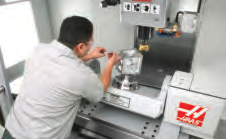
For shops that can’t create 5-axis programs in their CAM system, performing 3+2 machining on a trunnion like this one on a Haas VMC simplifies programming of even complex parts.
Okuma’s Endsley agreed a 5-axis programming system is unnecessary for five-sided work. “All the less-expensive programming systems basically have two post-processors for a machine. They have a 5-axis simultaneous post, which is very expensive, then they have a 3+2 post that is inexpensive. Many shops are coding the programs in, standing at the control. The message is that it’s not rocket science.”
Cope described processing of a simple part, comparing operations performed on a 3-axis machine to those carried out on a Hurco VM10U trunnion-style machine. On the 3-axis machine, the part was clamped in a vise and reoriented for each of a total of seven operations. Because two special fixtures were needed to hold the part at two different angles, time to set up two of the operations was 90 minutes for each. With the VM10U, the process was reduced to two operations. The first involved drilling holes used to mount the part to the trunnion table, and the rest of the machining was completed in the second part clamping. Setup and loading time fell from about 5½ hours with the 3-axis machine to about 1½ hours with the five-sided setup. The process also optimized tool changes, reducing cutting cycle time from 20 minutes to 13 minutes.
Courtesy of Okuma
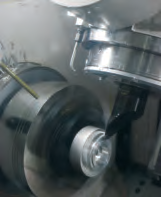
The multiple-axis machining concept can apply to lathes as well as milling machines. Okuma’s Multus series lathes are twin-spindle machines featuring an articulated 3-axis machining head adapted from an Okuma vertical mill.
In addition to providing time and labor savings compared to 3-axis machining, five-sided machining can offer advantages over 5-axis simultaneous techniques, according to Cope. One is speed. The maximum programmable feed rates of linear X, Y and Z axes are faster than those of rotary axes, while the speed of simultaneous 5-axis machining is limited by the speed of the slowest rotary axis.
Tool interference concerns can arise in a simultaneous 5-axis mode; the operator must ensure the tool extends far enough from the holder to reach features without interference and that the tool and holder don’t collide with other parts of the machine or the part itself. Five-sided machining simplifies the interaction of the tool, part and machine.
Of course, complex parts, such as aerospace engine blades and blisks, cannot be effectively manufactured without simultaneous 5-axis machining. And the continuous tool movement of simultaneous 5-axis machining can improve surface finish by eliminating the transition marks produced when a continuous contour is finished in two operations. Also, tilting a ballnose endmill to avoiding cutting on the center bottom radius of its nose permits more consistent control of chip load, extending tool life.
Trunnion vs. Swivel
Choosing table/trunnion or swivel-head setups depends on the application. For example, Cope said trunnion machines will usually offer better overall rigidity for heavy metal removal and are better at producing undercut features. In the case of the Hurco U-series trunnion machines, the part can be tilted 110° towards the front of the machine, providing 20° past vertical to perform an undercut operation. The swivel head on Hurco SR series machines, on the other hand, tilts ±92°, giving up some ability to perform an undercut, Cope said.
View print ads from this spread
Review the ads on this magazine spread to continue reading. Each ad takes two seconds; a two-page ad counts once.
Advertisers on this magazine spread
Print placements on this magazine spread
Gleason Corp.
new product focus
honing wheels. Opti-Form honing wheels from Gleason Corp. come with critical features, such as profile and lead crowning, already in them. Therefore, the wheel requires only a minimal amount of dressing and stock removal prior to honing parts. This reportedly reduces the time needed to perform initial tool dressing by up to 50 percent while extending the life of the honing wheel and.
new product focus honing wheels. Opti-Form honing wheels from Gleason Corp. come with critical features, such as profile and lead crowning, already in them. Therefore, the wheel requires only a minimal amount of dressing and stock removal prior to honing parts. This reportedly reduces the time needed to perform initial tool dressing by up to 50 percent while extending the life of the honing wheel and master gear used for dressing. ODs are from 270mm to 400mm and widths are up to 60mm. Gleason Corp. www.gleason.com
Visit Gleason Corp. View this placement in the issue recordPrint ads from this magazine
honing wheels. Opti-Form honing wheels from Gleason Corp. come with critical features, such as profile and lead crowning, already in them. Therefore, the wheel requires only a minimal amount of dressing and stock removal prior to honing parts. This reportedly reduces the time needed to perform initial tool dressing by up to 50 percent while extending the life of the honing wheel and.
new product focus honing wheels. Opti-Form honing wheels from Gleason Corp. come with critical features, such as profile and lead crowning, already in them. Therefore, the wheel requires only a minimal amount of dressing and stock removal prior to honing parts. This reportedly reduces the time needed to perform initial tool dressing by up to 50 percent while extending the life of the honing wheel and master gear used for dressing. ODs are from 270mm to 400mm and widths are up to 60mm. Gleason Corp. www.gleason.com
Continue reading
January 2011
However, tilting-head machines can be a better choice when machining heavy workpieces. A trunnion’s weight capacity is somewhat limited because the tilting mechanism must bear the entire weight of the part as well as machining forces. On a tilting-head machine, the part sits flat on a rotary table or the machine table itself, and its weight is transferred straight down to the shop floor.
Machine tool builders are seeing increased interest in five-sided machining techniques, and are responding with products aimed at those applications. “We are seeing the growth of 5-axis in the smaller job shop areas,” said Makino’s Howard. “A major reason is that the technology is more robust and also more affordable.”
Courtesy of Hurco
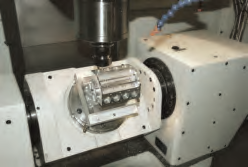
On a trunnion-table style 5-axis VMC like this Hurco VM10-U, the part is clamped one time and then rotated into a series of positions to machine each side and various features without refixturing.
For example, Howard cited Makino’s recent introduction of its F5 vertical machining center called the F5-5XR. The machine is fitted with a Tsudakoma tilting trunnion table, he said, and is “a high-performing yet economical platform offering full 5-sided machining and 5-axis capability.”
And machine tool builders are finding multiple ways to assemble multiple axes. Okuma’s Endsley said in addition to its workhorse MU-series trunnion machines, the company offers what it calls “vertical horizontal” Millac VH series. The machines essentially are horizontal machining centers equipped with an A-axis moving spindle with 150° of articulation.
Endsley noted that the “universal machining” multiaxis concept can apply to lathes as well as milling machines. Okuma’s Multus series are twin-spindle lathes with an articulated machining head, adapted from an Okuma vertical mill, mounted on the X-axis. “Basically, it has a 3-axis milling headstock that works with two lathe spindles,” he said. The machines can make a square part from a round bar clamped in the lathe chuck, eliminating special fixturing.
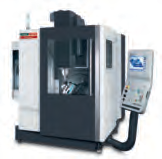
Dr. Greg Hyatt, vice president and chief technical officer, DMG/Mori Seiki U.S.A. Inc. agrees that there is “a lot of interest moving from 3- and 4-axis machines to 5-axis. It used to be the price point was prohibitive, and that made it hard for a shop to economically justify its first 5-axis machine.” Accordingly, DMG/Mori Seiki, Hoffman Estates, Ill., recently introduced the DMU 50 eco, a 3+2 version of its simultaneous 5-axis DMU 50 machine. “We realized there were many customers who didn’t need to be spending money on capital equipment they weren’t going to utilize,” Hyatt said. “The eco version gives them what they need without forcing them to buy capabilities they don’t need.”
Hyatt said machine tool builders are offering more 5-axis machine configurations (as well as machines with more axes, see sidebar on below). “A few years ago a machine tool builder might be satisfied with a single line of 5-axis machines. Now we feel that we need five lines or six lines, with one line optimizing speed, one optimizing milling torque, another envelope size, etc.”
The new machines present an opportunity for a wide range of shops to cut costs and boost productivity by employing technology that was only recently considered fit for only the upper reaches of the manufacturing industry. CTE
About the Author: Bill Kennedy, based in Latrobe, Pa., is contributing editor for CTE. He has an extensive background as a technical writer. Contact him at (724) 537-6182 or by e-mail at billk@jwr.com.
Contributors
DMG/Mori Seiki U.S.A. Inc.
(877) 275-6674
www.dmgmoriseikiusa.com
Haas Automation Inc.
(800) 331-6746
www.haascnc.com
Hurco Cos. Inc.
(317) 293-5309
www.hurco.com
Makino Inc.
(513) 573-7200
www.makino.com
Okuma America Corp.
(704) 588-7000
www.okuma.com
Triangle Precision Industries Inc.
(937) 299-6776
www.triangleprecision.com
Courtesy of Triangle Precision
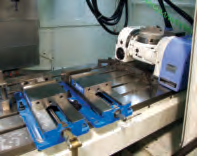
Triangle Precision Industries performs six-sided machining on a Hurco VMC by mounting a trunnion sideways in the Y-axis, freeing half the machine table for a pair of vises.
Minimize handling, maximize competitiveness
Triangle Precision Industries Inc. handles prototype and short-run parts production. CNC Coordinator Tim Friedmann said the prototype work can involve making just one piece, after which the Kettering, Ohio-based company works with the customer to meet production needs. Triangle’s equipment includes seven 5-axis machining centers, five of which are Hurco mills with trunnion tables for five-sided machining. Although the U-series machines can perform simultaneous 5-axis machining, Friedmann has yet to come across a part that he couldn’t simply position and 3-D contour with ballnose endmills.
He noted that the complexity of simultaneous 5-axis machining can scare people away from using the five-sided method but shouldn’t. “You just position and cut,” Friedmann said. “It makes every operation just one operation. Your handling time is none, your setup time obviously is eliminated. Your blends are all perfect because you control them all in the same operation, and your chance to scrap the part because you are taking it on and off the machine every time you change a side is eliminated.” Friedmann took parts requiring seven operations and made them in two.
Friedmann actually performs six-sided machining in the machines. “I have a trunnion that sits sideways in the Y-axis so that half my table is open. I’ll put a couple vises on the table to do a second operation on the parts as they come off the trunnion. I do five sides of the part, take it off, load it into the vise, then perform the second operation on the side that requires the least amount of work.”
To further boost throughput, Friedmann builds his own fixturing and mounts it on quick-change plates that are part of a System 3R referencing system. “We have 3R chucks with pull studs you mount to your fixture plate, and it holds like a toolholder holds up in a spindle,” he said. Changeover involves releasing the pull stud, removing the plate and replacing it with another.
Regarding five-sided machining, Friedmann said, “When we started doing this 5 years ago, it was like, ‘why isn’t everybody doing this?’ It makes everything so easy. If you aren’t doing this you are going to be left behind.”
—B. Kennedy
Courtesy of DMG/Mori Seiki
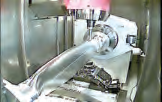
An example of pinch milling.
Courtesy of DMG/Mori Seiki
Machines like this DMU 50 eco, a 3+2 version of the simultaneous 5-axis DMU 50, enable end users to invest only in the capabilities they need, according to DMG/Mori Seiki.
Eight is not enough?
There are times when five axes … or six, seven or eight … are not enough. One example employs a concept similar to pinch turning, where two opposing cutting tools simultaneously machine a workpiece. On long shafts, for example, using twin tools produces balanced cutting forces and minimizes workpiece deflection. Pinch turning can quadruple metal-removal rates because running two tools simultaneously doubles removal volume. The balanced cutting forces also permit more aggressive cutting parameters, further boosting productivity.
According to DMG/Mori Seiki’s Greg Hyatt, engineers at the company thought pinch milling might be a way to machine thin-walled workpieces, such as fan stage blades. “We put the parts on our NT-series mill/turn machine between the two rotary axes, then mill them from above and below simultaneously. We have equal and opposite forces, so we can increase mrr while reducing deflection. This is one of the few opportunities where you are not compromising between quality and productivity.”
Hyatt said the tactic usually requires an 8-axis cut. Two spindles support either end of the workpiece; above the part is a spindle that operates in the X, Y, Z and B axes. Below the part is a turret that moves in X and Y. The workpiece is driven from both ends. “If we just drove it from one end with a center on the outboard end, there could be some torsional windup in the part,” he said. And the drive is not necessarily the same on both ends of the part. “For example, if we know that there is residual stress in the part and it tends to spring a certain way when we unclamp it, we can intentionally twist it into form when we are machining it so that when we release it, it will be where we want it to be,” he said. In addition to large fan stage aerospace blades up to a meter long, smaller blades and aircraft structure parts are also good candidates for the process.
“When those structural components have ribs that would interfere with a milling cutter, we sometimes put a specialized sort of work support on the lower side,” Hyatt said, comparing the supports to steady rests used in turning. “Instead of having equal and opposite forces between two cutting tools, we have a dynamic support, under numerical control, that follows the part as we tumble it and [the support] is moving dynamically all the time.”
Patents on the technique are pending, Hyatt said, and beta trials commenced within the last year.
—B. Kennedy
Glossary terms in this article
Related



Subscribers can use MFGAxis notes, saves and discussion tools with their innoNET account.


