

Small But Mighty: 5-Axis Machining
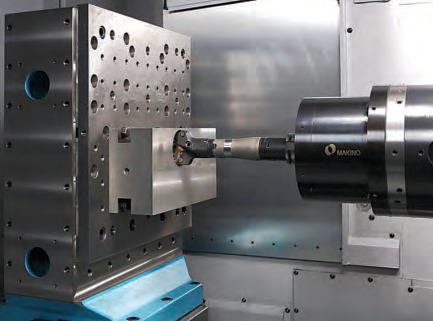
Courtesy of MakinoMore spindle power and torque enables Makino's latest 40-taper HMCs to tackle applications that previously would have required a 50-taper machine. Here, a machine equipped with an optional 300Nm spindle drives a 78mm drill for holemaking in class 35 gray iron.New technology opens up new applications for small HMCs.Horizontal machining centers with 400mm and 500mm pallets have taken the lion's share of the HMC market.
Courtesy of Makino
More spindle power and torque enables Makino’s latest 40-taper HMCs to tackle applications that previously would have required a 50-taper machine. Here, a machine equipped with an optional 300Nm spindle drives a 78mm drill for holemaking in class 35 gray iron.
New technology opens up new applications for small HMCs.
Horizontal machining centers with 400mm and 500mm pallets have taken the lion’s share of the HMC market. More than 64 percent of horizontal machines sold in the U.S. in 2009 had those pallet sizes, according to data from AMT—The Association for Manufacturing Technology.
“We knew machines with those pallet sizes make up the bulk of the HMC market in the U.S.,” said Dave Ward, HMC product manager for machine tool builder Makino Inc., Mason, Ohio. “Then we looked at the big challenges production-type shops are facing these days. They’re not competing with the shop across town or across the state. They’re competing globally, and the push from their OEM and Tier 1 and Tier 2 customers to really drive down per-piece costs is nonstop.”
With that recognition of competitive realities, Makino and other machine tool builders responded with a new crop of 400mm- and 500mm-pallet machines with 40-taper spindles that can tackle many applications that previously would have required a larger, heavier HMC with a 50-taper spindle. Making that possible are technologies ranging from optimized casting designs to more powerful spindles, roller bearing linear guideways and thermal management systems.
Adding to the machines’ productivity are pallet pools that enable lights-out or minimally attended operation. The smaller machines also have the benefits of lower capital, tooling and energy costs. “The reduction in tooling costs is about $40 per tool, and, by going to a 40-taper spindle from a 50-taper, you could be looking at 10 percent or more savings in capital costs per machine,” Ward said.
Energy cost savings could be even more substantial. DMG/Mori Seiki USA, Hoffman Estates, Ill., claims its NHX4000 and NHX5000 HMCs (400mm- and 500mm-pallet size, respectively) can achieve approximately a 40 percent reduction in total power consumption by reducing the number of motors in the machine compared to the conventional model, and by using an accumulator to enable hydraulic pumps to be turned off during machine standby.
More is More
Exemplifying the new breed of small HMCs are Makino’s a51nx and a61nx machines, which carry 400mm and 500mm pallets, respectively. Introduced at IMTS 2010, the HMCs have larger work envelopes than previous generations, improved casting designs and spindle and axis-guideway enhancements, the company reports.
Courtesy of Okuma America
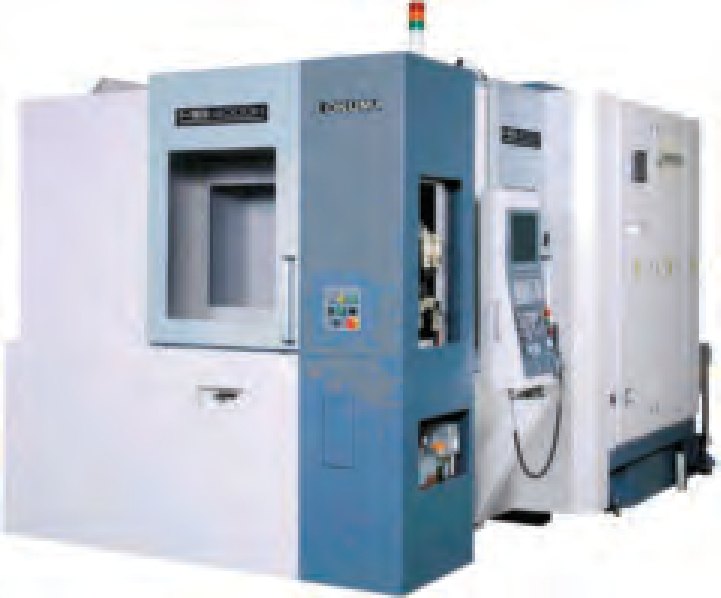
Okuma’s new MB-H machines come with a 40-taper, 15,000-rpm or 20,000-rpm spindle and real-time thermal management capability for high-speed machining.
“A larger machining envelope allows users to get larger parts into a smaller machine and save capital and floor space,” Ward said. “And there are other savings connected to using a smaller machine. For example, it’s going to be quicker than a larger machine in terms of axis accelerations, rapids and ATC times.”
The new machines have 12 to 14 percent more usable machining volume than previous Makino HMCs with the same pallet size, Ward noted. “But you can’t just increase the stroke and say that’s good enough,” he added. “You have to maintain rigidity.” In one case, an optional tall column on the a61nx expands the Y-axis from 650mm to 730mm, adding 80mm of Y-axis travel. “If I want to use that stroke at the top of the work envelope, I need to look at construction of the bed, the column, the table—anything that could contribute to increasing rigidity,” Ward said.
DMG/Mori Seiki has also changed its machine designs to better accommodate larger parts—and the tools to machine them. “Let’s say you want to machine an engine block on a 500mm-pallet machine,” said Greg Hyatt, the machine tool builder’s vice president of technology. “Four-cylinder and V-6 blocks fit on the pallets and in the machining envelope, but historically, smaller machines couldn’t be used because the line boring of cam and crank bores could not be performed. The parts fit, but the machines’ ATC capability didn’t support tools that were long enough. So you had to purchase an oversize machine to obtain a toolchanger to support the deep boring and gundrilling.”
DMG/Mori Seiki’s NHX4000 and NHX5000 HMCs handle maximum tool lengths larger than the pallet size—and have enough travel to use it, according to Hyatt. “Previously, many machines didn’t have enough Z-axis travel to back up and get a long tool in front of a large workpiece without interference,” he explained. “So, by combining increased Z-axis travel with a larger ATC, we can single-pass bore a workpiece that completely fills the pallet.”
Need for Speed
It’s not just machining envelopes and ATC capacities that are growing for HMCs with 40-taper spindles. Spindle speeds, torque and horsepower are all on the increase, as are axis acceleration/deceleration and rapid traverse. Driving the need for speed is the desire of many users to do high-speed machining.
“HSM techniques are much more readily accepted and used than they were even 5 years ago,” said Jim Endsley, machining centers product specialist at Okuma America Corp., Charlotte, N.C. “Right now we’re in a kind of unique time when cutting tool and machine capabilities are just about equal. That combination opens a lot of doors for high-speed machining materials that previously required a 50-taper spindle—Inconel and titanium aircraft materials, for example.”
Endsley said Okuma designed its new line of MB-H HMCs, which come with 40-taper, 15,000-rpm or 20,000-rpm spindles, for HSM. The spindles have a broader torque curve than spindles that run faster than 20,000 rpm, which require high-frequency drives, he added.
Ward said the 40-taper spindles on Makino’s new HMCs feature 19 percent more torque and horsepower than previous models. “One of them in particular offers an optional 300Nm spindle that is challenging the perception that you can’t do heavy-duty cast iron machining on a 40-taper machine,” he said.
According to Dave Lucius, vice president of sales, North America for Methods Machine Tools Inc., a Sudbury, Mass.-based distributor of machine tools, automation, tooling, fixtures and QC products, the Matsuura HMCs it offers have always used high-torque spindles. “Everyone’s looking at what’s coming in terms of work materials—titanium alloys, for example—and torque is a key for productive titanium machining,” Lucius said. “We’re all keeping our fingers crossed that the [Boeing 787] Dreamliner will finally take off. When that happens, titanium machining will take off with it.”
Lucius said Matsuura’s H.Plus-300 machines have a 300mm pallet but feature a machining envelope more like that of a 400mm-pallet machine. “Matsuura spindles have always used a roller bearing in the top of the spindle to allow a tighter preload, and the spindle’s direct-drive design keeps heat away from the bearing,” he added. “When we advertise 30 hp we can give you a 30-hp cut, because we’re not consuming horsepower in the integral spindle.”
Structural Improvements
Effective HSM means more than just having a fast spindle, and the builders interviewed for this article have made improvements to their machine structures and other components to handle the added stress of HSM.
For example, many builders have switched from recirculating-ball-bearing linear guide ways to roller-type guide ways on their small HMCs. “In linear guides with recirculating ball bearings, there is only one point of contact between the ball and the guide,” Makino’s Ward explained. “Using roller bearings, each roller gives you a line of contact with the guide. The result is better weight distribution, improved vibration characteristics, better longevity and overall increased rigidity.”
They are also optimizing casting designs to maximize rigidity while minimizing moving mass. “If you’re moving a lot of mass from point A to point B at very high speed, you can easily overshoot point B,” Endsley said. “Normally, you try to correct that with software, but that’s a patch, not a real solution. So there’s a delicate balance between minimizing moving mass yet keeping enough in there to maintain rigidity and deaden any harmonics.”
DMG/Mori Seiki is offering two versions of its NHX5000 500mm-pallet machine that use different castings depending on whether the user chooses a standard 40-taper or optional 50-taper spindle, according to Hyatt.
“In the past, when we offered various spindle options, they used the same machine structure,” Hyatt said. “Now, the machine that gets the 50-taper spindle has bigger, heavier castings to handle the higher torque without overpowering the machine structure and causing instability and chatter.
“On the other hand, the 40-taper version has lighter castings, so the customer doesn’t have to pay for rigidity he doesn’t need,” he continued. “And, the lower mass allows higher accelerations. So the machines may look very similar, but in fact not only the spindles but the columns and beds are different.”
Beating the Heat
In addition to stress, HSM’s fast axis movements generate another enemy of machine accuracy and reliability—heat. According to Endsley, Okuma has been studying thermal effects on machine tools in the lab for quite a while. “In Japan, we have more than 200 volumes of data on thermal effects,” he said. “Basically, we found you can alleviate thermal effects but you can’t eliminate them.”
Review the print ads from this magazine to continue
This quick advertiser review unlocks the rest of the article and keeps the full-screen reader focused on the ads instead of the page chrome.
Advertisers included in this article experience
Print placements connected to this article
Cgctool
To maximize the
reliability of the oil field components it machines, the Houma plant tightly controls processes and output is inspected at multiple points. Here, a pin connection thread is inspected with a tapered-thread pitch-diameter gage. Hunting Energy Systems PRECISELY ENGINEERED TO ROCK THE HOUSE IN: TITANIUM INCONEL STAINLESS ALUMINUM HARDENED STEELS.
To maximize the reliability of the oil field components it machines, the Houma plant tightly controls processes and output is inspected at multiple points. Here, a pin
Visit Cgctool View this placement in the issue recordMdmeast
Don’t Miss the Medical Device Industry’s
Trusted Project Acceleration Resource Exp o sitio n : J U N E 7–9 , 2 0 11 Co n ference : J U N E 6–9 , 2 0 11 J A C O B K. J A V ITS C O N V E NTI O N C E NTE R N E W Y O R K, NY Bring your unique design and manufacturing requirements to MD&M East, and leave with the resources needed for every stage of your product development lifecycle:.
Don’t Miss the Medical Device Industry’s Trusted Project Acceleration Resource Exp o sitio n : J U N E 7–9 , 2 0 11 Co n ference : J U N E 6–9 , 2 0 11 J A C O B K. J A V ITS C O N V E NTI O N C E NTE R N E W Y O R K, NY Bring your unique design and manufacturing requirements to MD&M East, and leave with the resources needed for every stage of your product development lifecycle: Face-to-face access to hundreds of the world’s best and most qualified suppliers Leading-edge technologies and resources for every stage of product development Products and services to improve productivity, reduce costs, and shorten time to market
Visit Mdmeast View this placement in the issue recordPrint ads from this magazine
reliability of the oil field components it machines, the Houma plant tightly controls processes and output is inspected at multiple points. Here, a pin connection thread is inspected with a tapered-thread pitch-diameter gage. Hunting Energy Systems PRECISELY ENGINEERED TO ROCK THE HOUSE IN: TITANIUM INCONEL STAINLESS ALUMINUM HARDENED STEELS.
To maximize the reliability of the oil field components it machines, the Houma plant tightly controls processes and output is inspected at multiple points. Here, a pin
Continue reading
March 2011
Endsley said Okuma’s MB-5000H 500mm-pallet HMC uses four temperature sensors in the spindle (two on each bearing) and eight sensors in the casting. Temperature data is fed to the machine’s PC-based OSP-THINC control, which uses software algorithms called thermal active stabilizers to provide real-time thermal compensation for the spindle and casting.
Thermal management doesn’t have to be complicated—it can be as simple as a slight modification in the way chips are handled, Endsley said. “No hot chips are ever in direct contact with the casting on our machines,” he said. “The chip flume is lined with a piece of sheet metal, and there’s an air barrier between that sheet and the casting to keep heat from the chips away from the casting.”
Turn Out the Lights
HMCs equipped with pallet pools are nothing new, but the machine tool builders interviewed for this article are adding new capabilities that can allow extended lights-out or minimally attended operation.
Courtesy of Methods Machine
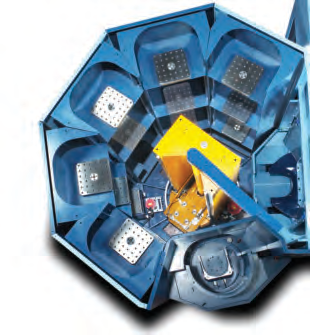
Matsuura’s H.Plus-300 HMC provides compact storage for up to 15 pallets with this hexagonal pallet changing/storage arrangement.
According to Methods’ Lucius, multi-pallet systems are one of Matsuura’s strong points. Users of the builder’s five-, 11- and 15-pallet systems can eliminate setup time, produce small lots and run with fewer personnel, often paying back the added investment of the pallet system quickly (see sidebar below).
Makino offers users either an eight-pallet system with a relatively simple control that works with a single machine, or a larger linear system that allows up to three layers of pallets to be used by multiple machines. Called the Makino Machining Complex, the latter includes “a high-level cell controller that determines which pallet should be delivered next based on tool and machine condition,” Ward said.
Courtesy of Makino
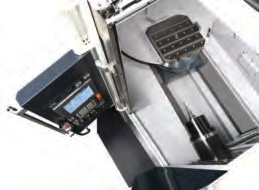
Machining envelopes of the new breed of HMCs tend to be cleanly designed with minimal areas where chips can collect—a must for unattended machining applications.
According to Hyatt, DMG/Mori Seiki has developed pallet pools that allow 4-axis and 5-axis machines to be combined in the same system. “If a shop has parts with just a few features that require full 5-axis capability, they don’t have to use the oversize, over-spec’d 5-axis machines to make the entire part,” he said. “In some cases, 80 or 90 percent of the work can be done on a smaller, less expensive machine, and only the work that demands 5-axis capability would be done on that machine.” He cited an aerospace valve that requires some drilling at odd angles as an example of a component suitable for such a system.
Endsley said he’s also seeing more interest in multipallet systems. Okuma offers both its own pallet pools and a “plug-and-play” interface to pallet systems from Fastems Factory Automation, West Chester, Ohio, that can be retrofitted in the field. “We used to have to do that kind of thing at the factory,” he said. “Now, the sheet metal is all prepped for installation. Users locate the Fastems system, connect some cables and the control automatically recognizes and interfaces with the pallet system.”
Thanks to multiple technology advances, the current generation of small HMCs gives users many of the capabilities of larger, heavier machines. As a result, many shops can consider purchasing HMCs that cost less up-front and take up less floor space. CTE
About the Author: Jim Destefani, a senior editor of CTE and MICROmanufacturing magazines, has written extensively about various manufacturing technologies. Contact him at (734) 528-9717 or by e-mail at jimd@jwr.com.
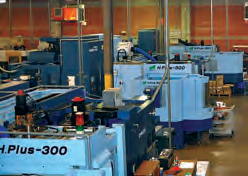
Courtesy of Ross Machine
Among the 31 machines on Ross’ shop floor are several Matsuura H.Plus-300 HMCs with multipallet systems that enable lights-out operation.
Ross Machine makes a lights-out commitment
HMCs with pallet systems can eliminate setup time and allow untended operation, often resulting in a quick payback on the investment, according to Dave Lucius of Methods Machine Tools Inc.
One company that has taken that philosophy to heart is Ross Machine Co. Inc., Belcamp, Md. In addition to operating other equipment, including vertical machining centers and 5-axis machining centers, the shop has 10 Matsuura H.Plus-300 HMCs with multi-pallet systems. Eight of the systems use 11 pallets each, while two are five-pallet setups. Ross Machine purchased the machines from Methods Machine Tools.
“On the horizontals, we do everything, from low quantities to high volumes using lights-out manufacturing,” said Tom Ross Sr., company president. “We run a single 9-hour shift with operators, but a lot of those machines run pretty much 24/7.”
Ross Machine’s bread and butter is defense and medical applications. “We do a lot of military work—communications parts, radio components and things like that,” Ross said. Work materials include aluminum, stainless steel and plastics such as Delrin, Teflon and carbon-impregnated materials for static-dissipation applications.
Founded in 1986 with a single Matsuura VMC, Ross purchased its first horizontals 10 years later. At one time, the shop operated 39 machines, but it has been replacing smaller, two-pallet machines with larger, more capable multipallet systems. “When you get rid of two machines and put in one, you need fewer people, have less maintenance and have more capacity,” Ross said.
Ross Machine occupies a 26,500-sq.-ft. building and has 26 full-time employees, only nine or 10 of whom are involved in machine operations. “With multipallet machines, you take off completed parts when you come in the morning, then you dedicate all your time to loading up everything and getting it going,” Ross said. “One guy handles at least three machines. We run lean and lights-out. We even have some jobs that run through the weekend, so people will be scheduled to come in on Saturday or Sunday and load up a few parts to keep the machines going.”
The company makes extensive use of vacuum workholding and, depending on job volume, may load all 11 pallets of a system with the same part. “We’ve made about 150,000 sets of parts for military radios over the past 5 years,” Ross said. “Each set consists of half a dozen different components that go into the same assembly. For amplifier components, we might get an order for 2,200 sets, and each set consists of a dozen parts.”
All the Matsuura multipallet systems use laser tool monitoring and allow machining of the next job if a broken tool is detected. “We try not to use the same tools on different parts,” Ross said.
—J. Destefani
Contributors
DMG/Mori Seiki USA
(847) 593-5400
www.dmgmoriseiki.com
Makino Inc.
(513) 573-7200
www.makino.com
Methods Machine Tools Inc.
(978) 443-5388
www.methodsmachine.com
Okuma America Corp.
(704) 588-7000
www.okuma.com
Ross Machine Co. Inc.
(410) 575-6100
www.rossmachine.com
Glossary terms in this article
Related




Subscribers can use MFGAxis notes, saves and discussion tools with their innoNET account.


