



Power Surge: Inspection Efficiency
Manufacturing parts for the nuclear energy industry, which is growing globally, is expected to expand in the U.S. as well. Three shops explain their strategies to capitalize on the growing market.
Manufacturing parts for the nuclear energy industry, which is growing globally, is expected to expand in the U.S. as well. Three shops explain their strategies.
Nuclear reactor video
Click here for a brief video overview of the Westinghouse AP1000 nuclear reactor, for which some shops are machining parts.
The recent recession cooled demand for electricity but a reviving economy will spark an increasing rate of consumption. The U.S. Department of Energy projects that U.S. electricity demand will rise 24 percent by 2035, about 1 percent each year. That means the U.S. will need hundreds of new power plants, according to the Nuclear Energy Institute. Maintaining nuclear energy’s current 20 percent share of generation from 104 operating reactors would require building at least one reactor every year starting in 2016, or 20 to 25 new units, based on DOE forecasts.
Although only one new nuclear reactor—the Watts Bar Unit 2 in Tennessee—is under construction in the U.S., the NEI reports 65 more are under construction around the world, including 27 in China. In addition, the U.S. Nuclear Regulatory Commission is reviewing 13 combined license applications from 12 companies and consortia for 22 nuclear power plants, according to the NEI.
The Obama administration is also supporting nuclear power to meet pollution-reduction and energy-security goals, with more than $8 billion in federal loan guarantees for Southern Nuclear Operating Co. Inc. to build two Westinghouse latest-generation AP1000 pressurized-water nuclear reactors at its Vogtle plant in Burke County, Ga.
Machining Required
Whether they’re for new nuclear power plants in the U.S. or abroad or for maintaining existing ones, machined metal parts are needed. L&S Machine Co. LLC, Latrobe, Pa., is one job shop that generates about three-quarters of its business machining parts for the expanding nuclear energy industry, noted Bill Kemerer, general manager for L&S. “It did spike my business pretty good,” he said.
Kemerer added that the nuclear parts L&S produces are made of either 300 series stainless steel or 700 series Inconel. Quantities vary from prototype and other low-volume runs to up to 50,000 a year for one part.
Courtesy of Bill Kennedy
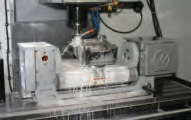
L&S Machine mounted a box-like stainless steel part on a Haas TR-160 trunnion and machined four sides of it, performed internal work, then turned it on an angle and rotated each corner to a different angle to perform another operation. One setup replaced four in performing four operations, and machining the part in one fixturing enables the shop to hold 0.002 ” to 0.003 ” true position between fixtures.
L&S produces the parts on 3-, 4- and 5-axis Haas machines, which are dedicated pieces of equipment for nuclear applications because the nickel-base alloy parts cannot be contaminated by contacting materials from other workpieces, such as cast iron, aluminum and copper. “If the customer ran any tests and found any smears on any of that product, then my whole process would be in jeopardy based on not having control of my process,” Kemerer said.
The same holds for metalworking fluids and other equipment L&S uses to process nuclear parts, such as glass bead blasting equipment. “I can’t run anything with any kind of chlorides unless I totally dump and purge all the coolant systems,” he said. “Everything I use for nuclear is dedicated.”
When a prototype job turns into a production run, Kemerer noted that he may opt to make changes to a process, such as changing fixturing, to satisfy new tolerances or other customer require- ments. That might also involve switching cutting tools. “I have tool vendors in here daily, saying they’ve got the latest and greatest mousetrap,” he said. “My reply is bring it in and show me. If you can beat what I’m doing productivitywise, then you’ve got to compete pricewise.”
Sizing Up
The nuclear energy parts L&S machines measure about 8½ “×8½ “×5 ” and smaller. In contrast, many nuclear parts are large. That’s the case at Lindquist Machine Corp., a Green Bay, Wis., custom machine builder servicing various markets by producing parts and the framework and major components of machines.
The company looked to secure work in alternative energy when the U.S. economy slowed at the end of 2008, according to Mark Kaiser, Lindquist’s president and COO. “We started doing some wind energy work, and we got into nuclear energy because it is not solely driven by U.S. economic conditions,” he said.
Lindquist received its first nuclear part order in January 2009 and shipped it last summer. “Now we’re heavy into the nuclear work,” Kaiser said, noting that the company supplies large, prime engineering contractors.
Courtesy of B. Kennedy
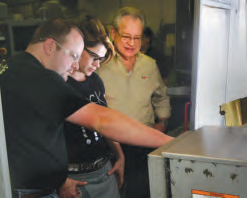
From right: Bill Kemerer, general manager for L&S Machine, Brenda DeBernardo, operator, and Josh Campbell, shop manager, check the setup of a part on a trunnion in a Haas vertical machining center.
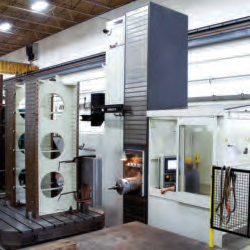
Initially, Lindquist was machining nuclear parts on an older horizontal boring machine, but the company knew it needed an upgraded machine to continue penetrating that market, according to Ernie Remondini, vice president of lean manufacturing. The work called for a faster, more accurate machine, with a minimum X-axis travel of 30 ‘ and Y-axis travel of 10 ‘. “We narrowed the field to three candidates and selected the MAG FT 3500 horizontal boring mill because it exceeded all the criteria,” Remondini said. “It was the only machine of the three made here in the U.S., and we liked the proximity of the MAG plant in Fond du Lac (Wisconsin).”
Lindquist ordered its FT 3500 with 10.2 ‘ of Y-axis travel, 49.1 ‘ of Z-axis travel, a 60-tool magazine and a live, 155mm spindle with contouring head. According to MAG, the machine’s special-geared AC digital drives maintain the high torque and stiffness needed to cut the 400 series stainless steel nuclear parts at Lindquist, and its 787-ipm rapid-traverse rate and rotary table reduced cycle times. In addition, the machine’s traveling-column design allows virtually unlimited X-axis travel for processing large and long workpieces or multiple batch parts, noted Helene Nimmer, global product leader for MAG.
Lindquist uses the horizontal boring mill to produce specialized fabricated bases, frames, weldments and castings more than 30 ‘ long × 14 ‘ tall and weighing more than 15 tons in quantities of one or two. Tolerances are ±0.0008 ” over 100 “. “They’re all very different,” Kaiser said. “It’s a very low-volume business.”
With short runs comes the need for adaptability. “They purchased floor plates to put in front of that machine, so it allows a bit of flexibility with regard to holding the workpiece and doing their machining applications,” Nimmer said.
Critical Components
East Tech Co. is another manufacturer machining parts for the nuclear energy industry. The Chattanooga, Tenn., design and manufacturing company produces nonsafety- and safety-related parts, such as shafts and impellers, to support a new power plant, noted Roger Layne, company president and CEO. East Tech typically machines the parts in runs of one to 10 on its six Mazak CAT 40 vertical machining centers.
View print ads from this spread
Review the ads on this magazine spread to continue reading. Each ad takes two seconds; a two-page ad counts once.
Advertisers on this magazine spread
Print placements on this magazine spread
800.521.9520 | mscmetalworking.com
Available exclusively at MSC Industrial Supply Co.®
IS #41.
Available exclusively at MSC Industrial Supply Co.® IS #41 800.521.9520 | mscmetalworking.com
Visit 800.521.9520 | mscmetalworking.com View this placement in the issue recordPrint ads from this magazine
IS #41.
Available exclusively at MSC Industrial Supply Co.® IS #41 800.521.9520 | mscmetalworking.com
Continue reading
March 2011
The parts are made of various workpiece materials, including 304 stainless, 4140 alloy steel prehardened to 28 to 32 HRC, A-2 tool steel and abrasion-resistant steel plate prehardened to 54 HRC. For holemaking and threading the latter workpiece, East Tech applies a special carbide drill and carbide tap with a custom coating, which it purchased from MSC Industrial Supply. “A standard carbide tap will not tap it,” Layne said. “We spent 4 weeks developing the process.”
Courtesy of MAG
Lindquist Machine uses the MAG FT 3500 horizontal boring mill with a traveling column to machine large, specialized parts for the nuclear energy industry.
Part size ranges from about ¼ ” to 2 ‘ in diameter. “We don’t have an overhead crane,” Layne said, “so we can only handle small to midsize parts up to 6,000 lbs.”
Layne noted that he had experience producing nuclear parts at a company he worked for and previous clients wanted him to perform that work at East Tech. The initial task involved hiring a quality consultant to write a certification program so the company could target nuclear parts. The next task was establishing the process to avoid stiff financial penalties. “If you don’t follow the procedures and something fails in a nuclear power plant, traceability is going to come back to who made it,” he said. “Everything is serially numbered and each part has a special tag with it so it can’t be mixed up with anything else.”
Maintaining Standards
Part manufacturers are required to have a certified program to machine parts for commercial nuclear power plants, but different approaches exist to being approved as a supplier. According to Daryl Montie, senior consultant for Arsenal Consulting Inc., Atlanta, which provides quality assurance solutions for the nuclear power industry, there are two ways. One is a commercial-grade survey, used when the purchaser wants to verify one or more critical characteristics based on the merits of a vendor’s commercial quality controls, according to the NRC’s Inspection Manual. Surveys should be conducted at a sufficient frequency to ensure that the process controls applicable to the critical characteristics of the procured item continue to be effectively implemented, according to the manual.
Courtesy of East Tech
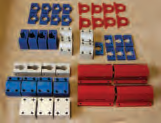
Top: East Tech machines parts for the nuclear energy market on its Mazak Nexus 510C-2 vertical machining centers. Above: A selection of anodized parts for a nuclear power plant.
“However, if you want an edge on the competition, you will become compliant with the nuclear standards,” Montie said. “The one that is generally passed down to fabricators and machine shops is ASME NQA-1.”
The ASME (American Society of Mechanical Engineers) NQA-1 quality assurance program covers safety-critical components, but not only the ones in a nuclear plant’s containment boundary, Montie noted. It also includes control systems, fire alarm systems, equipment pedestals, structural parts of the building, communication systems, pipe hangers and more—”anything that may prevent a safety problem.”
Because East Tech machines safety-related parts, the company has NQA-1 certification, as well as other certifications. Others interviewed for this article do not. Lindquist Machine, however, went through the ASME nuclear accreditation process known as N-stamp. This indicates the shop is producing commercial nuclear-grade components in accordance with ASME boiler and pressure vessel nuclear codes and standards. In addition, Lindquist is ISO 9001:2008 certified. “At the bare minimum, you need an ISO quality system in place and then you would need to be able to understand what the requirements are for the documentation and the record packages, because it’s significant,” Kaiser said.
Compared to NQA-1, which specifically deals with the criticality of components within the scope of what they do and is related to QA and QC systems, ISO is more geared towards achieving customer satisfaction, Montie noted. However, there is no central recognized body that provides an NQA-1 certification, stated Arsenal Consulting. Instead, approval of a quality system is performed by self audit through an independent auditor, and the customer is then responsible for qualifying the supplier through various means, including an on-site audit.
Courtesy of MAG
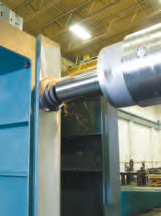
Lindquist Machine facemills a part on its MAG FT 3500 horizontal boring mill.
Montie added that obtaining NQA-1 status takes about 6 months. “That would be moving pretty good, with a reasonable allocation of resources, including management and shop floor personnel,” he said.
Following an NQA-1 program isn’t a requirement for L&S Machine, Kemerer noted, adding that its customer receives the requirements from the NRC or foreign regulatory agencies and then passes on those requirements to L&S. “My processes have been in place for 50 years,” he said. “A lot of mine have been grandfathered in because I developed the processes.”
Courtesy of B. Kennedy
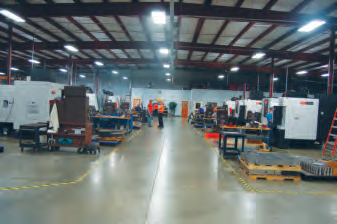
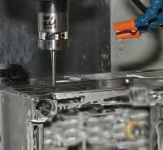
At L&S Machine, Haas VMCs are linked via a shop-wide wireless network that allows CAM files to be sent from the company’s mainframe to each machine to process parts. Then, when the parts are completed, SPC data gathered via Renishaw probes is sent to the mainframe via the same wireless network.
Nonetheless, Kemerer explained that the QA department plays a critical role in everything L&S does, including first-time, in-process, random in-process and finish inspections. “I have groups that do nothing but inspect finishes, look for burrs, the whole bit,” he said. He added that the company employs three people to handle higher-level documentation—documentation is required for every part—and 16 inspection-room and on-the-floor inspectors.
Machining parts for the nuclear energy market has some unique requirements, but it offers an opportunity for manufacturers with the right background looking to expand and diversify. “I’m sure many people in aerospace, medical and some in the ordinance areas of defense contracting have every capability in the world for doing nuclear components,” Kemerer said. “The big thing is to crack that nut.”
Courtesy of MAG
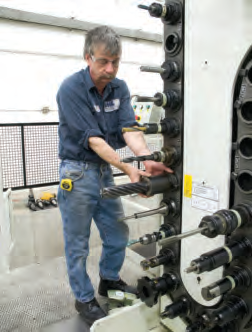
Lindquist Machine’s MAG FT 3500 horizontal boring mill has a 60-tool magazine.
Although poised for a revival, the U.S. nuclear energy industry faces numerous challenges, including competition from natural gas as development of vast shale gas reserves promise to lower fuel costs, the risk of cost overruns when constructing new nuclear power plants and grassroots NIMBY movements. But many observers feel nuclear power has its advantages and will experience a renaissance.
“Nuclear energy is cost-effective and it’s clean for the environment,” Kaiser said. “The biggest issue is the waste, but there is a lot of work being done to develop ways to deal with the waste safely and effectively. My sense is we’re going to see significant growth over the next 10 to 20 years in this market.” CTE
About the Author: Alan Richter is editor of CTE, having joined the publication in 2000. Contact him at (847) 714-0175 or alanr@jwr.com.
Contributors
Arsenal Consulting Inc.
(404) 247-9588
www.nqa-1.com
East Tech Co.
(423) 624-2550
www.easttechcompany.com
Lindquist Machine Corp.
(920) 713-4100
www.lmc-corp.com
L&S Machine Co. LLC
(724) 837-5500
www.lsmachineco.com
MAG
(920) 921-9400
www.mag-ias.com
Glossary terms in this article
Related




Subscribers can use MFGAxis notes, saves and discussion tools with their innoNET account.


