



Point and Shoot: 5-Axis Machining
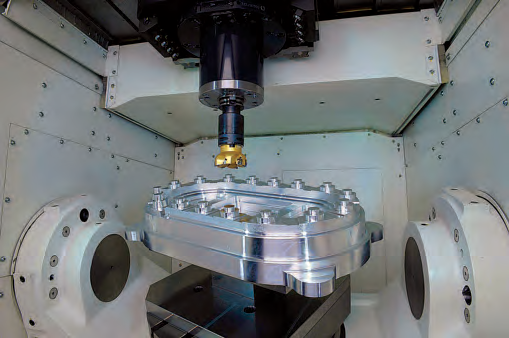
Five-axis machining on a vertical machining center doesn't have to be complicated.
Courtesy of Mazak
A 5-axis approach for vertical machining centers that doesn’t have to be complicated and can boost productivity.
Mention “5-axis machining” to many manufacturing engineers and shop managers and their eyes either glaze over or widen in apprehension. And, it’s true that simultaneous 5-axis capability is really needed only for a relatively small percentage of the most complex workpieces, according to Jim Endsley, machining centers product manager for Okuma America Inc., Charlotte, N.C.
“We never use the term 5-axis,” Endsley said. “Worldwide, less than 5 percent of the parts produced require simulta-neous 5-axis machining.”
But consider a vertical machining center equipped with a tilting rotary table. Such a machine can handle five-side machining of prismatic parts, a far more common application than 5-axis contouring. The addition of the A and B axes allows shops to finish a variety of workpieces in a single setup, reducing cycle times and avoiding possible scrap or rework due to stack-up errors. And the machines themselves can be easier to program and less capital-intensive than equipment capable of simultaneous 5-axis machining using spindle movement.
For these reasons, Okuma prefers to talk to potential customers about “universal machining,” Endsley said. “That focus on what we call ‘point-and-shoot’ 5-axis work tends to keep their attention. You position the C-axis, position the A-axis, and you drill a hole. Then you roll to the next position and do it again, or do some milling or whatever operation is required. That’s true universal machining.”
According to Endsley, 60 percent of parts machined worldwide also have a blind side—one that is not machined. “With a universal machine, that’s your locating point,” he said. “You can set that down on a table, roll the table around and attack five sides of that part. Again, that’s true universal machining—one setup and one complete part. “
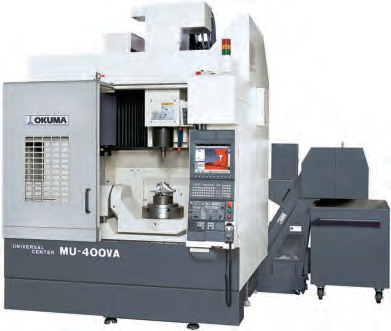
Okuma’s MU VMC series is a good example of the types of machines that can be fitted with a tilting rotary table. They are sold with 400mm and 500mm tables to avoid potential accuracy issues associated with heavy workpieces. “As you get larger, the part weight can affect accuracy when you articulate the table,” Endsley explained. Okuma specs its tilt/rotary table accuracies at the maximum weight and, for table sizes of 800mm and 1,000mm, builds its Millac VH machines with articulating heads, he added. This eliminates any potential accuracy problems due to part weight.
Point-and-Shoot Drivers
Why should a shop that operates 3-axis VMCs add a 4th or 5th axis to its next purchase? Chuck Birkle, vice president of sales and marketing for Mazak Corp., Florence, Ky., advised taking a global view of the market for machined parts.
“How can a shop in North America differentiate itself from shops in countries with lower labor rates? Machining parts complete in one setup helps create value to remain competitive,” Birkle said.
He also believes supply disruptions and long lead times for castings and forgings are leading more shops to consider machining parts from solid, a type of application that lends itself to the point-and-shoot approach. “Forged and cast near-net-shape components are hard enough for some companies to get,” he said. “If you have a part with geometry that used to be cast in, you may be considering increasing the cycle time a little bit and machining it from solid. The potential gains are huge. For that kind of application, you would want five-side capability, but you wouldn’t necessarily need contouring capability.”
Mazak offers several options for 5-axis VMCs. Its new vertical Integrex J machines, for example, are multitask machines that don’t provide full contouring capability, Birkle noted.
“We also want to provide shops with some way to automate their process,” he continued. “The vertical Integrex machines have two pallet changers that can integrate with our Palletech system and can provide substantial capability for unattended operation. So you have not only five-side milling, drilling, tapping and turning, but all those operations are consolidated with all the pallets and fixtures right in front of the machine. So what might otherwise take up a lot of floor space is brought down to one discrete manufacturing area.”
VMC vs. HMC
According to Endsley, some shops might be weighing the choice of a 5-axis VMC or HMC. In that case, the selection is driven more by part volume, according to Endsley. “Productivity-wise, these machines can hang with a HMC up to about 35,000 pieces per year,” he said. “After that, load/unload becomes an issue on the VMCs. And, if you’re running over 35,000 pieces annually, it probably makes sense to invest in the fixturing you’d need for HMCs.
Courtesy of Chiron America
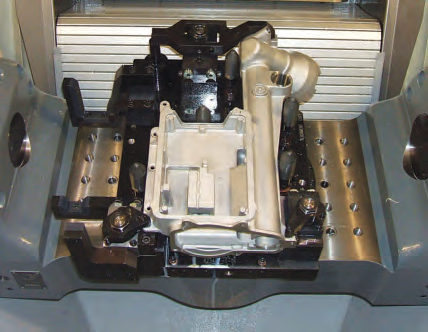
Switching from 3-axis and 4-axis to 5-axis Chiron machines enabled a Tier 1 automotive supplier to machine these power steering rack housings complete in a single clamping and hold position of the intersection point of primary bores on the part to ±40µm.
“But comparing apples to apples with a HMC at, for example, a 500mm pallet size, the first thing you need are two tombstones when you buy the HMC,” Endsley said. Those might cost $20,000 each, plus the expense for part-dedicated top tooling, including clamps and fixture plates.
“With universal VMCs, traditionally, you’ve got a stanchion that you made in the shop,” he continued. “It’s got a vise or other relatively inexpensive workholding device mounted on it, so I can spend maybe $2,000 on a universal fixture versus $40,000 for dedicated tooling on a HMC.”
4+1≠5
Doosan Infracore America Corp., Pine Brook, N.J., offers both standard C-frame machines equipped with tilting rotary tables and larger VMCs with fully integrated tilting rotary tables and 5-axis contouring capability. While there is a difference in capability between the point-and-shoot C-frame machines and the larger, full contouring VMCs, customers often choose based on the size of components they are machining, according to Ron Kilgore, machining centers product manager.
“Medical manufacturers, for example, generally produce relatively small but complex components,” Kilgore said. “They tend to go as small as they can and still make their parts, and they will choose a small C-frame machine with a tilt/rotary table because they want to save floor space. Aerospace customers, on the other hand, want a machine that has everything built in and that can handle large parts.”
An example of the latter type of machine is Doosan’s VC630/5AX, which combines a 630mm tilting rotary table with 5-axis contouring capability. Kilgore said Doosan is looking at extending the line in both directions with 800mm and 500mm rotary tables, but its C-frame machines with tilting rotary table and 4+1 CNC capability are probably a better bet for many shops. The phrase 4+1 refers to a 3-axis machine with a rotary table, with “4” being the X, Y and Z axes and the rotary table, and “1” being the tilt of the rotary table.
Courtesy of Okuma America
The MU400VA is typical of the “point and shoot” universal machines offered by Okuma. The MU series also includes a 500mm table machine.
Kilgore said VMCs with true 5-axis capability command a price premium of 20 percent or more over 4+1 machines. “It’s a different control, and it requires some specialized software features for simultaneous 5-axis, for example,” he said.
Shops that truly need simultaneous 5-axis capability also tend to want higher speed—and price tag—spindles, he added. “A lot of times they’re either cutting aluminum or taking skim-type cuts on tougher workpieces, such as turbine components, which requires a 15,000- or 20,000-rpm spindle.”
According to Kilgore, the learning curve involved in moving from 3-axis to 5-axis VMCs is fairly steep. “Shops that aren’t currently doing simultaneous 5-axis work, if they believe it’s easy, they’re misled,” he said. “Shops that have done it for years do it very well, but it’s a completely different way of thinking and usually a shop will even have to change its business model to some extent to truly embrace it.
“Point and shoot, on the other hand, is a jump [from 3-axis machining], but if a shop has operated HMCs at all it’s fairly easy to explain to them,” he continued. “The usual progression is a VMC, add a 4th axis to the VMC, move to a HMC, and then maybe later come back and add a 4+1 VMC.”
Norman Holtzhauer, engineering manager for Chiron America Inc., Charlotte, N.C., suggested that users new to point-and-shoot programming index the table to the required angle, then set a new work coordinate system that allows use of simple X-, Y- and Z-axis movements. “Controls allow you to have a number of different work offsets,” he explained. “You can set zero in whatever position you want. You’re not trying to track a zero point through 3-D space, so you can redefine it wherever you want to simplify programming.”
Point and Shoot Apps
Workpieces that lend themselves to point-and-shoot machining include any components that require, for example, multiple intersecting holes, drilling at odd angles or any operation on five sides. Hydraulic manifolds and similar components are often cited, and Doosan’s Kilgore recalled one shop that was making small, explosion-proof aluminum electrical enclosures using the 4+1 approach. “They used a 2-jaw chuck so the workpiece automatically centered when it was clamped,” he said. “They did five sides of the part, then moved it over to a vise on the side to finish the back end. Cycle time was less than 10 minutes.”
Courtesy of Doosan Infracore America
Doosan offers two approaches to multiaxis machining on a VMC: C-frame machines with 4+1 machining capability designed for point-and-shoot applications (shown here) and a 630mm table machine with full contouring capability.
The shop even standardized on three aluminum billet sizes, simply milling away any excess material if required. According to Kilgore, the arrangement allowed the shop to produce small lot sizes, even down to a couple of pieces, by nearly eliminating setup time.
Chiron’s Holtzhauer cited a Tier 1 automotive supplier machining two types of cast aluminum steering rack housings for electric and hydraulic power steering systems. The parts were initially produced across multiple setups on 3- and 4-axis machines supplied by Chiron, he recalled.
“Then the customer decided the shop had to hold the intersection point of the primary bores on the housing to within 40µm, with a 2.0 Cpk,” Holtzhauer said. “Basically, that means you can’t be off more than about 7µm to 10µm on each individual axis.”
Knowing that such absolute positioning accuracy was impossible to achieve using multiple setups, the shop initially tried to use a spindle probe to find the correct tool position for the second operation. The setup worked but added a substantial cycle time penalty.
Switching to 5-axis Chiron machines allowed machining of all four primary bores, plus finishing the other features, in one clamping, according to Holtzhauer. “The key was doing all the machining on one machine instead of three,” he said. “They were still doing all the same operations, so there weren’t big cycle time improvements and it still took three machines to get the same output. But the result was a much higher-quality part.” CTE
About the Author: Jim Destefani, a senior editor of CTE and MICROmanufacturing magazines, has written extensively about various manufacturing technologies. Contact him at (734) 528-9717 or by e-mail at jimd@jwr.com.

Courtesy of Haas Automation
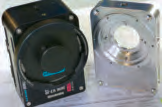
P+S Technik uses Haas 5-axis VMCs to machine bodies for its digital cameras.
Lights, camera, action!
The movie “Slumdog Millionaire,” which dominated the 2009 Academy Awards by winning eight Oscars, was the first movie shot mainly in digital format to receive the Academy Award for Best Cinematography.
The camera used to shoot “Slumdog” was the SI-2K Mini from P+S Technik GmbH, Munich, Germany. Founded in 1990, the company specializes in high-end digital cameras and equipment for the motion picture industry. In 2007, it developed the SI-2K Mini digital camera in cooperation with Silicon Imaging Inc., Niskayuna, N.Y. The SI-2K Mini is a complete digital movie recording system that combines flexibility with efficiency in production and processing. The camera has interchangeable hard drives and stores up to 4 hours of data. It also features a lightweight head housing a ⅔” CMOS (complementary metal oxide semiconductor) image sensor that can be separated from the camera body, so the camera’s “eye” can be hand-held or attached to a moving object.
The camera’s aluminum head is machined by P+S’s manufacturing division on a high-speed VF-3SS vertical machining center from Haas Automation Inc., Oxnard, Calif. Equipped with a Haas TR160 trunnion table, the machine enables milling of the parallel surfaces between the lens and the sensor location face to a tolerance of ±0.01mm, according to Richard Wagner, manufacturing division manager for P+S Technik. The head also requires production of a fine-pitch (M2×0.25) thread and other tight-tolerance features, and must look as good as it works, Wagner added.
P+S Technik now has five Haas VMCs—a 3-axis VF-1 and four 5-axis models. “We make 8,000 different parts for customers with average batch sizes of 50 to 100 pieces, although they can range from one prototype to 1,000 [production] pieces,” Wagner said. “Some of these can only be machined on a 4- or 5-axis machine, because you have to be able to simultaneously mill angles and radii so they merge into each other. It is also very economical to produce free-form surfaces on the VF-3SS using 3-D copy milling.”
The company continues to invest in machines and employees as it develops new technologies for more than 1,700 customers, including other optical specialists around Munich.
—Matt Bailey, Haas Automation Inc.
Contributors
Chiron America Inc.
(704) 587-9526
www.chironamerica.com
Doosan Infracore America Corp.
(973) 618-2500
www.doosan.com
Haas Automation Inc.
(805) 278-1800
www.haascnc.com
Mazak Corp.
(859) 342-1700
www.mazakusa.com
Okuma America Corp.
(704) 588-7000
www.okuma.com
P+S Technik GmbH
+49 (0) 89 45 09 82-30
www.pstechnik.de
Glossary terms in this article
Related



Subscribers can use MFGAxis notes, saves and discussion tools with their innoNET account.


