

Bagless recycling: General Industry Coverage
When operating a waterjet machine, the cutting water typically goes down the drain. However, water recycling systems can virtually eliminate this water loss, according to Benjie Massara, marketing director for WARDJet Inc. One problem is that traditional systems that filter workpiece particles and abrasive materials have a high operating cost because they consume large quantities of filter bags and include a deionization process, he added.
When operating a waterjet machine, the cutting water typically goes down the drain. However, water recycling systems can virtually eliminate this water loss, according to Benjie Massara, marketing director for WARDJet Inc. One problem is that traditional systems that filter workpiece particles and abrasive materials have a high operating cost because they consume large quantities of filter bags and include a deionization process, he added.
Therefore, machine builder WARDJet introduced the WRS-3000 modular system to recycle water without using filter bags and make deionization optional.
The recycling process begins by removing particles larger than 10µm through a multimedia filter. “The water runs through a number of different media without using something that’s consumable,” Massara said, noting that users recharge the multimedia filter every year or two by adding media material, such as anthracite.
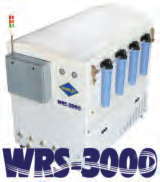
The WRS-3000 modular system from WARDJet recycles water from a waterjet cutting machine without using filter bags.
He added that the waste that’s removed contains no excess water, making waste disposal easy. “We have the system running on our floor and we’re reclaiming more than 85 percent of our water on average,” Massara said.
After the 10μm particles are removed, the water flows through a bank of four filters, removing particles from 5µm to 0.2µm in size.
Review the print ads from this magazine to continue
This quick advertiser review unlocks the rest of the article and keeps the full-screen reader focused on the ads instead of the page chrome.
Advertisers included in this article experience
Print placements connected to this article
Ctemag
We Do the Legwork
CUTTING TOOL ENGINEERING makes it easy to reach your customers! Our targeted, responsive and engaged September 2011 | Vol. 63 | Issue 9 m readership gives you unparalleled access to the metalworking industry. auto part s Facts about CTE subscribers: Magnesium weight, cut vehicle improve perf ormance 99% perform metalworking operations.
We Do the Legwork CUTTING TOOL ENGINEERING makes it easy to reach your customers! Our targeted, responsive and engaged September 2011 | Vol. 63 | Issue 9 www.ctemag.co m readership gives you unparalleled access to the metalworking industry. auto part
Visit Ctemag View this placement in the issue recordPrint ads from this magazine
CUTTING TOOL ENGINEERING makes it easy to reach your customers! Our targeted, responsive and engaged September 2011 | Vol. 63 | Issue 9 m readership gives you unparalleled access to the metalworking industry. auto part s Facts about CTE subscribers: Magnesium weight, cut vehicle improve perf ormance 99% perform metalworking operations.
We Do the Legwork CUTTING TOOL ENGINEERING makes it easy to reach your customers! Our targeted, responsive and engaged September 2011 | Vol. 63 | Issue 9 www.ctemag.co m readership gives you unparalleled access to the metalworking industry. auto part
Continue reading
October 2011
“You’re putting crystal clear water though that filtration process, so it extends filter life,” Massara added.
Next, the water travels though a dual-process chiller where the clean-water cooling circuit is separate from the water-and-glycol circuit to increase cooling efficiency. “The water-glycol mix just focuses on cooling the hydraulics,” Massara said, “so you’re going to have more cutting water on tap ready to be used [with a dual-process chiller] as opposed to a single-stage chiller.”
The water is then pumped to the cutting head.
According to Massara, end users tend to focus on removing total dissolved solids, which requires deionization, but removing total suspended solids is more critical. The WRS-3000 removes TSS to a level that doesn’t harm the waterjet machine’s pumps or high-pressure components. For those rare circumstances when a high TDS level is a problem, the company offers an optional deionization system.
The WRS-3000 is available for all new WARDJet machines and can be retrofitted to an existing waterjet machine from any builder.
For more information about WARDJet Inc., Tallmadge, Ohio, call (330) 677-9100 or visit www.wardjet.com.
Glossary terms in this article
Related




Subscribers can use MFGAxis notes, saves and discussion tools with their innoNET account.


