

A smooth transition into microparts
The Talking Shop column in the December 2011 issue of Cutting Tool Engineering offers an interview with the president of RS Precision Industries. Look for the print article here, as well as a link to more of the interview online.

Courtesy of All images: RS Precision
RS Precision Industries in Farmingdale, N.Y.
The following is an interview with Robert Savitzky, president of RS Precision Industries, Farmingdale, N.Y. The interview was conducted by Contributing Editor Bill Kennedy. During the last 6 decades, RS Precision has transformed from a traditional tool and die maker to a manufacturer of microscale parts. Abe Savitzky, Robert’s father, started the company in 1948 to make tool steel and carbide progressive stamping dies for the zipper industry. In 1960, Abe bought an EDM to facilitate die production, but soon realized its potential as a production machine. The company adopted CNC technology in 1985, employing an Enshu vertical machining center to cut parts prior to heat treatment. Technology changes in the electronics industry in the early 1990s resulted in a sudden 50 percent decline in demand for electronics assembly tooling. Fortuitously, the opportunity to make small parts developed at about the same time, enabling RS Precision to gradually complete its transition. After working as a manufacturing engineer for Hewlett Packard, Robert Savitzky joined the company in 1978 and became president when Abe retired in 1986.
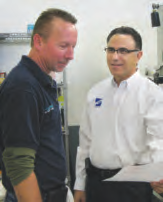
Robert Savitzky, right, discusses a part print with RS Precision ‘s EDM supervisor in front of the shop’s Mitsubishi EA8PV micro-holemaking sinker EDM.
Kennedy: How does your shop differ from a tool and die shop?
Savitzky: A typical tool and die shop is geared for one-at-a-time production and has a certain culture and a deliberate, careful pace. A die maker gets a blueprint of a stamped part and must design and build the tool to produce it. It is a considerable engineering and creative undertaking that requires exceptional visualization skills and craftsmanship. From an economic and a cultural point of view, a tool and die shop is not suited to production work. My father brought the tool and die processes from hand filing and machine fitting of punch and die cavities to form grinding and EDMing, thus transitioning the shop from one- or two-piece production to a mode more like a machine shop.
Kennedy: What aspects of the tool and die tradition aided the transition?
Savitzky: Most of all, meticulous attention to detail and a relentless pursuit of excellence. Many of our core competencies were a great fit for micromachining.
Kennedy: What challenges did you have to overcome in the transition?
Savitzky: When I first came to the company, methods for producing parts were in the hands of lead people, die makers. As a consequence, the methods were not consistent from batch to batch and repeatability was not predictable. My father’s efforts were essentially creative; he didn’t work out manufacturing details on paper. I initiated detailed operation sheets that contained the essential points for successfully making the parts. I performed engineering and documentation functions and supervised the shop to ensure jobs were done the way our method sheets required. I picked the brains of the smart people around me, highlighted the problems and asked for their advice on how to solve them. More importantly, I asked what concepts were behind their solutions. We developed innovative and effective solutions from this deep conceptual understanding of the problems.
Kennedy: How did your shop get into micromachining?
Review the print ads from this magazine to continue
This quick advertiser review unlocks the rest of the article and keeps the full-screen reader focused on the ads instead of the page chrome.
Advertisers included in this article experience
Print placements connected to this article
Schutteusa
Another class of errors is rotational. indicates the machine moved too little. to account for the error.
Because guide ways are not flat, as For a given machine position, the value Economic feasibility determines how each axis moves, the carriage may tip of each error function at that position can accurately a machine is built. To achieve forward or backward in the direction be mathematically combined to give the the required part accuracy, remaining.
Another class of errors is rotational. indicates the machine moved too little. to account for the error. Because guide ways are not flat, as For a given machine position, the value Economic feasibility determines how each axis moves, the carriage may tip of each error function at that position can accurately a machine is built. To achieve forward or backward in the direction be mathematically combined to give the the required part accuracy, remaining of travel (pitch), turn right or left from geometric error of the machine. The com- geometric errors are corrected through the direction of travel (yaw) or rotate manded machine position can be altered software. CTE clockwise or counterclockwise around the axis of travel (roll). The roll errors are denoted εx(X), εy(Y) and εz(Z), where ε indicates an angular error, the subscript
Visit Schutteusa View this placement in the issue recordPrint ads from this magazine
Because guide ways are not flat, as For a given machine position, the value Economic feasibility determines how each axis moves, the carriage may tip of each error function at that position can accurately a machine is built. To achieve forward or backward in the direction be mathematically combined to give the the required part accuracy, remaining.
Another class of errors is rotational. indicates the machine moved too little. to account for the error. Because guide ways are not flat, as For a given machine position, the value Economic feasibility determines how each axis moves, the carriage may tip of each error function at that position can accurately a machine is built. To achieve forward or backward in the direction be mathematically combined to give the the required part accuracy, remaining of travel (pitch), turn right or left from geometric error of the machine. The com- geometric errors are corrected through the direction of travel (yaw) or rotate manded machine position can be altered software. CTE clockwise or counterclockwise around the axis of travel (roll). The roll errors are denoted εx(X), εy(Y) and εz(Z), where ε indicates an angular error, the subscript
Continue reading
December 2011
Savitzky: We didn’t look for it, it just happened. We bid on a high-precision part about the size of a small jellybean. The part had 0.005 “- to 0.010 “-thick walls and tiny holes, including two off-center, 0.019 “-dia. holes that opposed each other through the part’s walls. The holes had to be in line within tenths. We learned how to make the part through trial and error. The first time we attempted making the holes using a drill jig. However, getting the holes in the right location relative to all the other features was difficult. Using a CNC machine with an indexing head, we were able to machine a number of features in perfect relationship to each other.
Kennedy: What were some of the biggest technical challenges you faced in moving to micromachining?
Savitzky: Early on, the primary challenge was how to hold fragile, thin-walled parts securely but gently enough so we didn’t damage or distort them. We had a great deal of experience building fixtures for small parts; when people sent parts for secondary EDMing operations, we had to learn how to hold them. We tended to use a lot of V-block-style fixtures because we could form grind them precisely and easily.
Kennedy: Your work is obviously fixture-intensive. How do you maintain productivity?
Savitzky: Modular tooling is an important piece of the puzzle. Our modular tooling from System 3R provides palletizing and setup reduction, and we are able to hold the workpieces in custom fixtures securely and with repeatability. We use modular tooling to move the fixture from a milling machine to an EDM with tight positional control. And with modular tooling, we can run smaller lots. For example, if a customer ordered 300 parts to be delivered over a period of 3 or 6 months, previously we would have had to run all 300 parts, and the lead time from start to finish was excessive. With modular tooling, we can cut our lots down to 100 or even 25 parts, because our setups are now plug-in simple.
Kennedy: What is your specialty?
Savitzky: EDMing and, to some extent, grinding are still key strengths in terms of having a happy customer and making a profit. In straight conventional machining, where the part has no EDMing, no grinding or no problem machining, we are not competitive. But that is going to change. We recently purchased a Mori Seiki NT-1000 multiaxis, mill/turn machine. It is not geared specifically to microparts, but to parts that are, to continue the food analogy, more the size of a large jelly bean to maybe a grapefruit. This equipment will give us competitive machining capability.
Kennedy: What’s an example of a part that can’t be created without EDMing?
Savitzky: A small part that has a deep rectangular pocket with a flat bottom and sharp corners to, let’s say, accommodate a miniature circuit board. We would rough mill the pocket and finish it with EDMing. In conventional machining, either the tool rotates or the workpiece rotates. This imposes design constraints. We say, “End the tyranny of rotation.” With our approach, we free the engineer from those constraints so he can design parts for superior performance and gain a competitive advantage.
Kennedy: Do you have a standard approach toward machining small parts?
Savitzky: No. Every job has to be analyzed. The part tells you how it needs to be produced, if you listen attentively enough. I’m serious. Methodizing and engineering the kind of jobs we do, to the level we do, is almost a Zen experience. And you have to think of the method as a chain. The machine tool is one of the links. Modular tooling is a link. Workholding fixtures are a link. Even the parts themselves are a link. Every link in the chain has to be strong or the process will fail.
Glossary terms in this article
Related




Subscribers can use MFGAxis notes, saves and discussion tools with their innoNET account.


