

Cutting noncut time: General Industry Coverage
The Look Ahead column for April 2012 sheds light on technology that reduces noncut time by optimizing B-axis rotation.
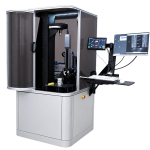
Most horizontal machining centers have a rotary B-axis in addition to the X, Y and Z axes. Traditionally, B-axis tables are indexing or NC rotary-type ones. On the a51nx and a61nx horizontal machining centers from Makino Inc., the B-axis rotation is accomplished by a direct-drive (DD) table, explained Dave Ward, horizontal product manager for the machine tool builder. “A key technology on our DD tables is Inertia Active Control (IAC), which can optimize the rotational acceleration to reduce noncut time,” he said, noting that the DD rotary table uses an integral motor and provides 0.0001° resolution—3.6 million positions.
Ward explained that because machine tool builders have no idea how much weight a customer is going to put on a pallet, they set the B-axis acceleration/deceleration default speed at the worst-case, maximum-weight, maximum-inertia scenario to ensure accuracy. That’s effective, for instance, when a tombstone-mounted pallet has workpieces at the outer edges, creating a high-inertia condition. In that case, the motor has to work hard to rotate the pallet. However, if that weight is concentrated near the center, IAC automatically increases the acceleration/deceleration speed accordingly because there is less inertia during rotation.
Courtesy of Makino
With a typical four-sided tombstone, Inertia Active Control can reduce noncut time during B-axis indexing 14 to 18 percent compared to the B-axis acceleration/deceleration default speed, according to Makino.
In addition to cemented carbide, suitable workpieces include hardened steel, glass and silicon carbide.
Review the print ads from this magazine to continue
This quick advertiser review unlocks the rest of the article and keeps the full-screen reader focused on the ads instead of the page chrome.
Advertisers included in this article experience
Print placements connected to this article
MDMEast.com
The Education, Innovative Solutions, and Strategic Business
Partnerships Needed to Bring Your Device to Market For nearly 30 years, MD&M East has been the industry’s trusted resource for every aspect of medical device development. This annual event puts you face-to-face with the industry’s best and brightest who have the expertise and engineering know-how you require to thrive in an environment that demands speed, quality, precision, and innovation
The Education, Innovative Solutions, and Strategic Business Partnerships Needed to Bring Your Device to Market For nearly 30 years, MD&M East has been the industry’s trusted resource for every aspect of medical device development. This annual event puts you face-to-face with the industry’s best and brightest who have the expertise and engineering know-how you require to thrive in an environment that demands speed, quality, precision, and innovation. Exposition: May 22–24, 2012 | Conference: May 21–24, 2012 Pennsylvania Convention Center | Philadelphia, PA Complete event details and registration at: MDMEast.com
Visit MDMEast.com View this placement in the issue recordCutting Tool Engineering
CUTTING TOOL ENGINEERING reaches more
machine shop managers than any other magazine in the metal, metalworking and machinery market.* 15,551 machine shop managers subscribe to CTE March Vol. 64 www.c Issue temag.c om –December 2011 BPA Circulation Statement up pa rts pr oduc tion June Editorial Focuses: Making Medical Parts; Drilling; Quality Control; heats.
CUTTING TOOL ENGINEERING reaches more machine shop managers than any other magazine in the metal, metalworking and machinery market.* 15,551 machine shop managers subscribe to CTE March Vol. 64 www.c Issue temag.c om
Visit Cutting Tool Engineering View this placement in the issue recordPrint ads from this magazine
Partnerships Needed to Bring Your Device to Market For nearly 30 years, MD&M East has been the industry’s trusted resource for every aspect of medical device development. This annual event puts you face-to-face with the industry’s best and brightest who have the expertise and engineering know-how you require to thrive in an environment that demands speed, quality, precision, and innovation
The Education, Innovative Solutions, and Strategic Business Partnerships Needed to Bring Your Device to Market For nearly 30 years, MD&M East has been the industry’s trusted resource for every aspect of medical device development. This annual event puts you face-to-face with the industry’s best and brightest who have the expertise and engineering know-how you require to thrive in an environment that demands speed, quality, precision, and innovation. Exposition: May 22–24, 2012 | Conference: May 21–24, 2012 Pennsylvania Convention Center | Philadelphia, PA Complete event details and registration at: MDMEast.com
Continue reading
April 2012
“More and more high-volume manufacturers are getting squeezed on their piece-part pricing,” Ward said. “IAC is a tool we can provide to our customers that allows them to get potentially thousands of additional parts produced on each horizontal machining center per year.”
With a typical four-sided tombstone, IAC can reduce noncut time during B-axis indexing 14 to 18 percent compared to the default value, according to Ward. “The more B-axis rotations the customer’s parts have, the more they’re going to benefit from this,” he said.
The technology’s foundation lies in the DD table’s ability to provide inertia feedback from the B-axis motor to the machine’s control. During the teach mode, the IAC rotates the pallet back and forth plus or minus 45°, senses the energy consumed to do that rotation and extrapolates from that how much inertia is on the pallet, Ward explained.
The 400mm-pallet and 500mm-pallet represent the largest segments of the horizontal market, according to Ward. “The a51nx and a61nx provide this key market with IAC capability, and we’re evaluating what’s the next model that would benefit from this technology.”
For more information about Makino Inc., Mason, Ohio, call (800) 552-3288 or visit www.makino.com.
Glossary terms in this article
Related

 MFGAxis Discussion
Be part of the shop-floor conversation
Like, save, or comment on this CTE story.
MFGAxis Discussion
Be part of the shop-floor conversation
Like, save, or comment on this CTE story.


MFGAxis Discussion