



Lean drives modularity: People & Companies
Cutting Tool Engineering's Shop Technology column in October addresses how lean manufacturing principles have changed the way engineers program machine tools and select tooling.
Lean manufacturing principles have changed the way engineers program machine tools and select tooling. Batch processing of parts, piles of work in process and dedicated fixtures are quickly becoming extinct as companies realize the cost advantages of being lean.
In the not-so-distant past, for example, it was common to build dedicated fixtures for machining a part. Often, a part required multiple fixtures to hold it in various orientations. Having multiple dedicated fixtures for a part increases the development cost and lead time, and dedicated fixtures often go unused or get scrapped when a job becomes obsolete.
Companies that eliminate the waste associated with dedicated fixtures have a competitive advantage in the marketplace. Many companies that embrace lean principles have eliminated dedicated fixtures and switched to modular ones.
Modular fixtures are constructed from a standard set of components that are interchangeable. Often these products are provided in kits of various sizes, which can be expanded by adding components as needed. The components are combined to make a fixture for one part and then disassembled and reassembled in different configurations for other parts.

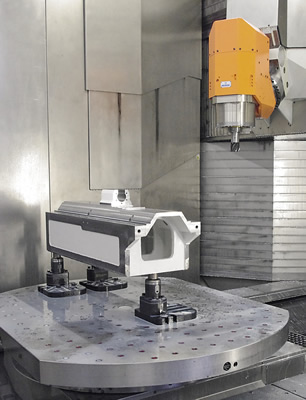
Unilock 5-axis riser chucks from BIG Kaiser Precision Tooling Inc. come in many different lengths and are available on base plates and as stacking modules to elevate a workpiece off the table for clearance or reach issues during multiple-axis machining. Image courtesy BIG Kaiser Precision Tooling.
There are several benefits associated with modular fixturing, such as reducing the lead time to develop a new part. At the company where I work, Mitsubishi, the delivery of a new assembly fixture can take 12 to 14 weeks after the vendor receives the order. CAD programming and sourcing activities prior to placing the order can add another 12 to 14 weeks, which means it takes 6 to 7 months to complete a dedicated fixture and get it to the machine. Modular fixturing can reduce these times to days, generating huge cost savings. A short lead time for fixturing can also be a game changer when trying to win new work.
Even well-designed dedicated fixtures can require rework and adjustment during process development, whereas adjustments to modular fixtures are quick and often achieved by simply replacing components.
View print ads from this spread
Review the ads on this magazine spread to continue reading. Each ad takes two seconds; a two-page ad counts once.
Advertisers on this magazine spread
Print placements on this magazine spread
Haas Automation Inc. | 800-331-6746 | www.HaasCNC.com
RELIABILITY. PRICE. REPUTATION.
Haas ST-20 CNC Turning Center = TOTAL CUSTOMER VALUE. WE KNOW what it’s like. That’s why we’re driven to make sure that every Haas We’re MACHINISTS, too. CNC machine is trustworthy, affordable, and always We CUT METAL every day. backed by the industry’s best after-sale service. Proud sponsor of the Stewart-Haas #41 car.
RELIABILITY. PRICE. REPUTATION. Haas ST-20 CNC Turning Center = TOTAL CUSTOMER VALUE. WE KNOW what it’s like. That’s why we’re driven to make sure that every Haas We’re MACHINISTS, too. CNC machine is trustworthy, affordable, and always We CUT METAL every day. backed by the industry’s best after-sale service. Haas Automation Inc. | 800-331-6746 | www.HaasCNC.com Proud sponsor of the Stewart-Haas #41 car
Visit Haas Automation Inc. | 800-331-6746 | www.HaasCNC.com View this placement in the issue recordPrint ads from this magazine
Haas ST-20 CNC Turning Center = TOTAL CUSTOMER VALUE. WE KNOW what it’s like. That’s why we’re driven to make sure that every Haas We’re MACHINISTS, too. CNC machine is trustworthy, affordable, and always We CUT METAL every day. backed by the industry’s best after-sale service. Proud sponsor of the Stewart-Haas #41 car.
RELIABILITY. PRICE. REPUTATION. Haas ST-20 CNC Turning Center = TOTAL CUSTOMER VALUE. WE KNOW what it’s like. That’s why we’re driven to make sure that every Haas We’re MACHINISTS, too. CNC machine is trustworthy, affordable, and always We CUT METAL every day. backed by the industry’s best after-sale service. Haas Automation Inc. | 800-331-6746 | www.HaasCNC.com Proud sponsor of the Stewart-Haas #41 car
Continue reading
October 2015
Experimenting with modular components allows a tool designer to prove out a new fixture concept before building a dedicated fixture, when justified. This process will lead to a more robust design, thereby reducing the risk of reworking a dedicated fixture and saving money because one-of-a-kind components used to build custom fixtures typically cost more than modular components. Modular components are standard items made in larger quantities, which yield the benefits associated with economies of scale. In addition, because they are stock items, it may not be necessary to keep an inventory of modular components, thereby reducing maintenance and inventory costs.
Having dedicated fixtures made from modular components also eliminates obsolescence, because the components can be disassembled and recycled to build other fixtures. Modular components also retain some resale value and can be liquidated through online auctions and used equipment dealers. Custom components rarely—if ever—have any market value, which means they hit the scrap bin when the job goes away.
Reduction in the amount of storage space needed to house fixtures is another benefit. Modular fixtures reduce the number of fixtures that must be stored and, in many cases, can be kept in a small tool box at the point of use. This frees shop space for value-added activities rather than storage.
Remember, it is not the modular components that bring value, it is the concepts and philosophies associated with modularity where the value is gained. Investing in those components may be difficult for some small shops. However, it is possible to adopt the concepts of modular fixtures by standardizing fixture designs, utilizing common hardware and avoiding part-specific fixture components where possible. Soft vise jaws and soft chuck jaws are examples of inexpensive modular components utilized by many shops.
Creativity and ingenuity play an important role in the use and development of modular concepts. One of the more creative ideas to achieve modularity used standard CAT 50 toolholders to fixture aerospace parts in a 5-axis horizontal machining center. A perfect off-the-shelf solution may not exist for a job, so think outside the box.
Modular fixtures can bring significant efficiency gains and cost reductions to any shop by eliminating the waste associated with the storage and management of dedicated fixtures. Getting started can be daunting, but a slow and deliberate move to incorporate modularity will pay dividends.
Glossary terms in this article
Related



Subscribers can use MFGAxis notes, saves and discussion tools with their innoNET account.


