

Multirib grinding wheels
A machinist who is cylindrical-grinding threads into hardened steel using multiple-rib, vitrified-bond, aluminum-oxide wheels is experiencing breakdown of the thread root, and turned to the Grinding Doc for help.
Dear Doc: I cylindrical-grind threads into hardened steel using multiple-rib, vitrified-bond, aluminum-oxide wheels and am getting breakdown of the thread root. I increased the number of passes from four to six to even eight, but it doesn’t seem to help. Why?
The Doc Replies: Think of multiple-rib grinding wheels as a series of, say, five different wheels, each with a slightly larger diameter than the previous wheel. Let’s say you’re taking a 1mm DOC. Depending on the geometry, the fifth rib grinds a 0.025mm DOC, the fourth rib a 0.050mm DOC, the third rib a 0.100mm DOC, the second rib a 0.200mm DOC and the first rib grinds the remainder, or 0.625mm (1.000mm – 0.025mm – 0.050mm – 0.100mm – 0.200mm = 0.625mm). That fifth, final rib is going to take 0.025mm regardless of the total DOC, because that’s the material remaining after the fourth rib grinds its 0.050mm DOC. If the total DOC is 0.025mm, only the fifth, final rib will remove material.
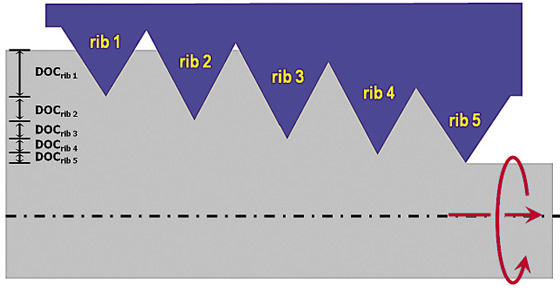
In this example for a 1mm DOC, the fifth and final rib grinds a 0.025mm DOC, the fourth rib a 0.050mm DOC, the third rib a 0.100mm DOC, the second rib a 0.200mm DOC and the first rib grinds a 0.625mm DOC. Image courtesy J. Badger.
Let’s say you decide to divide that one 1mm pass into five 0.200mm passes. That fifth rib is still going to take 0.025mm each pass. Sure, the first rib gets a complete break, but the fifth rib takes a beating, because it’s now doing five 0.025mm passes instead of one. When taking multiple passes, if the DOC on a pass is less than 0.375mm for this example (ribs 1 + 2 + 3 + 4 = 0.025mm + 0.050mm + 0.100mm + 0.200mm = 0.375mm), then the first rib is not removing any material per pass and the second rib is only removing 0.025mm. Because the fifth rib is the one generating the final form, you’re going to lose form more quickly when taking multiple passes.
Review the print ads from this magazine to continue
This quick advertiser review unlocks the rest of the article and keeps the full-screen reader focused on the ads instead of the page chrome.
Advertisers included in this article experience
Print placements connected to this article
Tungaloyamerica
MillLine Tungaloy America, Inc.
Valid from July 1st - December 31st, 2015 An economical slot milling solution with stable chip formation allowing deeper slots thus increasing productivity and stability in machining! Incredibly secure system for slot milling with excellent chip control! Promo Code: GUS22 TUNGSLOT/ GUS23 TECSLOT 1 BUY 30 inserts GET 50% off any cutter.
MillLine Tungaloy America, Inc. Valid from July 1st - December 31st, 2015 An economical slot milling solution with stable chip formation allowing deeper slots thus increasing productivity and stability in machining! Incredibly secure system for slot milling with excellent chip control! Promo Code: GUS22 TUNGSLOT/ GUS23 TECSLOT 1 BUY 30 inserts GET 50% off any cutter 2 BUY 50 inserts
Visit Tungaloyamerica View this placement in the issue recordPrint ads from this magazine
Valid from July 1st - December 31st, 2015 An economical slot milling solution with stable chip formation allowing deeper slots thus increasing productivity and stability in machining! Incredibly secure system for slot milling with excellent chip control! Promo Code: GUS22 TUNGSLOT/ GUS23 TECSLOT 1 BUY 30 inserts GET 50% off any cutter.
MillLine Tungaloy America, Inc. Valid from July 1st - December 31st, 2015 An economical slot milling solution with stable chip formation allowing deeper slots thus increasing productivity and stability in machining! Incredibly secure system for slot milling with excellent chip control! Promo Code: GUS22 TUNGSLOT/ GUS23 TECSLOT 1 BUY 30 inserts GET 50% off any cutter 2 BUY 50 inserts
Continue reading
August 2015
There’s a rough calculation for estimating the relative beating that final rib is taking: final rib beating = number of passes × workpiece rpm ÷ wheel speed. To give the final rib a break (and to better hold form), decrease the number of passes, making the first rib do more of the work, and slow the workpiece rpm or increase the wheel speed. Of course, you don’t want the first rib to break down too much either, because then subsequent ribs will start to break down as well. Also, these will all typically increase heat generation and the risk of burn. But if your biggest issue is holding form, this will help.
If you want to get clever, develop a spreadsheet using the DOC for each rib, workpiece rpm and wheel speed, and calculate a relative “aggressiveness number” for each rib in each pass. You can then try to distribute the load and the material-removal rates more evenly. CTE
Dr. Jeffrey Badger is an independent grinding consultant. The Doc will be giving his High Intensity Grinding Course in New York on Nov. 4-6, hosted by Lieber & Solow. Website: www.TheGrindingDoc.com.
Related



Subscribers can use MFGAxis notes, saves and discussion tools with their innoNET account.


