


Pros and cons of different guide ways
Scraping is one of the oldest and most historically significant metal-removal processes, notes Dr. Scott Smith in his Machine Technology column of the September 2014 issue of Cutting Tool Engineering magazine.
Three basic types of guide ways can support linear motion between machine tool components: rolling-element, hydrostatic and plain sliding ways.
In rolling-element ways, moving elements like the table are supported on the flat, straight guide ways that are mounted on stationary elements like the bed by rolling elements, such as cylindrical rollers. The friction in rolling-element guide ways is relatively low, so they provide little resistance to moving along the direction of the guide way. However, the contact patch is small—essentially a line on the side of each cylindrical roller. Rolling-element guide ways, therefore, have lower stiffness and less damping than other kinds of ways. In addition, these guide ways do not require any power to support the load.
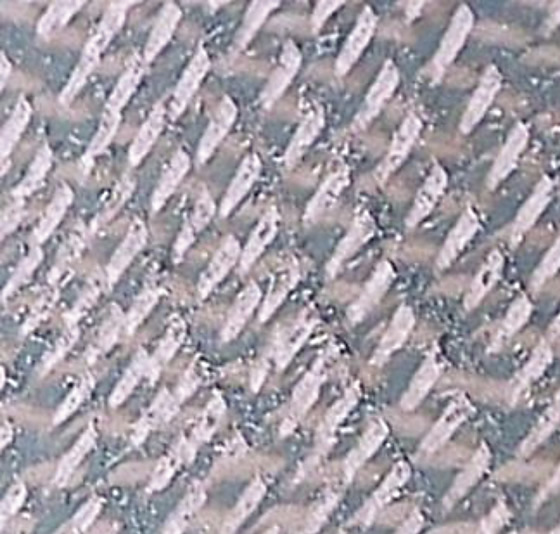
Courtesy of S. Smith
Figure 1. A scraped surface with blue marking compound. The blue spots mark small depressions that will contain oil.
Hydrostatic ways are formed by combining a hydrostatic bearing with a flat, straight way. The hydrostatic bearing consists of a pocket supplied with pressurized oil. The gap between the edges of the pocket and the guide way form a restriction, the flow of pressurized oil through the restriction controls the pressure in the pocket, and the pressurized oil supports the load. Hydrostatic ways have little friction, but they are active, requiring a pocket, a restriction, a pump and a flow of oil through the restriction even when the bearing is not moving.
Plain sliding guide ways do not require an external power source. The sliding element and stationary element are typically cast iron, and their surfaces are closely matched geometrically, but they are not perfectly smooth. A thin film of oil separates the two surfaces. It is retained in small, randomly dispersed depressions on the surfaces that act as oil reservoirs.
The reservoirs are replenished by occasionally squirting a little oil on the way in front of the sliding element. The oil is pulled by the motion of the sliding element from the reservoirs into the space between the contacting points of the two surfaces. This effect forms a hydrodynamic bearing, and the oil film is created and maintained by the motion. The critical features in the bearing are the close fit of the geometric form between the stationary and moving surfaces, and the surface texture. Unlike the other guide ways discussed above, the features on plain guide ways are obtained by hand scraping.
Scraping is one of the oldest and most historically significant metal-removal processes. It can be used to make accurate straight edges without the need of an external reference, and it is the basic metal-removal technique for making machine tools. Cast iron can be easily scraped, because it contains many graphite flakes in its structure. Small amounts of metal are removed from cast iron with a sharp blade, much like scraping paint off of a window.
The machine builder decides where to scrape by first painting the two surfaces to be matched with a thin coat of a marking compound, typically blue pigment mixed with a nondrying fluid, such as oil. The moving element slides along the stationary element for about 1 “, then the elements are separated. Contact that occurs between the elements removes the marking compound, and the compound left behind on the surface marks the low spots (see Figure 1 above).
If the surfaces have large a large geometrical form mismatch, there will be large contiguous shiny areas. A scraping tool, essentially a large, sharp, flexible blade on a handle, is used to remove small layers of metal from the shiny spots. This procedure is repeated many times on this section of the guide way, and many more times along its length. As the form of the moving element and the guide way are brought closer together, the blue spots become smaller and more randomly distributed. The goal is to eventually carry the load across a large bearing area and to create many small, randomly distributed depressions to hold the oil. Most scrapers try to make 10 to 40 small pockets per sq. in. Hand scraping of guide ways is a craft and it takes extensive training to become an efficient scraper.
A typical goal is to have 50 to 60 percent of the bearing area in contact with the way. If there is less contact area, the bearing will wear quickly, or the oil will not be pulled into the gaps. If there is a larger contact area, the reservoirs are insufficient to retain the oil, the bearing will be starved of lubrication, and the two surfaces will stick, like the wringing of gage blocks.
Good-quality plain sliding bearings, achieved by scraping, are an old technology, but still important in many machine tools. They create guide ways that do not require external power and provide high load carrying capacity and high damping. CTE
About the Author: Dr. Scott Smith is a professor and chair of the Department of Mechanical Engineering at the William States Lee College of Engineering, University of North Carolina at Charlotte, specializing in machine tool structural dynamics. Contact him via e-mail at kssmith@uncc.edu.
Glossary terms in this article
Related


Subscribers can use MFGAxis notes, saves and discussion tools with their innoNET account.