



Simulation optimizes multi-axis cutting: 5-Axis Machining
It's an unhappy day indeed when a CNC machine crashes. It may take days, perhaps weeks, to assess and repair the damage. During that time, the shop staff not only loses the machine's productive capacity but worries that it may not be possible to restore the machine to its previous ability to hold tight tolerances.
It’s an unhappy day indeed when a CNC machine crashes. It may take days, perhaps weeks, to assess and repair the damage. During that time, the shop staff not only loses the machine’s productive capacity but worries that it may not be possible to restore the machine to its previous ability to hold tight tolerances. It is bad enough when a vertical 3-axis CNC mill crashes, but when it happens to a 5-axis system that costs many times more, the downside is more serious.
With this in mind, Ascentec Engineering began researching the market for advanced machine simulation software when it was anticipating the installation of its first 5-axis horizontal machining center in 2011. The Tualatin, Ore., company provides machining services and printed-circuit-board-assembly tooling. After narrowing the field to two simulation packages, the company selected NCSIMUL from SPRING Technologies Inc. based on the software’s capabilities, ease of use and integration with its Mastercam CAM software from CNC Software Inc., Tolland, Conn., noted David Gilliat, director of manufacturing and machining technology for Ascentec.
Since then, Ascentec’s 4- and 5-axis manufacturing operation has grown to five machines. The equipment is used extensively for production and prototyping projects in support of the company’s aerospace and semiconductor-manufacturing customer base. During this time, there has not been a single crash.
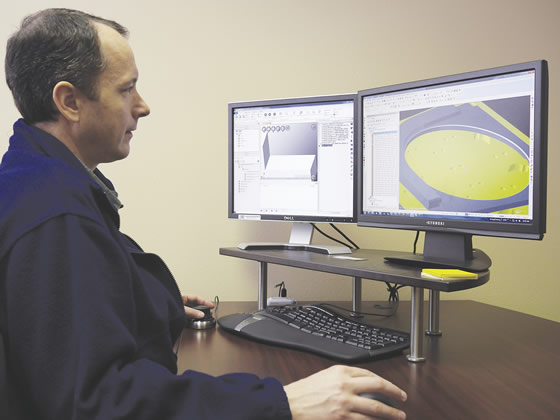
Courtesy of Ascentec Engineering
NCSIMUL simulation software is accessible to a programmer via a button in the CAM software programming environment.
“When we are programming our vertical mills, we routinely use the simulation features of our CAM software to assure that our toolpaths are fast and accurate and that they have not removed too much or too little material,” Gilliat said. “NCSIMUL goes beyond what the CAM software offers to provide an accurate simulation of the cutting actions based on kinematic models of the specific machine tool, as well as cutting tools, holders, fixtures and even the part loading system.”
He added that the simulation software is easy to use. After 2 days of training, the company’s four multiple-access programmers had a solid working knowledge of the software and its primary features. NCSIMUL is accessible to a programmer via a button in the Mastercam programming environment. Ascentec personnel still use the CAM software’s simulation features when programming, but they push the button and run it through NCSIMUL before posting the code to a multiaxis machine.
NCSIMUL analyzes the machine-specific G code and how the machine will perform based on actual machine and controller characteristics. This analysis, which takes about 15 minutes, results in:
- Detection of coding errors.
- Analysis of machine performance based on the CAM program’s code in relation to the machine model, part setup, related tools and secondary equipment to detect potential crashes and interferences.
- Verification of the simulated part’s geometry against the CAD model to ensure the machine will produce a good part.
- Automatic flagging of unacceptable conditions so the programmer can make necessary corrections before the CNC program leaves the CAM programming environment.
View print ads from this spread
Review the ads on this magazine spread to continue reading. Each ad takes two seconds; a two-page ad counts once.
Advertisers on this magazine spread
Print placements on this magazine spread
Niagracutter
At IMTS 2014, you saw how your
business is our focus. From high-speed milling in titanium to high-feed machining in hardened steels to finishing high-tolerance walls in deep pockets, Niagara Cutter is dedicated to helping you optimize your machining applications. Whether you specialize in aerospace, moldmaking or general machining, Niagara has developed new solutions.
At IMTS 2014, you saw how your business is our focus. From high-speed milling in titanium to high-feed machining in hardened steels to finishing high-tolerance walls in deep pockets, Niagara Cutter is dedicated to helping you optimize your machining applications.
Visit Niagracutter View this placement in the issue recordPrint ads from this magazine
business is our focus. From high-speed milling in titanium to high-feed machining in hardened steels to finishing high-tolerance walls in deep pockets, Niagara Cutter is dedicated to helping you optimize your machining applications. Whether you specialize in aerospace, moldmaking or general machining, Niagara has developed new solutions.
At IMTS 2014, you saw how your business is our focus. From high-speed milling in titanium to high-feed machining in hardened steels to finishing high-tolerance walls in deep pockets, Niagara Cutter is dedicated to helping you optimize your machining applications.
Continue reading
September 2014
Gilliat explained that Ascentec holds various parts using a dovetail fixture during machining. A vertical machining center cuts a dovetail workholding feature on the workpiece, which is then sent to a 5-axis machine. The program created in Mastercam eliminates as many setups as possible. NCSIMUL verifies that the machining process will be complete, determines what the maximum extension of the tools will be from the holder and confirms there will be no collisions. Upon completion, the part returns to the VMC for removal of the dovetail workholding feature.
During the past several years, Ascentec’s machining department has experienced substantial sales growth, nearly doubling each year for the past 3 years—much of it is attributable to the company’s expanding 4- and 5-axis machining capabilities. Simulation software has positively influenced this expansion, first by protecting the equipment but in other ways as well, allowing the shop to:
Increase multiaxis uptime. Initially, some time is lost when a programmer stops to simulate code with NCSIMUL. However, that time does not occur at a machine, meaning this time expenditure is more than recovered because the programmer does not have to prove his program in slow motion on the machine to verify a crash won’t occur.
Get to first-piece faster. The confidence factor created by simulation makes it possible to correct most problems before they arrive at the machine, to run first-piece operations faster, and move into production sooner.
Reduce scrap. Even a simple tool- on-feature collision can damage a high-cost cutting tool and scrap an expensive, complex part. With the installation of simulation software, the company has experienced zero scrap because of undetected interferences.
Access critical geometries. To provide tool access to features deeply embedded in cavities or obscured by complex features, or to shorten tools and enhance rigidity, it may be necessary to run tools and holders close to other nearby features. Gilliat said he and his programmers have intentionally and confidently operated within 0.100 ” of nearby features and fixturing to obtain these benefits without having to resort to an additional setup.
Run at higher speeds. Advanced tools and machining strategies, such as Mastercam’s Dynamic Machining, allow Ascentec’s 4- and 5-axis machines to operate in tight spaces while cutting at 300, 400 and even 500 ipm.
Adopt new tools and technologies. Simulation allows Ascentec to adopt new tools and machining strategies at an accelerated pace because it can explore “what if?” ramifications virtually instead of on the machine tool.
Achieve higher levels of quality. Because simulation software allows Ascentec to push its tool positioning to the maximum and eliminate as many setups as possible, part quality is improved, particularly where there are many features on multiple sides that must be verified in relation to each other.
In addition, customer service has improved. “High-speed manufacturing has been one of the greatest strengths of our business, helping to produce higher-quality work and shorten turnaround times for our customers,” Gilliat said. CTE
About the Author: Silvère Proisy is U.S. general manager for SPRING Technologies Inc., Cambridge, Mass. For more information about the company’s simulation and other software, call (617) 401-2197 or visit www.springplm.com.
Glossary terms in this article
Related



Subscribers can use MFGAxis notes, saves and discussion tools with their innoNET account.


