

Importance of using dry compressed air
Machine tools require compressed air for many functions, including transporting oil to the spindle bearings, actuating tool-change mechanisms and blowing chips and contaminants from tools and workpieces. For example, every time an automatic tool change occurs, the toolholder shank and the spindle taper are exposed to chips, oil, dirt and other contaminants from the cutting zone.
Machine tools require compressed air for many functions, including transporting oil to the spindle bearings, actuating tool-change mechanisms and blowing chips and contaminants from tools and workpieces. For example, every time an automatic tool change occurs, the toolholder shank and the spindle taper are exposed to chips, oil, dirt and other contaminants from the cutting zone. Any particles that stick to those exposed surfaces can reduce the machine accuracy and stiffness and even cause permanent damage to the connection. Most CNC machine tools use a blast of dry, compressed air to keep exposed surfaces clean. If the air is not dry enough, water in the air will condense on the surfaces, eventually causing rust.
Courtesy of S. Smith
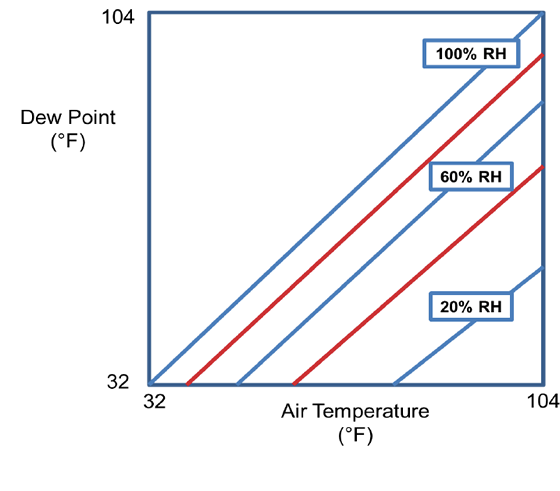
Figure 1. The dew point temperature is related to the air temperature for different values of relative humidity.
Water is present in ambient shop air, so water is also in the compressed air. The amount of water depends on many factors, but primarily temperature. Warm air holds more water than cold air. The amount is often expressed by the relative humidity (RH), the amount of water in the air compared to the amount of water the air can hold. This is a problem because the process of creating compressed air changes its temperature.
When the compressor compresses the air, the work creates heat, and the air exit-ing the compressor is usually well over 100° F (37.8° C). When the air contacts a cold surface, such as the inside of the compressed air tank, and cools, water condenses out of the air as dew. Picture the “sweat” on the outside of a glass containing a cold beverage or the fog on a bathroom mirror.
Additionally, when the pressure is released, such as when the air exits a nozzle, the temperature of the air drops again, and water condenses. The temperature at which the water begins to condense is the dew point.
When the air is “saturated”—100 percent relative humidity—the dew point is the same as the air temperature (Figure 1 on page 30). When less water is present in the air, the RH is lower, and the dew point is less than the air temperature. The goal of air drying for machine tools is to remove enough water so the dew point of the air will be significantly less than any temperature the air will encounter during its use. So how is it done?
The first step of air drying concerns the compressed air contacting the inside of the storage tank. The water that condenses here collects at the bottom of the tank, where it should be periodically or automatically drained.
Review the print ads from this magazine to continue
This quick advertiser review unlocks the rest of the article and keeps the full-screen reader focused on the ads instead of the page chrome.
Advertisers included in this article experience
Print placements connected to this article
Iscarmetals
MAX AR
) B Ultimate Insert Clamping Guarantees Supreme Tool Life Jet Pressure with Free Unobstructed Unique Chipbreakers Chip Flow for Ultimate for Ultimate Insert Life Blade Life Parting and Parting and Parting and Parting and Parting and Parting and Parting and Grooving Grooving for Grooving for Grooving for Grooving for Grooving for Grooving for for Cr-Ni Alloys.
) MAX AR B Ultimate Insert Clamping Guarantees Supreme Tool Life Jet Pressure with Free Unobstructed Unique Chipbreakers Chip Flow for Ultimate for Ultimate Insert Life Blade Life Parting and Parting and Parting and Parting and Parting and Parting and Parting and Grooving Grooving for Grooving for Grooving for Grooving for Grooving for Grooving for for Cr-Ni Alloys, Hard Materials Hard Materials Hard Materials Soft Materials Soft Materials Stainless Steel Ductile Materials and
Visit Iscarmetals View this placement in the issue recordPrint ads from this magazine
) B Ultimate Insert Clamping Guarantees Supreme Tool Life Jet Pressure with Free Unobstructed Unique Chipbreakers Chip Flow for Ultimate for Ultimate Insert Life Blade Life Parting and Parting and Parting and Parting and Parting and Parting and Parting and Grooving Grooving for Grooving for Grooving for Grooving for Grooving for Grooving for for Cr-Ni Alloys.
) MAX AR B Ultimate Insert Clamping Guarantees Supreme Tool Life Jet Pressure with Free Unobstructed Unique Chipbreakers Chip Flow for Ultimate for Ultimate Insert Life Blade Life Parting and Parting and Parting and Parting and Parting and Parting and Parting and Grooving Grooving for Grooving for Grooving for Grooving for Grooving for Grooving for for Cr-Ni Alloys, Hard Materials Hard Materials Hard Materials Soft Materials Soft Materials Stainless Steel Ductile Materials and
Continue reading
May 2014
Next, the air often passes through a “separator.” This cylinder-shaped device causes the air leaving the tank to swirl in a chamber at high speed. The centrifugal force throws the water droplets, along with oil and other contaminants, to the sides of the chamber, where they flow down and collect. The water is drained out the bottom. These steps typically remove about half of the moisture from the air. For some applications and some environments, that is sufficient to prevent condensation when the air is used in the machine tool.
If not, a common and significantly more expensive additional step is to use a refrigeration dehumidifier. Here, a separate cooling system, such as refrigerator or chilled water, creates a surface a few degrees above the freezing point of water. As the air passes this surface, additional moisture condenses out and is collected. This is similar to the dehumidification process in a residential air conditioner.
Even more water can be removed using membrane air dryers, deliquescent dryers and desiccant dryers. In a membrane air dryer, the air passes through bundles of hollow, semipermeable tubes. The water vapor can pass through the tube walls, but the air cannot. The water is collected on the outside of the tube bundles and is drained.
In a deliquescent dryer, the air passes through a bed containing a chemical with an affinity for water, such as salt or calcium chloride. As the air passes through the bed, the chemical dissolves the water vapor and the resulting liquid drains from the bottom of the tank. The chemical is consumed and must be periodically replenished.
In a desiccant system, chemicals that are not consumed, such as the silica gel often seen packaged with electronics in shipping containers, adsorb water on their surface. These systems must be periodically replaced or regenerated using heat to drive off the water. CTE
About the Author: Dr. Scott Smith is a professor and chair of the Department of Mechanical Engineering at the William States Lee College of Engineering, University of North Carolina at Charlotte, specializing in machine tool structural dynamics. Contact him via e-mail at kssmith@uncc.edu.
Water is present in ambient shop air, so water is also in the compressed air. The amount of water depends on many factors, but primarily temperature.
Glossary terms in this article
Related




Subscribers can use MFGAxis notes, saves and discussion tools with their innoNET account.


