

Tool provides path to productivity
Extend tool life and boost productivity when milling Inconel 718. A 6-flute endmill programmed to follow a trochoidal milling toolpath.
END USER: Matherne Instrumentation Specialists Inc., (985) 876-9808, www.matherneinstrumentation.com.
CHALLENGE: Extend tool life and boost productivity when milling Inconel 718.
SOLUTION: A 6-flute endmill programmed to follow a trochoidal milling toolpath.
SOLUTION PROVIDERS: IMCO Carbide Tool Inc., (800) 765-4626, www.imcousa.com; Tooling and Accessories Group Inc., (985) 507-9207
Gilbert Boquet always keeps his eyes open for new opportunities to shave machining time and reduce tool costs, especially when producing parts made of difficult-to-machine Inconel 718. Boquet is mill foreman at Matherne Instrumentation Specialists Inc., Houma, La., in the heart of the Gulf Coast oil industry. The company makes precision-calibrated instruments used in oil fields, which are demanding work environments. The instruments have to be tough—Inconel tough—to get the job done. Therefore, the cutting tools used to produce the instrument components have to be up to the task.
Courtesy of IMCO Carbide Tool
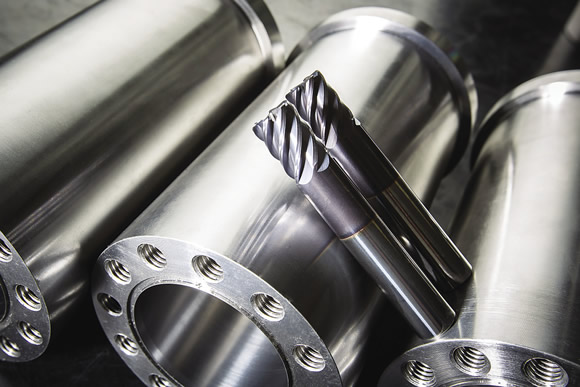
Matherne Instrumentation went from six tools per part to one and cut cycle time in half when milling Inconel 718 parts for precision-calibrated instruments used in oil fields after switching to Omega-6 M7 series 6-flute endmills from IMCO. Tools are shown resting on top of completed parts.
Matherne was experiencing problems when applying standard 4-flute endmills. Each part required six tools to rough at a cutting speed of 70 sfm and a feed of 1 ipm, according to Neal Wilson, a manufacturer’s representative at Tooling and Accessories Group Inc., Ponchatoula, La., which represents Perrysburg, Ohio-based IMCO Carbide Tool Inc. in Louisiana, Mississippi and Arkansas.
Wilson recommended IMCO’s Omega-6 M7 series 6-flute endmills. According to IMCO, the tool’s corner radius protects the corner from chipping and breakage and its high helix angle creates a high shear plane in the cutting zone for enhanced efficiency and chip control.
Wilson also recommended a trochoidal milling toolpath. When trochoidal milling, the toolpath maintains a constant tool engagement and feed. A constant tool engagement means less loading and unloading of a tool as it enters and exits the cut, which prolongs tool life. It also means the tool spends less time cutting air and more time removing metal.
Review the print ads from this magazine to continue
This quick advertiser review unlocks the rest of the article and keeps the full-screen reader focused on the ads instead of the page chrome.
Advertisers included in this article experience
Print placements connected to this article
Rosedaleproducts
Keep Your Hydraulic
Systems Clean! With our versatile designs, and because we build in-house, Rosedale is poised to meet your filtration needs. Contact us today to keep your system clean. • Bulk Oil Handling • Coolants • Cutting Oils • Fuels • Hydraulic Oils NCO FILTER • Lubrication Oils Open • Process Liquids w/o tools • Quench Oils 150 psi.
Keep Your Hydraulic Systems Clean! With our versatile designs, and because we build in-house, Rosedale is poised to meet your filtration needs. Contact us today to keep your system clean.
Visit Rosedaleproducts View this placement in the issue recordPrint ads from this magazine
Systems Clean! With our versatile designs, and because we build in-house, Rosedale is poised to meet your filtration needs. Contact us today to keep your system clean. • Bulk Oil Handling • Coolants • Cutting Oils • Fuels • Hydraulic Oils NCO FILTER • Lubrication Oils Open • Process Liquids w/o tools • Quench Oils 150 psi.
Keep Your Hydraulic Systems Clean! With our versatile designs, and because we build in-house, Rosedale is poised to meet your filtration needs. Contact us today to keep your system clean.
Continue reading
January 2013
CAM software is available to automatically generate those toolpaths, but Matherne didn’t have a CAM package at the time (but now does), Wilson noted. “After I explained the toolpath, Gilbert Boquet took the concept and long-handed his own program,” he said. “That was very impressive.”
With the program completed, Matherne tested the IMCO tools against three other brands. “No other brand was close,” Wilson said, noting Matherne was able to increase the cutting speed to 110 sfm, the feed to 4.2 ipm and up the metal-removal rate because of the two additional cutting edges on the IMCO endmills, which means less work per flute and longer tool life. As a result, only one tool was needed to rough a part.
Wilson added that by adjusting for radial chip thinning, which resulted from the more efficient toolpath, Matherne made additional productivity gains. “We were able to cut the cycle time probably in half,” he said about all the machining gains combined.
Chip thinning occurs when the WOC is less than the cutter radius. When this happens, the length of the cutting edge engagement becomes larger than the radial DOC, and the chip becomes thinner because it is distributed over a greater length of cutting edge. A thinner chip carries less heat from the cutting edge, escalating tool wear. With chip thinning adjustment, the chip returns to the desired thickness, allowing it to carry more heat from the cutting edge and extending tool life.
Matherne uses the Omega-6 M7 series endmills for other Inconel projects as well, including a complex 8½ “-dia. part with multiple windows and ¼ ” lugs.
“We get better tool life,” Boquet said. “And we don’t have to replace tools as often, so we save time.”
Glossary terms in this article
Related




Subscribers can use MFGAxis notes, saves and discussion tools with their innoNET account.


