
Software provides significant time and cost savings
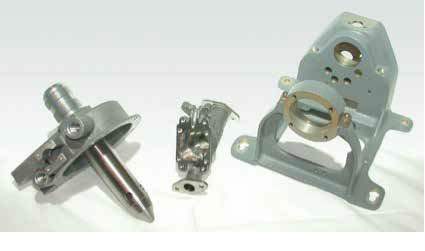
Founded in 1976 by George McNab to serve the growing demand for precision aerospace components, Mac Machine Company Inc. has since expanded its manufacturing capabilities to serve the defense, commercial aircraft, and medical diagnostics and implant industries.
Founded in 1976 by George McNab to serve the growing demand for precision aerospace components, Mac Machine Company Inc. has since expanded its manufacturing capabilities to serve the defense, commercial aircraft, and medical diagnostics and implant industries. Mac Machine provides clients like Honeywell, Northrup Grummon, Sandia National Laboratories, and Zimmer Medical with a variety of precision parts, assemblies and weldments, all designed and produced at its 20,000-sq-ft facility in Baltimore, Maryland.
Many of today’s leading manufacturers got started in the United States’ aerospace industry. Mac Machine is one of them. Since its inception, Mac Machine has continually positioned itself at the forefront of precision manufacturing technology. The company implemented CAD/CAM capabilities in the late 70s, well before being mandated by customers. Today, it combines state-of-the-art 5-axis machines, tool holding systems, and CAM verification software with the traditional machinery necessary for the development and production of highly sophisticated parts and assemblies.
Mac Machine’s capabilities include milling, turning, grinding and CNC programming and inspection, as well as honing, laser marking and silk screening. Its quality system complies with the requirements of industry standard ISO 9001:2000, and also complies with AS-9100 and Rev C. NAD CAP Certification #115110-D.
In 2009, Alvin Moore was brought on board to serve as the company’s Global Shop Solutions ERP software administrator. His mission? To coach employees in improving their ERP software skills while ensuring that the company reaped the full benefits of using a fully-integrated ERP system. Since then, Mac Machine has implemented a number of changes in how they use the software that have resulted in significant time and cost savings.
EDI a real-time saver
 One of Moore’s first areas of focus involved finding a more efficient way to track the huge quantities of parts ordered by Mac Machine’s largest customer, Honeywell.
Every day, Honeywell sends Mac Machine a report consisting of more than 3,500 lines identifying every individual order and whether the purchase orders are planned or confirmed. Previously, Mac Machine had two individuals spending upwards of 30 hours a week printing out spreadsheets and trying to keep track of everything on the report. Moore found a way to eliminate this manual work by automating the process through the Electronic Data Interchange (EDI) module.
“Because the Honeywell report contains so many forecasted orders, I had to figure out the best way to handle them in regards to scheduling,” said Moore. “It took a bit of trial-and-error to determine the most efficient way to use EDI, but now the whole process is automated. Global Shop Solutions electronically imports the Honeywell data. I run the EDI report once a week on Monday night.
On Tuesday we run the shop action required report. Global Shop Solutions tells us everything we need to do without spending 30 hours on manual labor.”
“Interestingly, none of the information has changed,” said Moore. “What’s changed is how we’re using it in Global Shop Solutions. If I see any revision changes, I enter them into the system and then run the report again. I spend a maximum of three hours uploading and analyzing the report. The two people who used to manually track the report now spend their time on other activities. And nobody has to touch anything. It’s all handled within the Global Shop Solutions system.”
Going paperless
Global Shop Solutions ERP software also enabled Mac Machine to go paperless on the shop floor, a move that has paid off with numerous operational improvements. According to Moore, two screens in the Inventory application in particular — Work Order Action Required and Purchase Order Action Required — have generated huge time savings in regards to tracking information related to material requirements.
Previously, Mac Machine employees would print the standard MRP report, which listed all the different due dates for raw materials needed for each job. This report frequently ran up to 50 pages, requiring lengthy review times. Now, employees review the same information directly from the Work Order Action Required and the Purchase Order Action Required screens, only they do it without paper and in far less time. And they can easily pick and choose which data to review simply by sorting by the job, part or customer.
“It all starts with the highly versatile Supply & Demand screen,” noteed Moore. “From there, you can easily access the Work Order Action Required and Purchase Order Action Required screens. These have enabled us to go from a paper system with a very large manual report to a visual system in Global Shop Solutions where we can sort the data any way we want using many different fields.”
“Global Shop Solutions gives you a lot of options in how to sort and review the data,” continued Moore. “One of the real benefits of this visual system is that it makes it easy to see how a change in one area affects everything else on the shop floor. When you’re looking at paper reports, it’s hard to get that big picture perspective.”
To assist in going paperless, Mac Machine installed five Shop Floor Data Collection stations on the shop floor. These now serve as the primary focal point for collecting work data. Instead of using manual time cards to track their time, operators now electronically log on to jobs through the Shop Floor Data Collection screens. Instead of jotting down comments or notes on work orders, they enter all information into the system at the stations.
“In addition to speeding up workflow, going paperless with the Shop Floor Data Collection stations has eliminated many redundant work processes,” notes Moore. “For example, previously a paper work order was distributed throughout the floor. Now, all work orders are created and delivered electronically through the Global Shop Solutions system — another small change that has contributed to big improvements in job efficiencies.”
Flexible scheduling
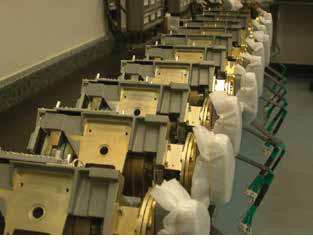 Moore also points to the Advanced Planning & Scheduling (APS) module as a major time saver. “We’re not a company that makes the same parts over and over again,” he said. “We constantly run parts that are completely different in shape, size, and complexity from the job that came before it. The ability to schedule all these diverse jobs through Global Shop Solutions is a huge benefit. It’s much faster and more efficient than manual scheduling. Plus, Global Shop Solutions’ schedule modifier makes it easy to schedule multipallet machines, which we frequently run.”
“What I really like about APS is its amazing flexibility. The system allows us to schedule in many different ways. It lets us schedule forward or backwards. It lets us schedule finitely or infinitely. And when a customer calls in with a last minute change, APS handles it with ease. We can put in the new work order, rerun the schedule, and see exactly where it fits and which jobs it pushes behind. All we do is enter the job data and APS does the scheduling for us.”
Mac Machine predominantly uses backwards scheduling for the majority of its jobs. But schedulers also make frequent use of Global Shop Solutions ERP software’s ability to schedule forward and backward at the same time. This unique “hybrid” scheduling feature provides unprecedented flexibility and visibility in terms of maximizing machine loads and labor time while preventing bottlenecks due to overscheduled capacity.
Why does Moore prefer backward scheduling? “Because I like to see what is technically considered past due,” he said. “When you backward schedule, you can see everything that is supposed to be done before the date you select. That’s my personal preference, and that’s one of the real benefits of APS. Depending on how you like to run things, Global Shop Solutions lets you schedule in many different ways and see the data in many different formats.”
“It all comes down to how you want to run your shop,” added Moore. “Do you only want to see what will be late in the future? In that case, you forward schedule. Do you want to see everything that’s past due now? Then you backward schedule. If you want to look at a combination of the two, you backward schedule everything that can fit and then forward schedule everything that doesn’t fit. And that’s the real beauty of the APS module. You’re not restricted to only one way of scheduling.”
Looking ahead
Now that Mac Machine has mastered the basics of the ERP software on a company-wide basis, Moore has begun looking at some of the more advanced features.
“Currently, I’m working on implementing some of the mobile applications, one of which involves setting up the wireless printer for our move tickets. Once we get the printer up and running, it will take the manual process of people determining lot size out of the equation. Operators will simply enter their time and our runner will get a ticket that tells him when the parts are done and ready to go. In the near future I also plan to start using Global Application Builder (GAB) and other features to customize certain parts of the system to the way we get things done in our business.” Moore has also begun to explore the possibility of expanding the benefits of Document Control feature — currently used only in the quality department — to the shop floor as well.
“Global Shop Solutions is such a powerful system, and I’ve feel we’ve only just begun to tap into its potential,” said Moore. “I can’t wait to see where we are with the software in another year or two.”