

Achieving machining effectiveness
In the first part of this two-part series, I looked at what actually happens in the cutting zone and how that knowledge allows end users to select the best possible cutting tool and CAD/CAM strategy for a particular material to optimize material removal.
In the first part of this two-part series, I looked at what actually happens in the cutting zone and how that knowledge allows end users to select the best possible cutting tool and CAD/CAM strategy for a particular material to optimize material removal. This second part covers why it is important to adopt this approach not only for all CNC machining processes, but as a significant production cost-saving measure companywide and industrywide.
Typically, production cost centers are evaluated independently, including tool, raw material, capital equipment and manpower costs. However, incremental savings in each typically don’t add up to significant gains. My contention is that the areas of cutting tools and CAM, particularly software that has newer toolpath-generation technologies, along with machine capabilities, must be looked at concurrently. The goal is to hit the optimized sweet spot of all three—referred to as “machining effectiveness”—to significantly reduce production costs.
To adopt this approach, follow these four steps:
- Select optimal cutting tools for the part.
- Based on the toolmaker’s recommendations, import the correct parameters for machining at a consistent chip load using toolpaths that have this capability.
- Optimize the cutting parameters, if necessary, to match the full capabilities of the machine the job is running on.
- Repeat for every toolpath process you create with CAD/CAM software where the same tools, workpiece material and machine are used.

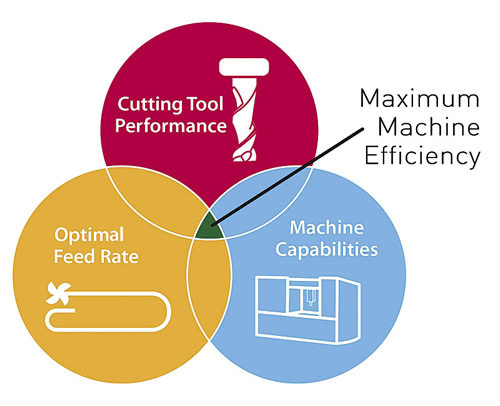
Illustration courtesy CNC Software.
Optimal material removal and cutting tool performance occur when CNC machines are programmed using newer CAD/CAM software. This technology continually maintains the cutting tool manufacturer’s recommended cutting conditions and chip load, regardless of part geometry. High material-removal rates, with predictable and long tool life, significantly reduce cycle times and production costs. This is necessary for achieving machining effectiveness. In addition, improved mrr and tool life can be realized with virtually any tool, because these newer toolpath strategies are based on consistent cutting conditions.
With these newer toolpath strategies, part manufacturers of all types typically reduce cycle times from 25 to 70 percent when roughing—sometimes much more. One manufacturer, for example, reported a cycle-time reduction from 32 minutes to 12 minutes by implementing a machining effectiveness mind-set.
With a toolpath that always keeps the tool in a safe cutting condition and does not violate the tool manufacturer’s recommended chip load specs, CNC programmers can apply different methodologies. On faster machines where workholding might be lighter and cutting tool selection more traditional, users might opt for a higher feed rate and small step-over to maximize the mrr and reduce cycle time. If running on a higher-horsepower machine, which tops out on feed rate yet enables the workholding to be locked down, a company might run newer tools that are capable of slotting two, three or four times deeper than was possible a short time ago—even in hardened steel, stainless and superalloys. The shop could run heavy step-overs of 65 to 80 percent at 2 to 3 diameters deep or more and see material-removal gains of 70 to 75 percent compared to traditional toolpath strategies.
Review the print ads from this magazine to continue
This quick advertiser review unlocks the rest of the article and keeps the full-screen reader focused on the ads instead of the page chrome.
Advertisers included in this article experience
Print placements connected to this article
Hornusa
Micro-Precision Taken to the Extreme
Machine the smallest of parts with maximum precision – accurate to tolerances in the micron range. Authentic Supermini®. The high-production tooling system handles the most challenging jobs starting in bore diameter 0.2mm (.008 ). More than 1,000 standard carbide inserts with ideal geometries are HORN – EXC ELLENCE IN TECHNOLOGY.
Micro-Precision Taken to the Extreme Machine the smallest of parts with maximum precision – accurate to tolerances in the micron range. Authentic Supermini®. The high-production tooling system handles the most challenging jobs starting in bore diameter 0.2mm (.008 ). More than 1,000 standard carbide inserts with ideal geometries are available. All standard and custom solutions fit the same toolholder for use with or without coolant. www.hornusa.com Expertise meets the high-tech production of miniature parts. www.hornusa.com HORN – EXC ELLENCE IN TECHNOLOGY GROOVING PARTING OFF GROOVE MILLING BROACHING PROFILE MILLING REAMING
Visit Hornusa View this placement in the issue recordPrint ads from this magazine
Machine the smallest of parts with maximum precision – accurate to tolerances in the micron range. Authentic Supermini®. The high-production tooling system handles the most challenging jobs starting in bore diameter 0.2mm (.008 ). More than 1,000 standard carbide inserts with ideal geometries are HORN – EXC ELLENCE IN TECHNOLOGY.
Micro-Precision Taken to the Extreme Machine the smallest of parts with maximum precision – accurate to tolerances in the micron range. Authentic Supermini®. The high-production tooling system handles the most challenging jobs starting in bore diameter 0.2mm (.008 ). More than 1,000 standard carbide inserts with ideal geometries are available. All standard and custom solutions fit the same toolholder for use with or without coolant. www.hornusa.com Expertise meets the high-tech production of miniature parts. www.hornusa.com HORN – EXC ELLENCE IN TECHNOLOGY GROOVING PARTING OFF GROOVE MILLING BROACHING PROFILE MILLING REAMING
Continue reading
December 2016
Although parts manufacturers have been slow to adopt these newer strategies and embrace a machining-effectiveness mind-set, there are signs they are finally beginning to take hold. Straw polls of CAD/CAM users and industry-event attendees indicate that 30 to 40 percent of programmers and machinists are increasingly using new toolpath strategies. But what about the other 60 percent? They frequently report not looking into it because, honestly, they don’t have the time or have not received approval to do so.
But it doesn’t take much time to implement a demonstrably better cost-cutting methodology. Tool manufacturers’ recommended machining parameters are often available in tool libraries and are easily imported directly into a CAD/CAM system when selecting a tool and material. Adjustments are made based on tool capabilities, such as whether to take a small or large step-over and what limits need to be applied to the DOC based on the type of tool. Machine limits relative to spindle speed, feed rate and horsepower are also considered prior to processing the program.
Using toolpaths that maintain consistent chip load and safe cutting conditions, it’s simply a matter of taking the program out onto the machine. Machine performance is validated relative to holding the programmed feed rate, ensuring the right workholder is in place and maintaining the required spindle load.
Once the program is running on the machine, it may be necessary to make some minor adjustments to toolpath parameters to ensure the software is taking full advantage of the machine’s capabilities. Conversely, some machine control settings may need adjustment to take full advantage of the toolpath.
Benefits can be seen in practically every application. For example, a job shop took 6 hours off of a 24-hour cycle for producing an aerospace part by adopting the machining effectiveness methodology. This conversion paid for itself after the first part was produced. Better still, the company had a contract to make six more of the parts.
The reality is that many manufacturers in many industries are operating far less efficiently than they could be and leaving money—lots of it—on the table by not optimizing cutting tool, toolpath and machine performance, and by not viewing them as forming an integrated system. Cutting costs is necessary to compete and remain profitable. However, there’s a lost-opportunity cost savings when companies don’t leverage everything they can get from interrelated technologies. Aiming at that optimized sweet spot called machining effectiveness can result in significant gains.
Toolmakers are confident that their best route to justifying the benefits of high-performance cutting tools is to show new users the financial gains improved productivity provides. Among those who does this is Tom Raun, national milling product manager for Iscar Metals Inc. He maintains that the cost of the cutting tool is insignificant compared to the benefit of reduced cycle times. Cutting tools represent about 3 percent of a typical CNC shop’s total costs. If tool life can be doubled, the payback amounts to less than 1.5 percent of the shop’s total costs for cutting tools. Even so, if a shop realizes it can reduce its tooling costs by $1 million by making a simple purchasing decision, it will jump on that opportunity.
On the other hand, experience has convinced Raun that a 20 percent gain in material-removal efficiency can yield a 15 percent improvement in manufacturing costs per unit. So, a shop with $100 million in sales could realize a $15 million gain by making an average 20 percent across-the-board improvement in machining cycle times using mostly existing equipment and software.
Savings of this magnitude could be used to achieve such worthy objectives as improving profits, capturing more business and doing the modest amount of training required for more-robust workforce development and continuous improvement.
Glossary terms in this article
Related




Subscribers can use MFGAxis notes, saves and discussion tools with their innoNET account.


