

Air force
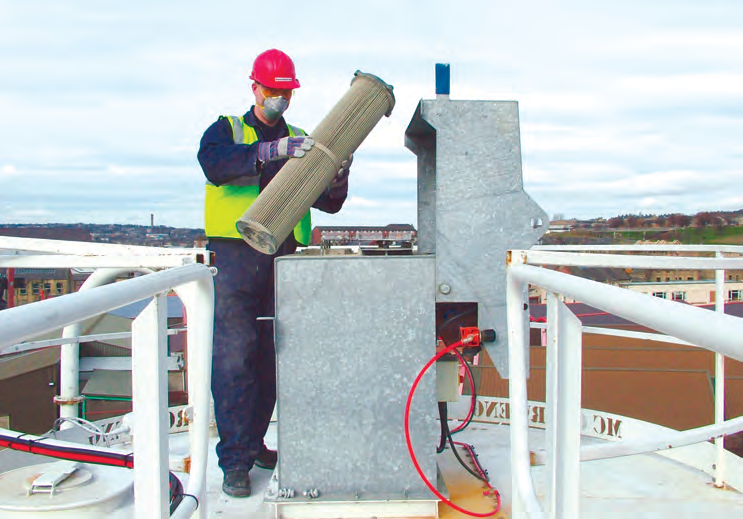
Courtesy of Dantherm FiltrationDust collection systems need to be inspected and repaired on a regular basis. In this photo, a Dantherm Filtration technician works on a rooftop dust collection system.The last thing managers at small and medium-sized job shops want to think about these days is spending money.
Courtesy of Dantherm Filtration
Dust collection systems need to be inspected and repaired on a regular basis. In this photo, a Dantherm Filtration technician works on a rooftop dust collection system.
The last thing managers at small and medium-sized job shops want to think about these days is spending money. Yet there are a few shop improvements that may be worth investing in. One is indoor air quality (IAQ).
Cleaner plant air can increase morale, employee productivity and part quality. Also, IAQ can affect machine tools, which are more susceptible to damage and distortion due to particulates in the plant’s air than ever before. This is because tolerances are becoming tighter (some say precision machining is going to be measured in angstroms in the near term). A particle of dust can distort accuracy in ways not clear to the eye, but very clear to precision measuring devices.
Plant air, therefore, is headed towards the same environmental requirements as clean rooms used extensively, for example, in the semiconductor industry, according to some experts.
Besides those concerns, there is also an ever-growing body of federal and state regulations on air pollution—for inside and outside the plant. The number and complexity of these regulations is staggering, but you still must deal with this “regulatory fog.”
The two most important federal agencies to track and communicate with are the Occupational Safety and Health Administration and the Environmental Protection Agency.
Inside Out
A simple regulatory rule is “inside the shop it’s OSHA and outside it’s EPA,” according to Joe Topmiller, technical sales manager, United Air Specialists Inc., Cincinnati.
But there are other organizations that companies can look to for direction when choosing an air cleaning system, including the National Fire Protection Association, Quincy, Mass. It is the responsibility of the manufacturer to ensure that air handling and air cleaning systems are equipped with features that provide safe venting of explosive events or safe suppression of explosive events when handling potentially combustible dust. Two particular NFPA standards to note are No. 68, which deals with explosion protection by deflagration venting, and No. 69, which covers explosion prevention or suppression systems.
Compliance can be costly, but spending on IAQ upgrades can bring clear benefits to the bottom line, according to Joe Snyder, a CNC machinist based in Jackson, N.J. “Everyone talks about increasing production and part quality by fine tuning cutting conditions or selecting proper tools,” Snyder said. “There is one aspect many people do not address: the psychological effects of working conditions in a shop environment.”
Many shops, he continued, have welding, fabricating, assembly and paint areas. All can create health and safety issues and “an environment that is detrimental to machine accuracy and life,” Snyder said.
Like a Clean Room?
In effect, regulation and the need for higher part quality are driving machine shops and fabricators to become more like semiconductor production clean rooms, with ever-cleaner air to improve both employee health and machine accuracy.
For example, Trostel Ltd.’s Polymer Compounding Div. (PCD), Whitewater, Wis., uses two ceiling-mounted cartridge dust collectors from United Air Specialists to capture carbon black dust before it lands on four DC motors that power a dump and blend mill. The dust collectors also provide a continuous airflow to keep the motors from burning up. Previously, the company used cooling fans, which would pull dust into the motors, frequently shorting them out, according to Jayson Irwin, Trostel facilities engineer.
The entire Trostel facility is some 28,000 sq. ft., but the area of the mixing operations is about 7,000 sq. ft. When Trostel PCD’s maintenance staff was evaluating clean air solutions for their 33-person facility, the company had five goals:
• keep conductive dust from being pulled into the motors by the cooling fans,
• improve air quality,
• reduce employee risk,
• reduce maintenance, and
• reduce downtime.
And all five goals needed to be accomplished with a system (or systems) that would pay for itself in a year and fit into a small space. This was made possible with the installation of two ceiling-mount cartridge dust collectors that were directly ducted to two mill motor intakes. “The dust collection equipment easily paid for itself in less than 12 months,” Irwin noted. “We went from servicing each of the four motors about four times a year to not having to touch any of them for 14 months.” Considering the cost of downtime and fees to fix the motors, this turned out to be a $35,000 to $50,000 a year savings.
According to Topmiller, a reputable company should be able to evaluate a facility and provide several solutions for a given process. For example, there are often multiple choices of systems to provide clean air within a facility. Equipment recommendations can vary drastically according to a facility’s unique layout, process and usage, and the most cost-effective system for one company may not be the same for another.
“Generally, it is recognized that employees are a company’s greatest asset,” said David P. Jones, sales manager, Air Cleaning Equipment Inc., Broadway, N.C. “Lost time and turnover can result in many negative results. I find it unconscionable that employees are asked to tolerate [poor air quality] conditions. Regrettably, the effect of ignoring this problem is difficult to quantify.”
Jones added that a shop is more likely to retain employees when attention is paid to the workplace environment. “I have had quite a few operators express appreciation for their employers concern with regard to air quality concerns.”
Where do you begin? “Housekeeping problems can be reduced when attention is paid to the source of the problem,” Jones said. “When I go into a shop and see machine coolant dripping from the ceiling and overhead ducts, I know we can greatly improve the overall environment in the shop with properly applied equipment.”
Costs and Savings
One way to look at the cost is to consider the savings of an air cleanup effort. “Consider the cost associated with the loss of coolant and lubricant into the atmosphere. Systems can capture this material and return it to the process machinery, resulting in a tremendous operating savings,” Jones said. “A low-cost, general-purpose soluble cutting fluid will cost $15 to $20 per gallon. Condensing machine oil mist that would otherwise escape into the shop environment and returning it to the machining center reduces the amount of fluid that must be purchased. If you just save 1 gallon a day from one process machine, over a year you save almost $2,000,” Jones added.
Review the print ads from this magazine to continue
This quick advertiser review unlocks the rest of the article and keeps the full-screen reader focused on the ads instead of the page chrome.
Advertisers included in this article experience
Print placements connected to this article
Iscarmetals
Parting Intelligently
Powerful Wide Inserts for Grooving, Turning Increasing Your and Profiling at High Feeds PROFITABILITY Machining Intelligently Turning Intelligently Turning into Lower Costs with High Productivity SUMOTURN Coated Grades Milling Intelligently Cost Saving Milling Superior Fine Pitch Endmills Drilling Intelligently Drilling Down.
Parting Intelligently Powerful Wide Inserts for Grooving, Turning Increasing Your and Profiling at High Feeds PROFITABILITY Machining Intelligently Turning Intelligently Turning into Lower Costs with High Productivity SUMOTURN Coated Grades
Visit Iscarmetals View this placement in the issue recordPrint ads from this magazine
Powerful Wide Inserts for Grooving, Turning Increasing Your and Profiling at High Feeds PROFITABILITY Machining Intelligently Turning Intelligently Turning into Lower Costs with High Productivity SUMOTURN Coated Grades Milling Intelligently Cost Saving Milling Superior Fine Pitch Endmills Drilling Intelligently Drilling Down.
Parting Intelligently Powerful Wide Inserts for Grooving, Turning Increasing Your and Profiling at High Feeds PROFITABILITY Machining Intelligently Turning Intelligently Turning into Lower Costs with High Productivity SUMOTURN Coated Grades
Continue reading
May 2010
Another savings from air filtration is the reduced cost to heat or cool air. If a shop is venting air directly outside, for every 350 to 400 cfm of air being exhausted, 1 ton (12,000 Btu) of cooling capacity is required. If this air can be cleaned and returned to the facility, cooling loads can be reduced considerably. For new installations, lower-capacity HVAC equipment can be installed, resulting in considerable savings, according to Jones.
“To cool 1,000 cfm of fresh air introduced to a space (to make up for air being ventilated to the outdoors) it will cost upwards of 30 cents per hour. This may not sound like much; however, say you have 10,000 cfm of exhaust operating 8 hours a day. At 10 cents per kW per hour, you can spend over $500 per month in makeup air cooling costs,” Jones noted.
For new projects, the installed air conditioning capacity can be reduced by the corresponding amount of ventilation air that will not be required if proper air cleaning equipment is installed. Jones said: “At $1,200 to $1,500 per ton, these cost savings can be significant. Again, say you opt for air cleaners vs. installing 10,000 cfm of exhaust, you may be able to reduce the facility cooling load by 28 tons. At $1,200 installed cost, you save nearly $33,600 on initial equipment cost.”
Courtesy of UAS
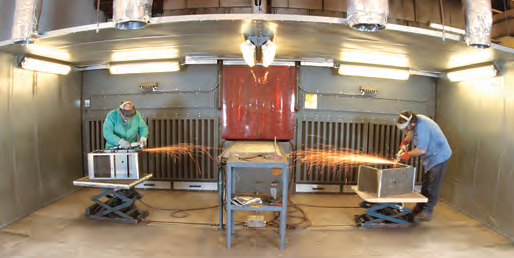
United Air Specialists uses its own MCB cartridge dust collector in the company’s grinding booth. UAS installed a small air conditioning system specifically for the grinding booth and a nearby powder paint booth.
Proper investigation of particular facilities and applications should be taken to properly project energy cost savings associated with cleaning the air vs. exhausting the air in a manufacturing facility. “Every situation is different,” Jones said.
System maintenance is another cost. Often, the dust collector is in the back of the building. “Most of the time it’s out of sight and out of mind,” said Rob Onusko, filtration customer service manager, Dantherm Filtration Inc., Thomasville, N.C. “But when it breaks, people notice because the resulting downtime affects the company’s profitability. With regular preventive maintenance, customers can help eliminate costly downtime, minimize operating costs and increase system productivity.”
Routine maintenance will keep the collector operating and thus allowing the end user to produce his product daily, which effects the bottom line. “Obviously, if you’re not producing you’re losing money,” Onusko added. “The longer you let something go, the greater the chance it will cost more in the end as something may break as a result.”
It is difficult to put an exact cost on all of this, he said, because “it’s like getting your car serviced. Different (dust collectors) models and makes cost more than others, as do the spare parts. If we can service several collectors in one area, then this helps reduce the expenses that get passed along to the customer. But the onsite per hour charge would be the same.”
There are many consultants and equipment manufacturers that can help shops determine if they are in compliance with appropriate EPA, OSHA and NFPA regulations. Also, all three of these organizations have divisions that focus on small companies, with information available on the Internet (epa.gov, osha.gov and nfpa.org).
The Nitty Gritty
Morale and employee health are as critical as regulatory compliance. “Hand-held grinders, torches, laser cutters and polishers create a lot of dust and smoke in the shop,” Snyder said. “Where does all this go but into our lungs, creating a health hazard first. Then it settles onto computer boards and machine ways as well.” The dust accelerates wear not just on the machine tools but on PC and CNC boards as well. Because the dust has metallic particles in it, it can short out the boards, he added.
The dust also settles onto inspection equipment, such as surface plates, he noted. “Some may find this hard to believe, but if you use a 0.00005 ” indicator with gage blocks, you can actually see the wear spots from dust and dirt on the surface plate. That’s why you have to clean the surface plate before each use and then use a different spot on the plate each time you use it.” He suggested a test if you don’t think your shop has a dust problem: “Look on the top of any machine enclosure.”
Snyder questions how safe, healthy, content and productive employees can be if they are subjected to excessive and unnecessary fumes, dust, excessive temperature swings and noise while they fight with equipment problems caused, in part, by these conditions. “Is it any wonder why there are very few under-40 machinists and even fewer coming into this trade?” he asked. “The trade still has a reputation for being dirty and unsafe. We can correct that.” CTE
Is your shop like a clean room? It could be. About the Author: George Weimer is a freelance writer based in Lakewood, Ohio, with an extensive background in the metalworking industry business press. Contact him at weimerg4@yahoo.com.
Tips on getting to clean room air quality
What can you do to upgrade your shop and make it more and more like a clean room? Consider these suggestions:
• Install air filters, properly sized for air exchange,
• Use direct ventilation systems over laser cutters and welders,
• Isolate paint and gluing areas (with proper ventilation) from other work areas,
• Use appropriate exhaust ventilation systems to remove contaminated air from grinding, polishing and buffing operations,
• Employees on the shop floor should not have to wonder why the office is always so comfortable while the shop floor is either frigid or sweltering, andn With the advent of fully enclosed CNC machines and the availability of air conditioning for small shops, there is no reason for poor indoor air quality in any shop.
—Joe Snyder, CNC machinist and former shop owner
Air quality in shops: What to look for
When it comes to indoor air quality in machine shops, all regulatory agencies tend to measure the same compounds and chemicals. The following is a short list of what shops should be checking for:
• airborne dust particles,
• airborne particulate measurements,
• airborne ultrafine particulate levels,
• collection and monitoring of long-term data on air quality,
• temperature and relative humidity,
• CO2 and fresh air levels, and
• volatile organic compound concentrations.
Further checks should include indoor mold and water damage assessments as well as dust mite allergen evaluations, HVAC ductwork evaluations and odor and hydrocarbon assessments.
—OccuHealth Inc., Mansfield, Mass.
Contributors
Air Cleaning Equipment Inc.
(919) 258-3330
www.aircleaning equipment.com
Dantherm Filtration Inc.
(800) 533-5286
www.danthermfiltration.us
OccuHealth Inc.
(800) 729-1035
www.occuhealth.com
Trostel Ltd.
(262) 248-4481
www.trostel.com
United Air Specialists Inc.
(800) 252-4647
www.uasinc.com
Glossary terms in this article
Related



Subscribers can use MFGAxis notes, saves and discussion tools with their innoNET account.


