

Apprenticeships can provide effective training
Various apprenticeship programs are available to connect the gap between the skills that parts manufacturers need and the ones job seekers offer.
Beam. Truss. Suspension. Cantilever. Cable-stayed. Similar to physical bridges to traverse a body of water, for example, various types of apprenticeship programs are available to connect the gap between the skills that parts manufacturers need and the ones job seekers offer. Presented here are apprenticeship programs provided by a machine tool builder, benchmarked by the German dual education system and managed by a staffing agency.
One common thread, of course, for all the programs is that they involve working at a manufacturer and attending classes at an educational institution.
Building a Better Workforce
It’s not a challenge to find people willing to be trained to work at a machine tool builder. But because each builder is different and has its own proprietary technology, it is nearly impossible to hire technicians—even highly experienced ones—who can perform immediately, according to Charlie Cagle, field service manager at Okuma America Corp., Charlotte, North Carolina.
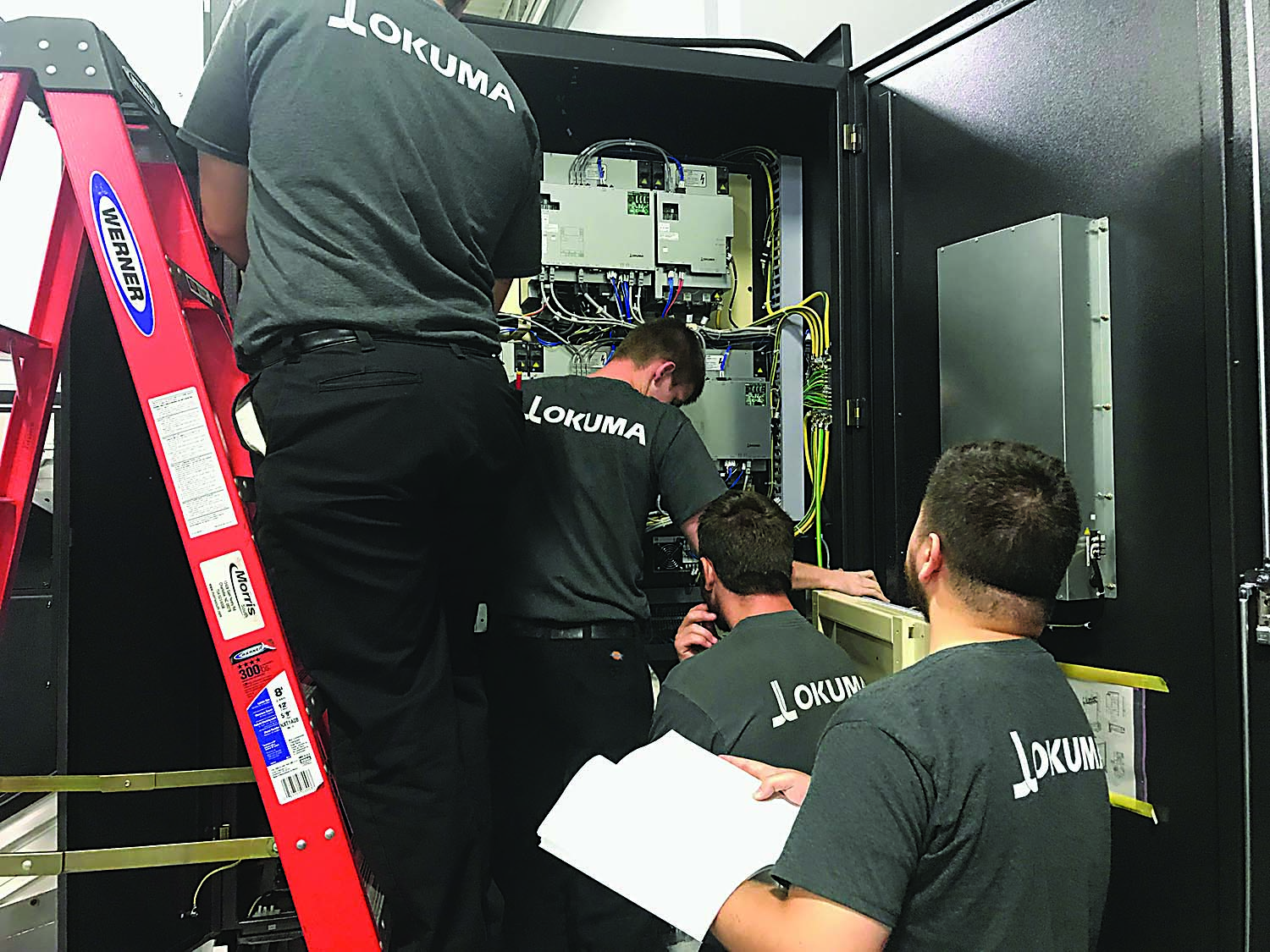
Apprentices at Okuma America put the theoretical knowledge they gained in classes into practice on a machine tool. Image courtesy of Okuma America
“Unless you’ve worked on Okuma machines, there is going to be some level of training required,” Cagle said. “It’s hard to find people with Okuma-specific skills. I’m sure that other big builders have the same challenge.”
As a result, after a multiple-year hiatus, Okuma restarted and altered its apprenticeship program in 2015 to focus only on training technicians, Cagle noted. The company partners with nearby York Technical College for classroom and hands-on lab-type learning. The participants, whom Okuma hires as apprentices, attend 10 one-week classes, or modules, and work at the company for two to three weeks between each module to put the theoretical knowledge they gained into practice on a machine tool under the supervision of someone, such as a principal engineer or senior technician, Cagle said. One class, for example, covers mechanical maintenance on Okuma LB EX horizontal lathes.
After they complete the program in eight months, apprentices take part in a graduation ceremony where they receive a certificate of completion and are promoted to technician level 1. Three graduated in 2016, four graduated in 2018, and four more are expected to finish the program next year, Cagle noted.
Although Okuma understands that the applicants for the apprentice positions will not have the technical skills for the job, Cagle said they must possess the proper character, drive and potential. However, having a degree from a community college, such as in electronics or mechatronic engineering, helps.
“We try to pick the guys who we think will grow into great technicians,” he said. “We are looking for guys who have strong mechanical aptitude but maybe not a ton of experience.”
American Program With a German Flavor
Rather than develop an apprenticeship program in-house, some machine tool builders select to train workers with an already established program. One such offering is the Chicago-based Industry Consortium for Advanced Technical Training Apprenticeship Program, which has machine builders GF Machining Solutions LLC, Lincolnshire, Illinois; Engis Corp., Wheeling, Illinois; and Hermle USA Inc., Franklin, Wisconsin, in its network of more than 60 participating manufacturers in five states. In addition, 14 colleges are in the ICATT network, noted Program Director Virginia Attaway Rounds.
Chicago-based German American Chamber of Commerce of the Midwest Inc. founded the program, but a manufacturer doesn’t have to be a member of that organization to participate, Rounds said.
“The ICATT Apprenticeship Program is available to any employer that needs to train their skilled workforce and the profiles we assist with,” she added. “Because we were able to leverage the experience of thousands and thousands of German employers and manufacturers when creating the program, we are able to gather that information and not have to reinvent the wheel on what a training plan could look like.”
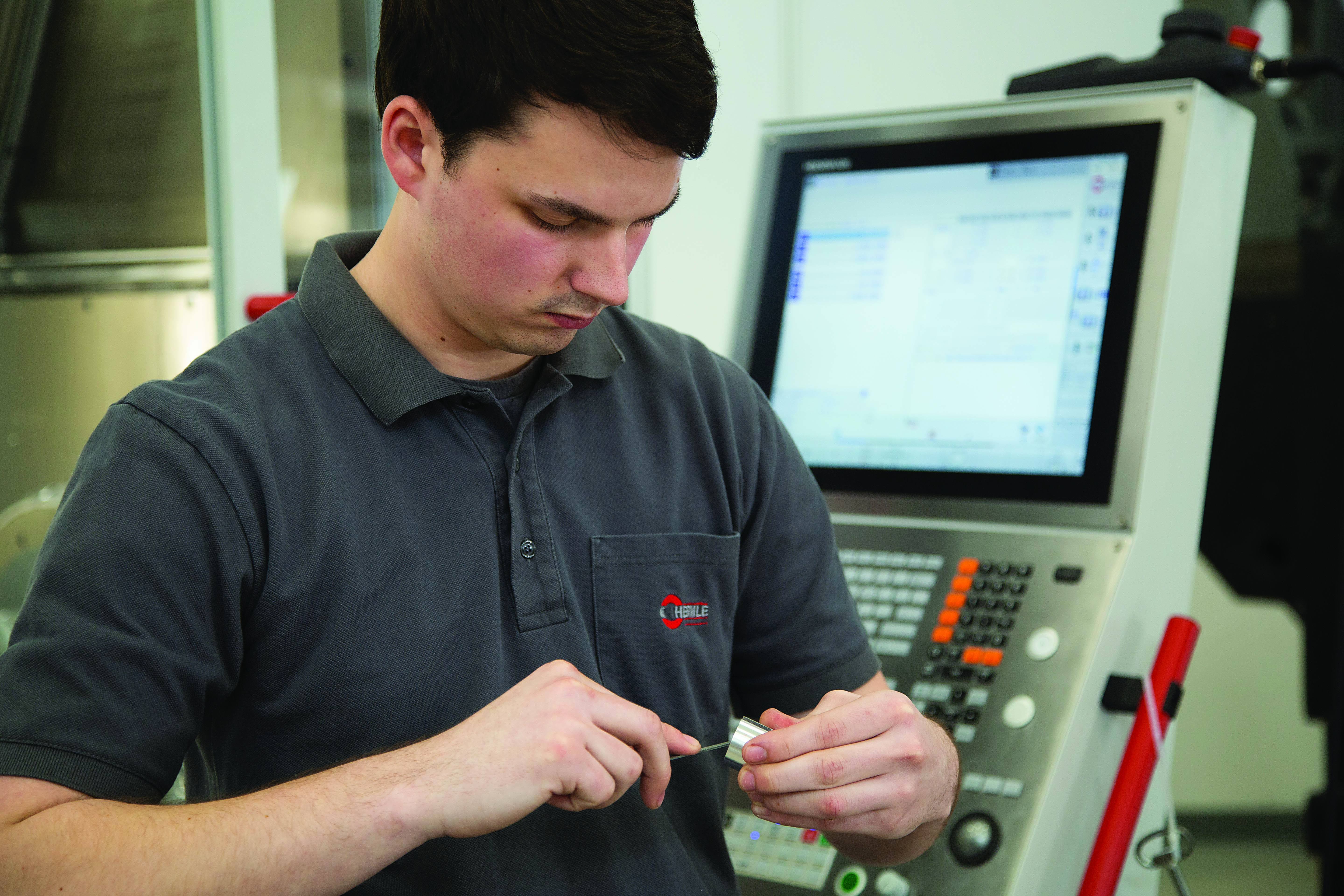
Thomas Renier, an apprentice in the ICATT Apprenticeship Program, works at Hermle USA Inc., Franklin, Wisconsin. Image courtesy of ICATT Apprenticeship Program
After working at a company and completing the three-year program, apprentices receive an associate degree from the college their employer paid for them to attend and are required to be an employee of that company for two more years, Rounds said. “This is really important for the security of our employers because they are investing a lot in the apprentices.”
However, the idea is for an employer to treat an apprentice as someone special who will be part of the “company family” for an extended period of time and enjoy a career with upward mobility. At the ceremony for the first graduating apprentices held at IMTS 2018, Rounds noted, one graduate said he could see himself working at the company for his entire career while eventually earning an engineering degree by taking night courses.
Rounds said the program targets three manufacturing occupations: industrial maintenance, machine tool building and CNC machining.
But just studying the subject isn’t enough. “You can’t improve what you don’t measure,” Rounds said, “so every one of our apprentices takes comprehensive exams, both a written exam and a practical exam, so we can actually measure what they have learned. What the employers do with those exam results is completely up to them.”
Review the print ads from this magazine to continue
This quick advertiser review unlocks the rest of the article and keeps the full-screen reader focused on the ads instead of the page chrome.
Advertisers included in this article experience
Print placements connected to this article
Toolflo
The Threading Specialist!
FLO-LOCK ON-EDGE CHASERS API Threading chasers! Full line of standard threading inserts • Buttress, WW, NPT, Rounds... and toolholders with chip control! LAYDOWN Wide array of standard thread geometries in both inch and metric sizes! Extensive offering also includes chipbreaker items, multitooth configurations, and pressed.
The Threading Specialist! FLO-LOCK ON-EDGE CHASERS API Threading chasers! Full line of standard threading inserts • Buttress, WW, NPT, Rounds... and toolholders with chip control! LAYDOWN Wide array of standard thread geometries in both inch and metric sizes!
Visit Toolflo View this placement in the issue recordPrint ads from this magazine
FLO-LOCK ON-EDGE CHASERS API Threading chasers! Full line of standard threading inserts • Buttress, WW, NPT, Rounds... and toolholders with chip control! LAYDOWN Wide array of standard thread geometries in both inch and metric sizes! Extensive offering also includes chipbreaker items, multitooth configurations, and pressed.
The Threading Specialist! FLO-LOCK ON-EDGE CHASERS API Threading chasers! Full line of standard threading inserts • Buttress, WW, NPT, Rounds... and toolholders with chip control! LAYDOWN Wide array of standard thread geometries in both inch and metric sizes!
Continue reading
May 2019
A practical examination, she explained, might involve taking pre-machined parts, machining additional components and combining them into a working assembly with a pneumatics circuit within a six-hour time frame.
To date, the ICATT Apprenticeship Program has trained or is training 70 apprentices, with about two-thirds of the apprentice slots filled last fall, Rounds said. She added that filling those slots is something two ICATT employees dedicate all their working time to, reaching out to high school students, military service veterans and other prospects to encourage them to participate and create awareness about career opportunities in manufacturing.
Staffing and Training
Madden Industrial Craftsmen Inc. frequently found that people were seeking a way to advance their skills rather than just being placed at a job site. So the industrial staffing company developed a training program to meet their requests, said Kelsey Scotch, corporate recruiting manager for Madden, which has an office in Beaverton, Oregon, and three more in Washington: Everett, Vancouver and Renton.
“We are the first staffing agency to manage an apprenticeship program,” she said. “It’s registered with the state of Oregon.”
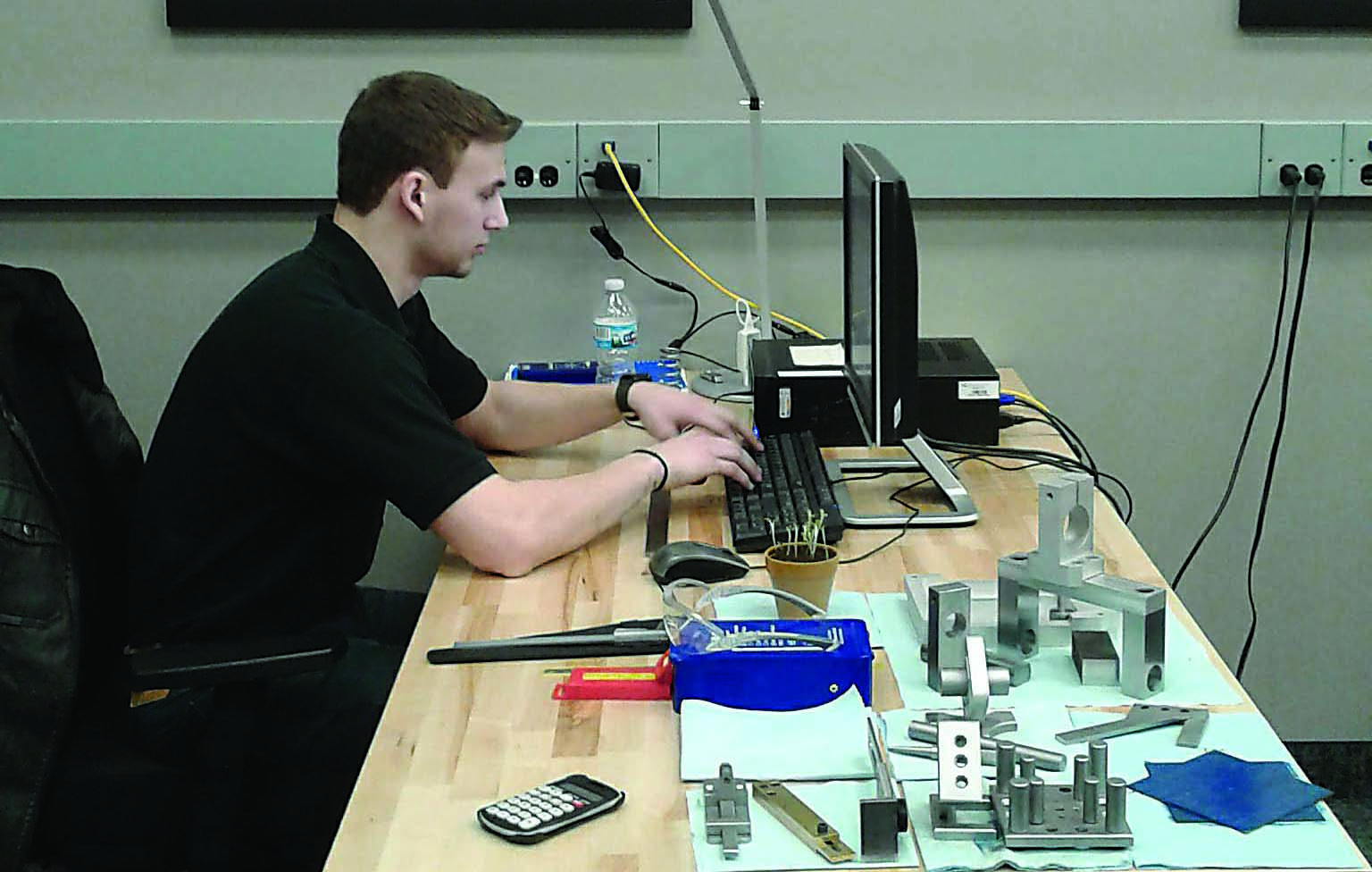
In addition to physical skills, the ICATT Apprenticeship Program helps develop an apprentice’s digital manufacturing skills. Image courtesy of GF Machining Solutions LLC
The four-year welding fabricator program is the first curriculum that the company developed in-house, Scotch added, and Madden partners with Portland Community College to provide four-year machinist and millwright apprenticeship programs. Welding apprentices also take courses at PCC while receiving on-the-job hours at one of the agency’s client facilities. Upon program completion, participants receive an associate degree and a journeyman card.
There is no requirement to continue working for a company after graduation, Scotch said. “When people have to work for a certain number of years after completing it, it’s impossible to enforce.”
Nonetheless, apprentices often develop a feeling of loyalty to a manufacturer that committed the time and effort to train them and paid for their classes, she added.
An apprentice, however, may not even be employed by the same manufacturer throughout the entire program. If a company needs to lay off an apprentice or goes out of business, Madden can move the apprentice to another manufacturer, Scotch explained. “So it keeps them employed and they get a variety of workforce training and never fall out of the program, which often happens with apprentices when employers face downturns.”
She emphasized that developing an apprenticeship program is a significant endeavor that takes at least a year.
“It is difficult for mom and pop shops or even medium-size companies to develop training programs,” Scotch said. “That’s where a staffing agency can come in and help. They are able to have high-quality training without the upfront cost and time and energy needed to create these programs.”
In the future, Scotch expects that Madden Industrial Craftsmen will develop additional apprenticeship programs. It is in the process of switching the majority of the class work to an online format to enhance flexibility. “We just started getting things off the ground,” she said.
Mind the Gap
According to Rounds, more and more young people are showing interest in the ICATT Apprenticeship Program.
“What’s also really gratifying is when their parents start to come around,” she said. “We have to make parents happy to send their kids into manufacturing careers. We have to have counselors recognize this as an attractive option for the best and brightest and not just a catchall for people who aren’t four-year college material.”
However, convincing enough people about the advantages of a manufacturing career will take time. Rounds estimates that it will take a generation to change the negative perception of manufacturing that has developed over the past decades.
Rounds added that the outlook is positive for closing the skills gap, but the bridge will never be fully built. “We can never close it; we can only keep it from getting bigger because the technology keeps going on, and we’re always chasing that skills gap. We’re doing everything we can.”
For more information about the ICATT Apprenticeship Program, view a video presentation at cteplus.delivr.com/2d2w9
Related



Subscribers can use MFGAxis notes, saves and discussion tools with their innoNET account.


