


Avoiding chatter resonance: General Industry Coverage
The Grinding Doc helps a shop experiencing chatter as its grinding wheel goes from 3" to 2" running at a constant 10,000 sfm.
Dear Doc: My ID wheel goes from 3″ to 2″ at a constant 10,000 sfm. I seem to get chatter constantly when the diameter is around 2.5″, and then I dress a bunch off and the problem goes away. What’s going on?
The Doc Replies: Chatter is my least favorite subject because there are so many different types of chatter. One possibility is that as the wheel rpm gradually increases from 12,732 rpm to 19,100 rpm [rpm = 12 × sfm ÷ (π × wheel diameter in inches)], it passes through a resonant frequency of the wheel and spindle assembly. When the wheel speed is at or near this frequency, the spindle displaces, which means it literally starts to uncontrollably bounce up and down at high amplitude.
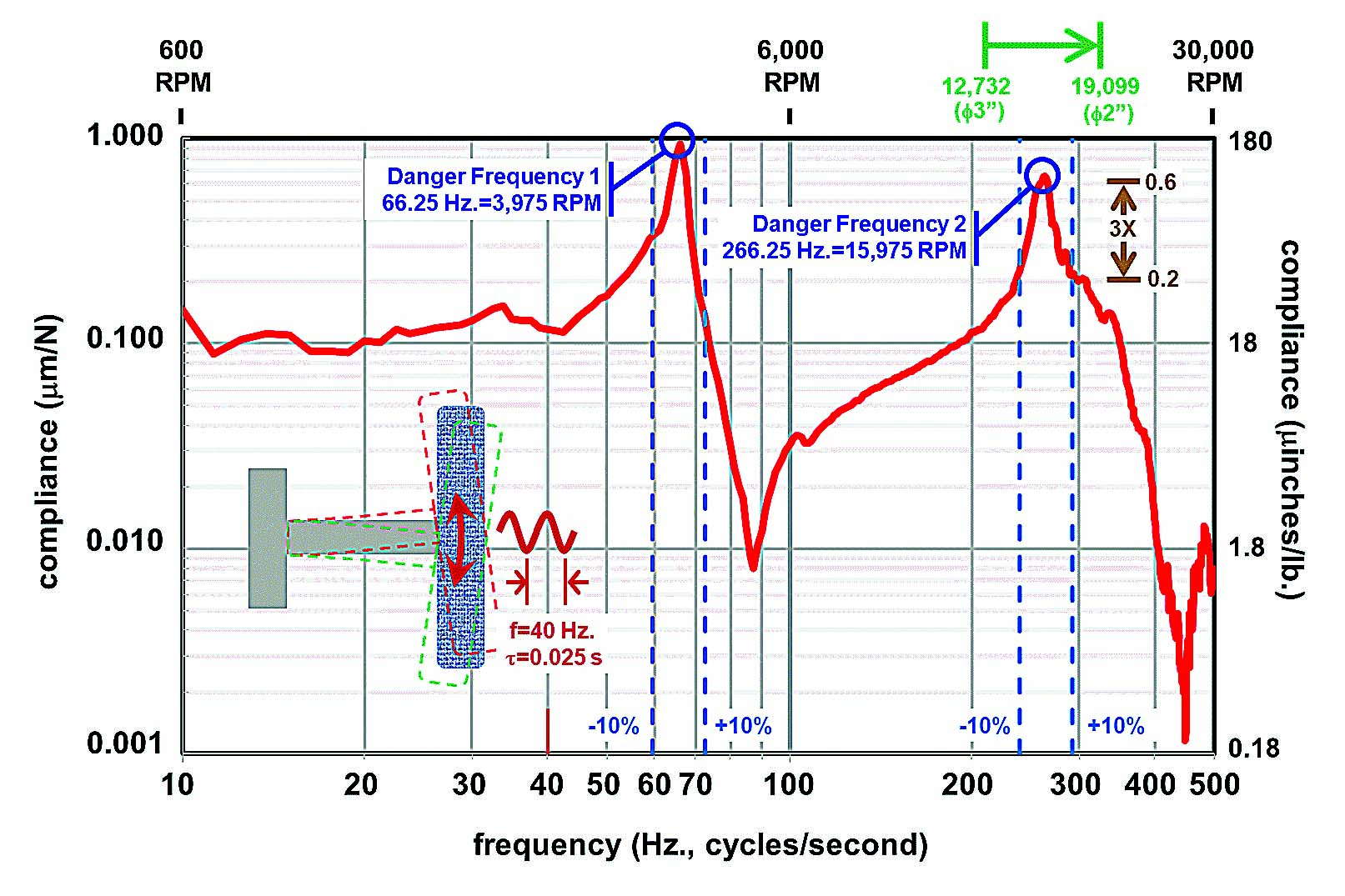
A frequency response function of the wheel and spindle assembly on a cylindrical grinder, courtesy of machine tool vibration expert Jon VanSant, shows the “danger frequencies.” Image courtesy of J. Badger
The figure shows the measured frequency response function of the wheel and spindle assembly on a cylindrical grinder. To build an FRF, intermittently push up on the spindle at a low frequency and measure how much it displaces. Then, repeat at higher frequencies and plot compliance versus frequency. (Compliance is the inverse of stiffness.)
A spindle usually doesn’t displace much, but at certain frequencies, it does so significantly. In other words, the wheel and spindle assembly is always bouncing up and down a tiny amount. But at some frequencies, the bouncing becomes huge.
How huge can this amplitude become? The figure shows a log-log plot. What looks like a small difference is actually enormous. In this case, the danger frequencies are 66.25 Hz and 266.25 Hz. If you run a wheel at or near 3,975 rpm or 15,975 rpm, the spindle starts bouncing frantically up and down, causing big scallops on the workpiece—i.e., chatter.
In your case, danger frequency No. 1 is outside your rpm range (the green arrow in the figure). But danger frequency No. 2 isn’t and occurs when the wheel is about 2.4″ in diameter [diameter = 12 × sfm ÷ (π × rpm)].
What’s the solution? Your operator is getting away from the danger frequency by dressing the wheel, which increases the wheel rpm. A better approach is just to increase or decrease the wheel rpm by, say, 10 percent. It might not look like much on the log-log scale, but this modest change will reduce your compliance by a factor of 3 (the brown arrow in the figure).
Changing the wheel rpm is a quick, first thing to try that may solve the problem. If not, you’ll have to dig deeper, which involves calculating chatter frequency from the distance between chatter marks and the workpiece velocity and then trying to pinpoint the source of the chatter. The next step is to use a hammer and accelerometer to determine natural frequencies of wheel-spindle assemblies, dresser-spindle assemblies and the workpiece.
Related


Subscribers can use MFGAxis notes, saves and discussion tools with their innoNET account.