

Bringing it home: Turning Performance
Horst Engineering's Mexican operations are homeward bound. The contract manufacturer is closing its operations in Guaymas, Sonora, and shipping the equipment back to the U.S. The Mexican facility, which employed 50 people, was established in 2006. As part of the move, Horst is establishing a satellite facility in South Windsor, Conn., about 4 miles (6.4 km) from its East Hartford headquarters.
Horst Engineering’s Mexican operations are homeward bound. The contract manufacturer is closing its operations in Guaymas, Sonora, and shipping the equipment back to the U.S. The Mexican facility, which employed 50 people, was established in 2006. As part of the move, Horst is establishing a satellite facility in South Windsor, Conn., about 4 miles (6.4 km) from its East Hartford headquarters. The company also plans to expand operations at its sister company, Sterling Machine Co. Inc., Lynn, Mass.
“After careful evaluation, our management team decided to expand operations in the U.S. rather than continue in Mexico,” said CEO Scott Livingston. “The workforces in Connecticut and Massachusetts are so highly skilled that it makes up for what was a perceived lower cost of doing business in Mexico.”
Privately owned Horst Engineering & Manufacturing Co. was founded in 1946 and has 95 employees at its two plants in East Hartford. The company’s core processes include Swiss screw machining, turning, milling, thread rolling, centerless grinding, honing and light assembly. Sterling Machine employs 40 people. Included within Horst is Thread Rolling Inc., a 20-year-old business unit that performs thread rolling and centerless grinding for other contract manufacturers.
Made in Mexico
When it was built, Horst Engineering’s Mexican plant was part of a companywide expansion to meet demand from aerospace customers. “When we launched the maquiladora, we wanted to grow our manufacturing business around the concept of lower-cost regional manufacturing,” Livingston said. “At the time, some of our OEM customers were encouraging us to establish a manufacturing operation outside the U.S. due to demands within their companies to expand the supply chain and spread procurement out geographically.”
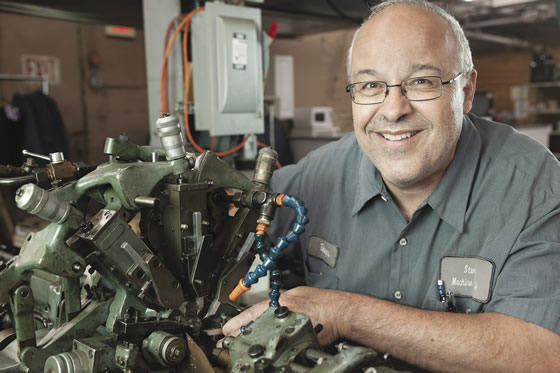
Dean Robinson, a veteran machinist, at Sterling Machine, which uses both modern CNC equipment and “old-school” cam-style Swiss-type screw machines, one of which is shown here. All images courtesy Alan Grant, Digital Creations.
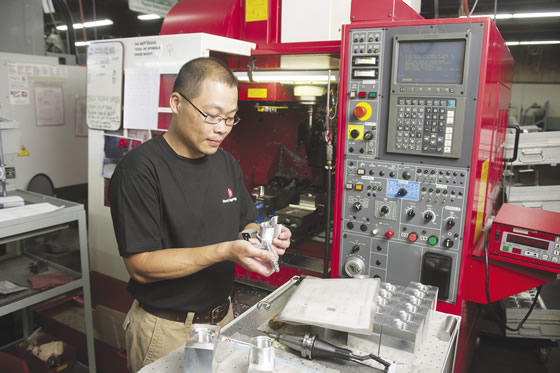
Chinh Nguyen, milling setup technician for Horst Engineering, inspects an aerospace part.
After researching various locations, the company decided on Mexico as the best option. “We needed to expand our physical footprint anyway, and we got some business for the Mexican plant from legacy customers and some from new customers who were exclusively focused on that region,” he said.
Livingston noted the Mexican operation offered cost savings, but not what he calls “transformational” cost savings. “We never planned for the Mexican plant to replace our U.S. manufacturing base. We were growing in Connecticut at the same time we were growing in Mexico.”
Fundamental Changes
Over the past 9 years, some business fundamentals have changed. “In 2006, it was relatively easy to get to Guyamas, but after the Great Recession, the flight patterns changed and made it harder for us to get there and more challenging for us to manage the plant,” Livingston said.
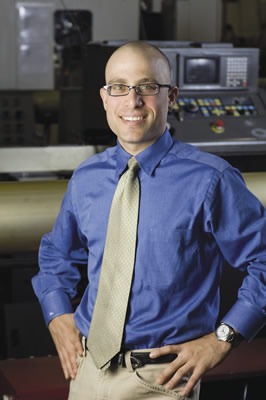
Horst Engineering CEO Scott Livingston.
He also said when the company first invested in the Mexican plant, it was led to believe that a more robust supply chain would develop over time. “To complete our parts, we rely heavily on an ecosystem of suppliers offering services such as heat treatment, coatings and testing. That supply chain has been slow to develop in Guyamas. We were still limited in some of the products that we could produce there, while in New England many of those services are within a stone’s throw of our plants.”
It was also challenging for Horst’s suppliers to reach the Mexican plant. For example, Horst primarily used U.S. suppliers to install machine tools, and it was difficult to get that equipment delivered, installed and calibrated.
Livingston said the case for reshoring is more compelling today because the economics have changed, with labor cost being a smaller part of equation and increased automation making it easier to increase production in the U.S. “Also, the availability of skilled labor is tight everywhere—not just in New England,” he said. “It’s tight in Mexico, too, because more companies have brought businesses there and soaked up the pool of available skilled labor.”
Livingston cautioned that he is speaking only from his own experience and noted other companies continue to invest in Mexico. “It’s good for those companies and it’s good for Mexico,” he said. “Mexico is fortunate to have a manufacturing-oriented economy and people there aspire to jobs in advanced manufacturing. We had several employees who were furthering their careers and elevating their economic status. But in order for us to grow our business, we needed more than that location could offer.”
Homing in on Efficiency
Horst Engineering decided that it could get “more” at home in Connecticut. Livingston noted that metalworking technology continues to improve and Horst is quick to invest in advanced technology and processes—such as multiaxis machining and lean initiatives—that can boost productivity.
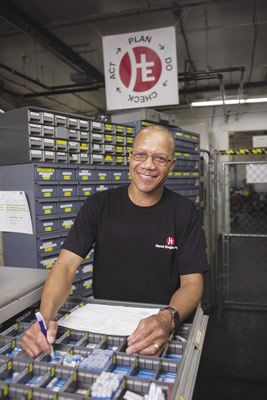
Crib Attendant Henry Presley leads Horst Engineering’s kitting process.
Review the print ads from this magazine to continue
This quick advertiser review unlocks the rest of the article and keeps the full-screen reader focused on the ads instead of the page chrome.
Advertisers included in this article experience
Print placements connected to this article
Fax+1 817 258 3221, [email protected]
s No Time
for Downtime! Interchangeable solid carbide reaming head Wide range of ISOTURN small sized system for accuracy and high productivity inserts for increased profitability ISCAR METALS INC. 5/26/15 11:15 AM.
s No Time for Downtime! Interchangeable solid carbide reaming head Wide range of ISOTURN small sized system for accuracy and high productivity inserts for increased profitability ISCAR METALS INC. Tel+1 817 258 3200, Tech Tel 1-877-BY-ISCAR Fax+1 817 258 3221, [email protected] www.iscarmetals.com 5/26/15 11:15 AM
Visit Fax+1 817 258 3221, [email protected] View this placement in the issue recordPrint ads from this magazine
for Downtime! Interchangeable solid carbide reaming head Wide range of ISOTURN small sized system for accuracy and high productivity inserts for increased profitability ISCAR METALS INC. 5/26/15 11:15 AM.
s No Time for Downtime! Interchangeable solid carbide reaming head Wide range of ISOTURN small sized system for accuracy and high productivity inserts for increased profitability ISCAR METALS INC. Tel+1 817 258 3200, Tech Tel 1-877-BY-ISCAR Fax+1 817 258 3221, [email protected] www.iscarmetals.com 5/26/15 11:15 AM
Continue reading
July 2015
The combination of greater efficiency from combined operations, a better manufacturing infrastructure and a competitive cost structure drove the decision to focus investment in New England. While some aerospace OEMs still look for geographic diversity in their supply chains, “we’re working hard to retain some of those customers right now by focusing on the total value that we offer with operations consolidated in New England,” Livingston said.
The Mexican plant officially closed in February, and Horst began work on the South Windsor satellite plant after leasing the former manufacturing site. “It’s giving us the opportunity to reconfigure plant layouts at all our Connecticut operations to get better workflows and create specific value streams at each plant,” he said, adding that redeploying all of the Mexican plant’s equipment will continue into next year.
For example, Horst will consolidateits Swiss-type screw machining in the new South Windsor satellite plant, with the exception of two Swiss screw machines at Sterling Machine. The South Windsor plant will be staffed with about 15 workers when running at full capacity.
Horst has already hired some workers that will migrate to the satellite plant once it is completed and plans to add more people as the Mexican equipment is brought back online. In the meantime, the company has increased production at its existing plants to deliver products previously manufactured in Mexico.
“We’ve had to be creative in order to maintain our deliveries,” Livingston said. “We are operating two shifts at all the plants, and that will continue throughout 2015 and 2016, based on improvements in the economy in general and the aerospace manufacturing economy in particular.”
Recruiting, Hiring, Growing
One of the challenges in ramping up production in Connecticut is the competition for skilled manufacturing workers. As a result, Horst is working closely with local vocational-technical high schools to recruit machining students, leveraging referrals from existing employees, using recruiters and stepping up its on-the-job training.
“It’s a matter of executing our searches better to find people with the right basic skill sets so we can mold them to our specific processes,” Livingston said. He added that the existing staff reacted positively to the “nearshoring” of the company’s Mexican operation and to the opportunity to learn new skills. “We’ve got guys who are going from 2-axis lathes to multiaxis lathes and from multiaxis lathes to multiple-turret, multiple-spindle lathes. It’s giving everyone an opportunity to pitch in and move up.”
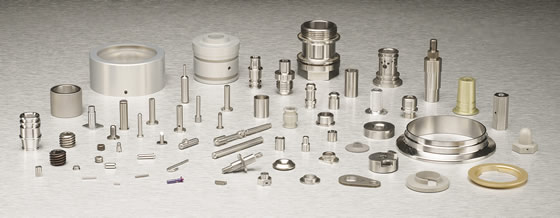
Sterling Machine specializes in aircraft engine parts machined from high-temperature alloys.
Horst is also using grants from the Connecticut and Massachusetts governments to conduct lean-enterprise and incumbent-worker training.
As if moving a plant 2,800 miles wasn’t enough, the company is also looking for a new location for its Sterling Machine subsidiary in greater Boston, with the goal of doubling plant size and moving during the second half of 2016.
“We are excited to strengthen our local ties, both in Connecticut and Massachusetts, because the aerospace industry is so firmly entrenched here,” Livingston said. “There is an incredibly talented pool of workers and a strong network of suppliers that are vital to our success.” CTE
About the Author: Alan Rooks is editorial director of CTE. Contact him at (847) 714-0174 or arooks@jwr.com.
Majoring in aerospace, minoring in medical
Horst Engineering & Manufacturing Co.’s primary business is machining aerospace components, including a range of custom metal and plastic parts, such as fasteners, pins and bushings. The company also produces medical and dental instruments and implants, in addition to parts for many other industries.
The ISO 9001:2008- and AS 9100-registered company ‘s quality management system meets the requirements of military specifications, and the company is a U.S. Department of Defense QSLM-approved manufacturer of threaded fasteners. Horst’s calibration system meets the requirements of ISO 10012:2003 and MIL-STD-45662 and its gaging system is fully traceable to the National Institute of Standards and Technology (NIST).
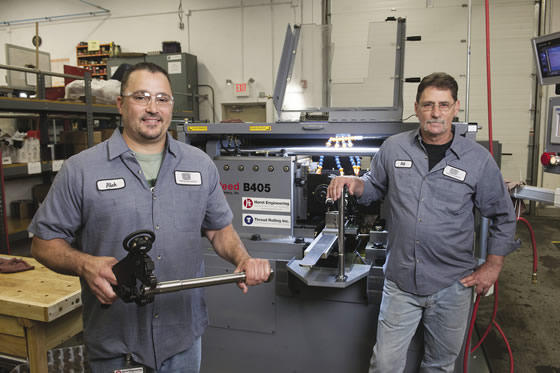
Horst Engineering employs several multigenerational teams, including Rick Gdovin Sr. and Rick Gdovin Jr.
Horst Engineering’s medical products are produced to ISO standards and its systems are ISO 13485-compliant for automotive and commercial customers. The company has also worked to the requirements of other global industry specifications for automotive and other commercial customers, including ISO/TS 16949:2002. Its inspection methods provide real-time statistical process control and employ a digital gaging system.
While the company performs a variety of machining processes, one of its specialties is Swiss-type screw machining. Using this process, it can produce parts with a minimum diameter of 0.020 ” (5mm) and a maximum diameter of 1.250 ” (32mm). It operates Swiss screw machines with up to 13 axes, can machine materials as hard as 48 HRC and produces parts in lots from 50 to 100,000.
—A. Rooks
Glossary terms in this article
Related



Subscribers can use MFGAxis notes, saves and discussion tools with their innoNET account.


