

A clamping system to eliminate blade vibration on blisks
Turbine blades are typically mounted on compressor disks and milled from a single piece of material rather than constructed blade by blade. These are known as blade-integrated disks, or blisks, and their main function is to compress air in the turbine.
Turbine blades are typically mounted on compressor disks and milled from a single piece of material rather than constructed blade by blade. These are known as blade-integrated disks, or blisks, and their main function is to compress air in the turbine. These turbine blades are long and thin, which can cause problems when manufacturing them all at once, according to Roman Kalocsay, a former engineer at the Fraunhofer Institute for Production Technology. (The clamping system prototype was created by the Fraunhofer Innovation Cluster Adaptive Production for Resource Efficiency in Energy Generation and Mobility.)
For starters, the blades vibrate like a tuning fork during production, forcing manufacturers to process the outer edge of a blade to its finished state before moving on to other areas. Additionally, the tension on the turbine blades causes the geometry to be slightly warped. Kalocsay promises a remedy for eliminating blade vibration with a new clamping system that absorbs 12.5 percent of the vibration in titanium blisks compared to just 0.027 percent without it. “Using the clamping system, manufacturers can rough mill the blades first, and then perform the precise finishing work because the blades no longer vibrate,” he said.

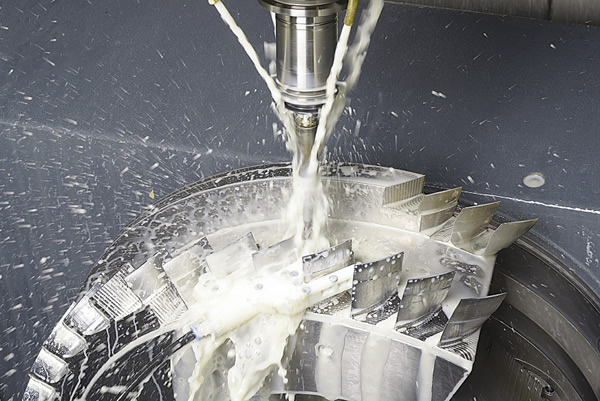
Blisks are long and thin, which can cause vibration and warped geometry problems.
Review the print ads from this magazine to continue
This quick advertiser review unlocks the rest of the article and keeps the full-screen reader focused on the ads instead of the page chrome.
Advertisers included in this article experience
Print placements connected to this article
1-800-storloc
the best tool cabinet
you’ll ever buy guaranteed for 55 years 100% made in the usa in every way! Made by aMerican craftsMen in the Usa COMMAND MORE ATTENTION WITH COLOR. Call your CTE rep today to incorporate color into your ad program! East Central East Scott Beller Dave Sweeney Central West Far West Dave Jones Ryan King Scan to view the Readex Research.
the best tool cabinet you’ll ever buy guaranteed for 55 years 100% made in the usa in every way! 1-800-786-7562 1-800-storloc Made by aMerican craftsMen in the Usa www.storloc.com COMMAND MORE
Visit 1-800-storloc View this placement in the issue recordPrint ads from this magazine
you’ll ever buy guaranteed for 55 years 100% made in the usa in every way! Made by aMerican craftsMen in the Usa COMMAND MORE ATTENTION WITH COLOR. Call your CTE rep today to incorporate color into your ad program! East Central East Scott Beller Dave Sweeney Central West Far West Dave Jones Ryan King Scan to view the Readex Research.
the best tool cabinet you’ll ever buy guaranteed for 55 years 100% made in the usa in every way! 1-800-786-7562 1-800-storloc Made by aMerican craftsMen in the Usa www.storloc.com COMMAND MORE
Continue reading
December 2015
Eliminating vibration with the clamping system reduces manufacturing costs. The vibrating blades put a strain on a tool’s cutting edges, forming fissures that quickly increase in size with mechanical and thermal stress. A tool often has to be replaced after cutting only 4m (13.12 ‘) worth of material. Initial experiments with the clamping system, however, suggest that tools could last two to three times longer.
“Spring-loaded clamps automatically grasp the blade with equal amounts of tension on both sides,” Kalocsay explained. “As soon as the elements are in position, they are hydraulically clamped in place and hold the workpiece as if it had grown there.”
During repair, the blades cannot be milled piece by piece out of the material as all the blades are already in place. Instead, if their edges appear to be “frayed,” the manufacturer reapplies the material using laser metal deposition and then mills it to the desired form. It is nearly impossible to align the blades perfectly using clamps or rubber. Consequently, workpieces must be remeasured afterwards in a time-consuming process because it is not clear how much they have drifted to the left or right. The clamping system helps here, too.
“It doesn’t change the blisk’s geometry by even a micrometer. The blade is fixed in place in just a few seconds and can be worked on immediately,” Kalocsay added.
For more information about the Fraunhofer Institute for Production Technology, Aachen, Germany, visit www.fraunhofer.de or call +49-241-8904-316. CTE
Glossary terms in this article
Related



Subscribers can use MFGAxis notes, saves and discussion tools with their innoNET account.


