


A closer look at boring combustion parts
Cutting tool manufacturers have been responding to the market and providing creative, effective solutions for boring holes.
Boring is a term applied to many activities, from making holes in the earth to making holes in wood for construction. Although the term describes a multitude of activities, they all include the making and enlarging of holes. At a machine shop, boring is typically defined as enlarging an existing hole with a single-point cutting tool.
Experienced machinists, toolmakers and engineers are familiar with the varied styles of boring tools. Experienced craftspeople are also familiar with the countless methods used to make boring tools, such as creating homemade extensions for hard-to-reach areas and fashioning Rube Goldberg-type devices to eliminate chatter. Fortunately, cutting tool manufacturers have been responding to the market and providing creative, effective solutions for boring holes.
Machining Combustion Parts
At Mitsubishi Hitachi Power Systems Americas Inc., combustion parts start as flat materials. They are then cut, formed and welded to create a final product. During the manufacturing process, we utilize lathes and horizontal boring mills to bore the geometry of critical features.
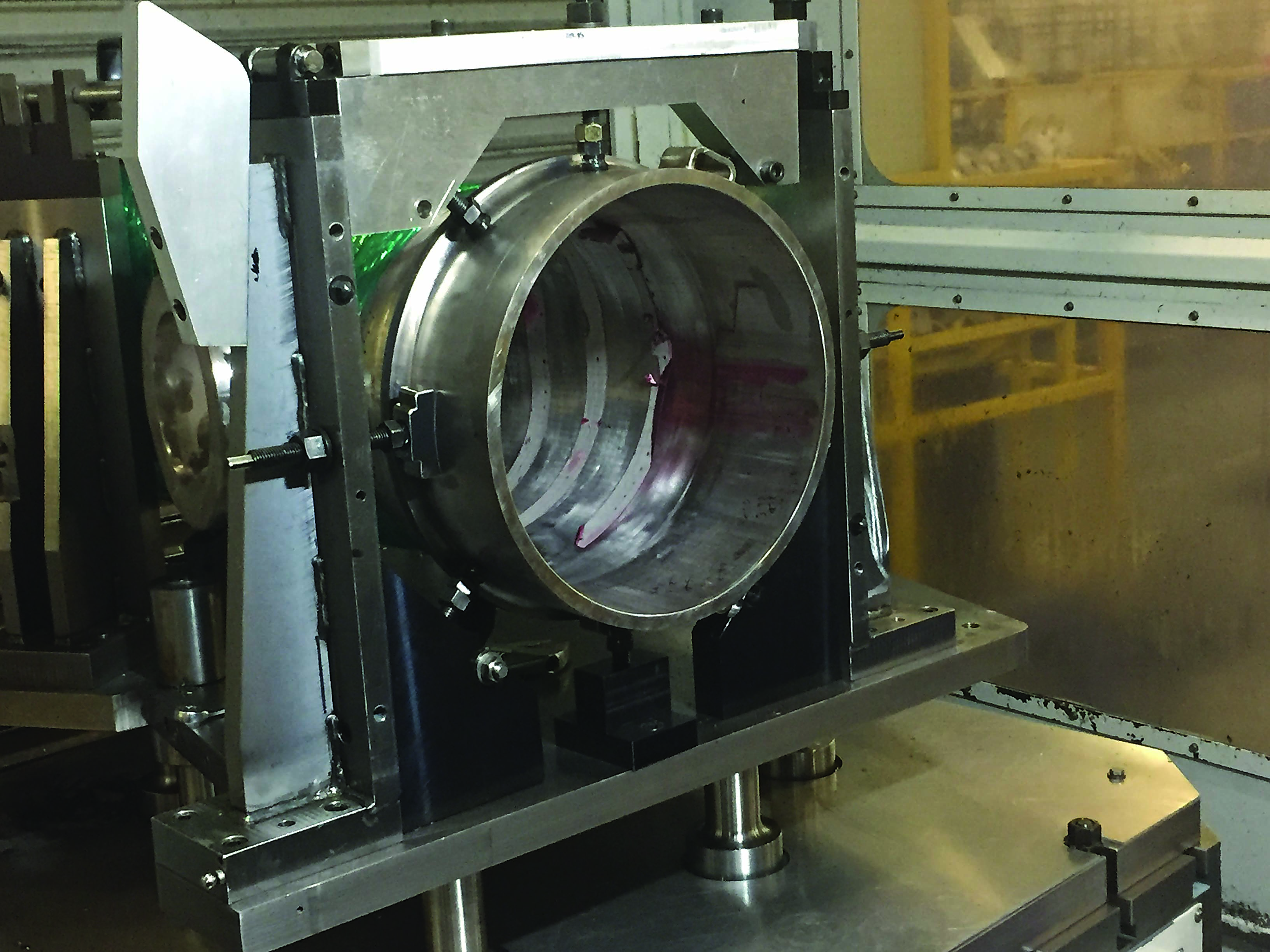
The inlet of a combustion transition piece is ready for boring in a horizontal boring mill. All images courtesy of C. Tate
In the past, as we started manufacturing parts, we struggled to machine combustion assemblies. Machining became a bottleneck process, disrupting part flow. Most of our problems resulted from boring operations.
Boring combustion baskets caused the most trouble. These long cylinders with large diameters have thin walls made from materials like Inconel, which is difficult to bore.
Our primary challenge was gaining access to the areas that needed machining. We originally used indexable boring bars with traditional steel bodies but quickly figured out they would not work because they caused chatter. We discussed several other options, including solid-carbide bars and larger-diameter specials. Eventually, we settled on mechanically dampened boring bars, which effectively eliminated chatter.
In addition, they were offered in the lengths we needed and were built to accept quick-change indexable heads. Once set in a lathe’s turret, they do not need to be removed. We simply change the head when a different-style insert is needed, which allows one bar to perform boring, grooving and threading. Flexibility reduces the overall cost of the project and shortens setup times.
Combustion transition pieces are the companion parts to combustion baskets but are considerably larger and require more machining. CTPs are not as prone to chatter because the setup is stiffer, the areas to machine are easier to reach and the walls of the part are thicker. The inlet end of a CTP resembles a large-diameter pipe. Inlet diameters are slightly different across the product line, ranging from 310mm to 320mm.
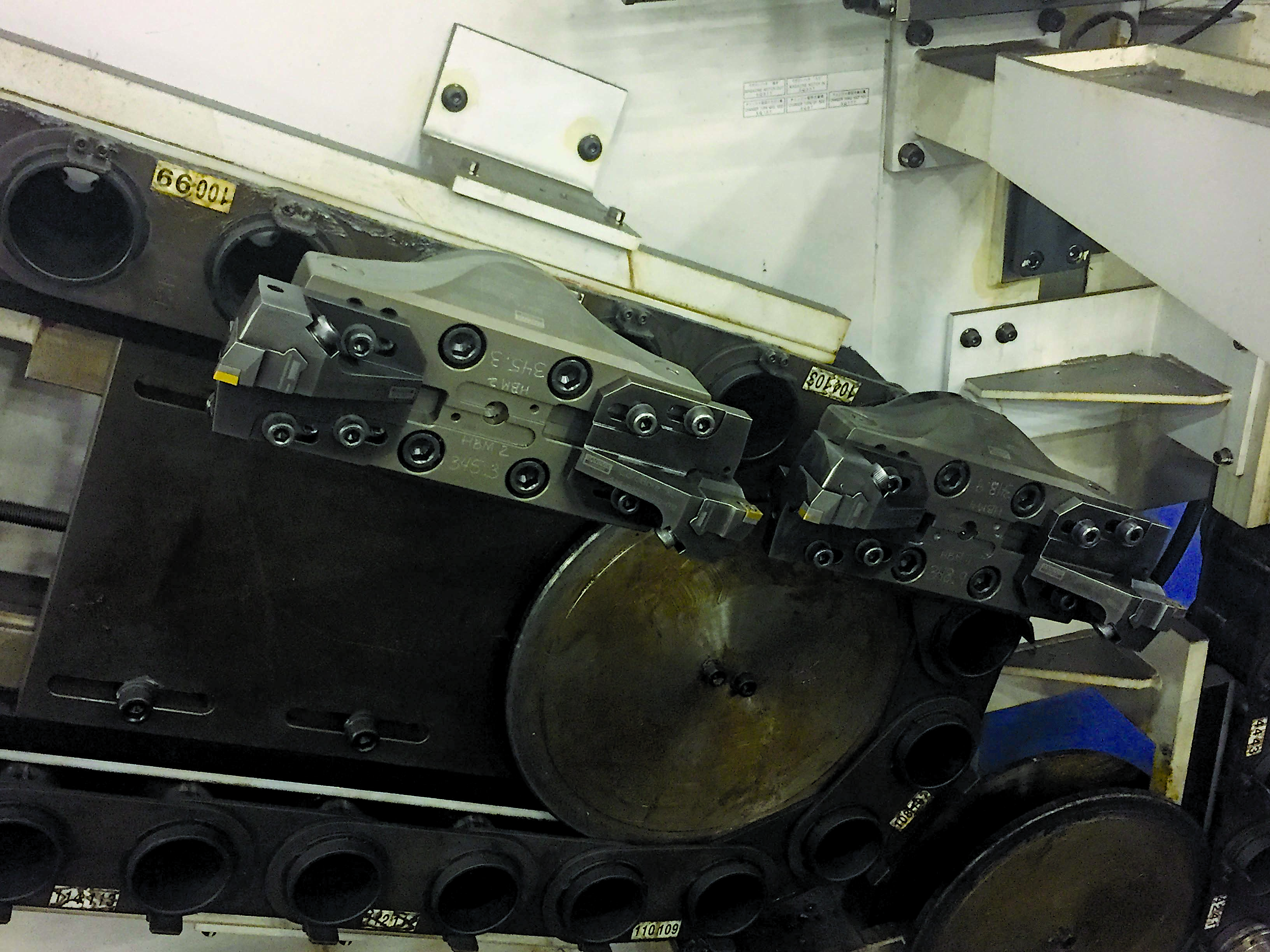
Two bridge-style boring tools in the tool chain of a horizontal boring mill. Each diameter required a dedicated tool.
View print ads from this spread
Review the ads on this magazine spread to continue reading. Each ad takes two seconds; a two-page ad counts once.
Advertisers on this magazine spread
Print placements on this magazine spread
Ceratizit
SILVERSTARTM GRADE
CTPM245 FOR MILLING HIGH ALLOY STEELS ▲ Ultra-modern post treatment process Excellent stability for cleaner, longer cutting ▲ Special optimized layer structure Machines longer; more parts per tool ▲ New PVD coating technology Toughest high-temperature coating ▲ Superior performance in: • 300 Series Austensitic SS • 400 Series Martensitic SS.
SILVERSTARTM GRADE CTPM245 FOR MILLING HIGH ALLOY STEELS ▲ Ultra-modern post treatment process Excellent stability for cleaner, longer cutting ▲ Special optimized layer structure Machines longer; more parts per tool ▲ New PVD coating technology Toughest high-temperature coating ▲ Superior performance in:
Visit Ceratizit View this placement in the issue recordPrint ads from this magazine
CTPM245 FOR MILLING HIGH ALLOY STEELS ▲ Ultra-modern post treatment process Excellent stability for cleaner, longer cutting ▲ Special optimized layer structure Machines longer; more parts per tool ▲ New PVD coating technology Toughest high-temperature coating ▲ Superior performance in: • 300 Series Austensitic SS • 400 Series Martensitic SS.
SILVERSTARTM GRADE CTPM245 FOR MILLING HIGH ALLOY STEELS ▲ Ultra-modern post treatment process Excellent stability for cleaner, longer cutting ▲ Special optimized layer structure Machines longer; more parts per tool ▲ New PVD coating technology Toughest high-temperature coating ▲ Superior performance in:
Continue reading
January 2019
Our first inlet machining operations for CTPs included helical milling. With helical milling, which was selected primarily for flexibility, we could use a single cutting tool to machine the different diameters found across the part family, thereby reducing tooling costs. Helical milling worked but was slow and plagued by premature insert failure that could break expensive milling tools. It became evident that helical milling, although effective in many other applications, was not the best choice for machining these parts.
Boring Decisions
We determined that boring would be the best option and purchased bridge-style boring tools. These tools have several advantages, starting with a Coromant Capto connection that allows us to attach various spindle adapters and extensions when needed. Bridge-style tools have a main body that will accept various subassemblies, allowing users to do ID work, OD work and face grooving. Most importantly, the costs to operate and repair the heads are far less than for the milling tools.
Modularity of these boring tools allows us to rough with simple (inexpensive) indexable holders or finish by bolting on a fine boring head that can be adjusted in 0.002mm increments. Although these bridge-style assemblies cost about $3,500 each, they are one of the best options available when boring a 320mm hole.
Each gas turbine disc has a dozen 80mm-dia. holes used to bolt the discs together into a single unit called a rotor. These holes are the most challenging boring job we have. Some of these holes are over 600mm deep; the boring tools can sag under their own weight, making accurate holes difficult to achieve.
To combat the difficulties associated with deep holes, we plan to begin using padded, or guided, tools, which are an adaptation from the automotive industry. They resemble a traditional boring head and enable a small amount of adjustment. However, they are made for a specific hole size, not a range of sizes.
Holders can be adjusted radially and axially, eliminating error from runout. Lapped guide pads placed around the circumference of the head ride on the bored hole to prevent the tool from wandering off course. We expect to see improved quality, process capability and cycle times by applying the tools.
Creating accurately sized holes can be a challenge when tolerances are tight. Add complicating factors, such as large diameters or high diameter-to-length ratios, and things can really become difficult. Learning about new technologies, understanding the available tools and learning about methods used in other industries can provide pathways to success in difficult boring operations.
Glossary terms in this article
Related



Subscribers can use MFGAxis notes, saves and discussion tools with their innoNET account.