

Cold, hard and thin: General Industry Coverage
With hardness greater than 40 Gpa, diamond-like coatings (DLCs) provide a low coefficient of friction, resist chemical attack and protect against abrasive wear for a host of applications, such as cutting tools and wear components in machine tools.
With hardness greater than 40 Gpa, diamond-like coatings (DLCs) provide a low coefficient of friction, resist chemical attack and protect against abrasive wear for a host of applications, such as cutting tools and wear components in machine tools.
Conventional pulsed-laser deposition (PLD) takes place in a vacuum chamber and deposits thin films of coatings, such as DLCs, but it’s difficult to deposit uniform coatings and form the required particle-free coatings, according to Picodeon Ltd. Oy, a coating equipment manufacturer. These challenges limit the scalability of the process to industrial production.
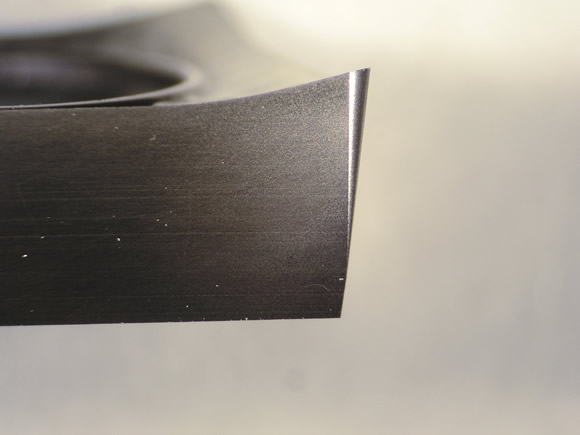
Courtesy of Picodeon
A cutting tool insert with a diamond-like coating deposited via Picodeon’s Coldab US PLD process.
To achieve the desired composition, the company reported that it developed the ultrashort PLD cold-ablation process based on a high-power laser beam with a pulse duration typically less than 10 picoseconds. (A picosecond is one trillionth—0.000000000001—of a second.) This enables coating substrates at temperatures below 100° to 150° C. In addition, a cold-ablation method’s plasma does not contain a significant proportion of molten material and particles, which are found in hot-ablation processes that use lasers with pulse lengths in the nanosecond regime.
Called Coldab, the US PLD technology is suitable for depositing DLCs and other coatings with thicknesses from a few hundred nanometers to 2µm to 3µm on virtually any substrate, including metals, ceramics, composites, elastomers and even tissue paper.
Review the print ads from this magazine to continue
This quick advertiser review unlocks the rest of the article and keeps the full-screen reader focused on the ads instead of the page chrome.
Advertisers included in this article experience
Print placements connected to this article
We Asked The Mastercam Community...
Why do you use Mastercam?
Mastercam is the most widely used CAD/CAM software in the world with an unmatched global community to back it up. Join us to find out how the #MastercamFamily can benefit you
We Asked The Mastercam Community... Why do you use Mastercam? Mastercam is the most widely used CAD/CAM software in the world with an unmatched global community to back it up. Join us to find out how the #MastercamFamily can benefit you. 671 Old Post Rd.Tolland, CT USA • 800 228 2877 www.mastercam.com
Visit We Asked The Mastercam Community... View this placement in the issue recordPrint ads from this magazine
Mastercam is the most widely used CAD/CAM software in the world with an unmatched global community to back it up. Join us to find out how the #MastercamFamily can benefit you
We Asked The Mastercam Community... Why do you use Mastercam? Mastercam is the most widely used CAD/CAM software in the world with an unmatched global community to back it up. Join us to find out how the #MastercamFamily can benefit you. 671 Old Post Rd.Tolland, CT USA • 800 228 2877 www.mastercam.com
Continue reading
September 2013
“Any components that need to have the highest possible hardness or wear resistance can achieve improved life cycles, greater heat and pressure resistance and/or improved performance with diamond-like coatings,” said Picodeon CEO Marko Mylläri. “Our US PLD process can deliver the exact surface defined by our customers’ engineers because of the high level of tuning enabled by our process.”
The tunable process parameters include pulse energy, pulse length, repetition rate and substrate preheating, the company stated. In addition to cleaning substrates to remove dirt and moisture prior to coating, some materials are preheated from 800° to 950° C (1,472° to 1,742° F) to promote the formation of a suitable surface structure.
Because cubic boron nitride and carbon nitride coatings are stable at extreme temperatures and offer low chemical reactivity when cutting hardened steels and other ferrous materials, the company is developing technology for depositing those materials as coatings. However, they are quite difficult to produce as thin coatings.
For more information about Picodeon Ltd. Oy, Li, Finland, call +358-40-533-3432 or visit www.picodeon.com. CTE
About the Author: Alan Richter is editor of CTE. Contact him at (847) 714-0175 or alanr@jwr.com.
Glossary terms in this article
Related




Subscribers can use MFGAxis notes, saves and discussion tools with their innoNET account.


