Demand rises for ultrahard-material cutting machines
A recent report, "Global Ultra Hard Material Cutting Machines Market" by Transparency Market Research, forecasts a healthy compound annual growth rate of 10.8 percent for these machines for the years 2016 to 2024, with the total market reaching $1.8 billion by the end of that period.
A recent report, “Global Ultra Hard Material Cutting Machines Market” by Transparency Market Research, forecasts a healthy compound annual growth rate of 10.8 percent for these machines for the years 2016 to 2024, with the total market reaching $1.8 billion by the end of that period. The report’s authors expect rising demand to lead to more competition and lower prices.
TMR analysts believe this growth will be driven in part by the increased use of synthetic-diamond semiconductor substrates made via chemical vapor deposition. This market is expanding due to the material’s improved thermal management capabilities, allowing greater power densities for electronics within a smaller footprint. CVD-diamond materials also find application in cutting tools, thermal conductors and gemstones.
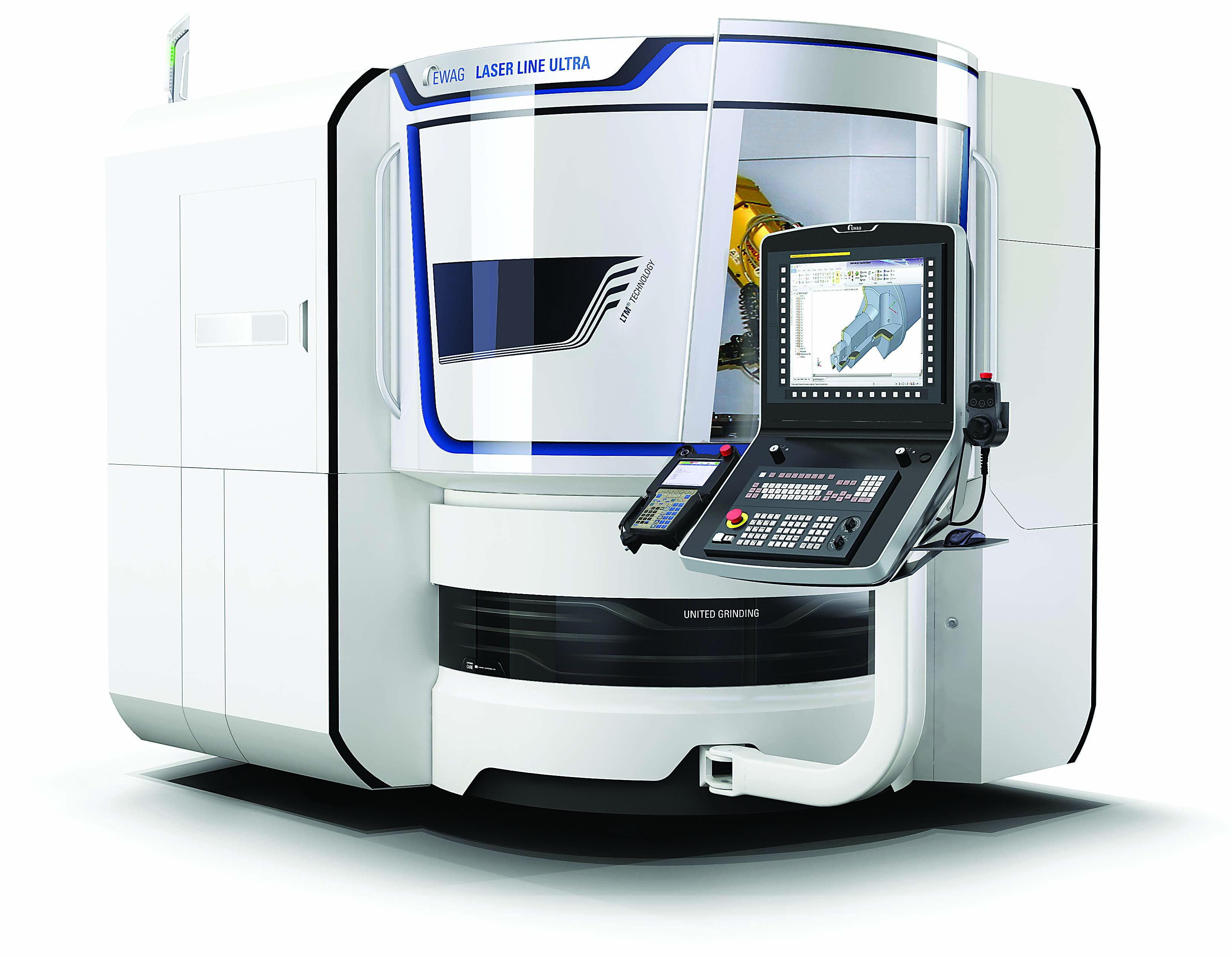
EWAG’s Laser Line Ultra with ultrashort-pulsed laser technology machines all commercially available cutting materials, including carbide, PCBN, ceramic, PCD, CVD-diamond and monocrystalline diamond without producing heat. Image courtesy of EWAG.
Also pushing the demand for ultrahard-material cutting machines is the rise in use of PCBN as a substitute for diamond, according to the report. Cutting tool tips made of PCBN or PCD are projected to spur demand for machines capable of cutting and shaping these ultrahard materials. PCD is an amalgam of diamond grains sintered in a cobalt/nickel matrix.
The global report analyzes three market segments of cutting machines for ultrahard materials: EDMs, laser cutting machines and others—primarily mechanical grinding machines that remove material with diamond abrasives.
According to Frank Gaebler, director of marketing for laser solutions provider Coherent Inc., Santa Clara, Calif., traditional grinding products used to shape tool tips made of PCD introduce microcracks, which weaken the tools. Grinding also can pull individual diamond grains out of the PCD matrix, leaving voids along the edge of the tip. To minimize these voids, manufacturers have tended to use PCD made with a smaller diamond grain, which has the unfortunate effect of reducing tool life.
EDM has the ability to create precise, complex shapes in ultrahard materials. However, the TMR report points out that new fiber laser technology is 30 times faster than EDM. It also efficiently machines complex geometries with finer-quality surfaces.
There are other benefits, too, according to Gaebler. EDM requires a material that is electrically conductive, such as PCBN, but synthetic-diamond tools are nonconducting. The diamond grains in PCD tools are also nonconducting. As a result, EDMs are unable to create complex shapes, such as chipbreakers and chamfers, in these materials.
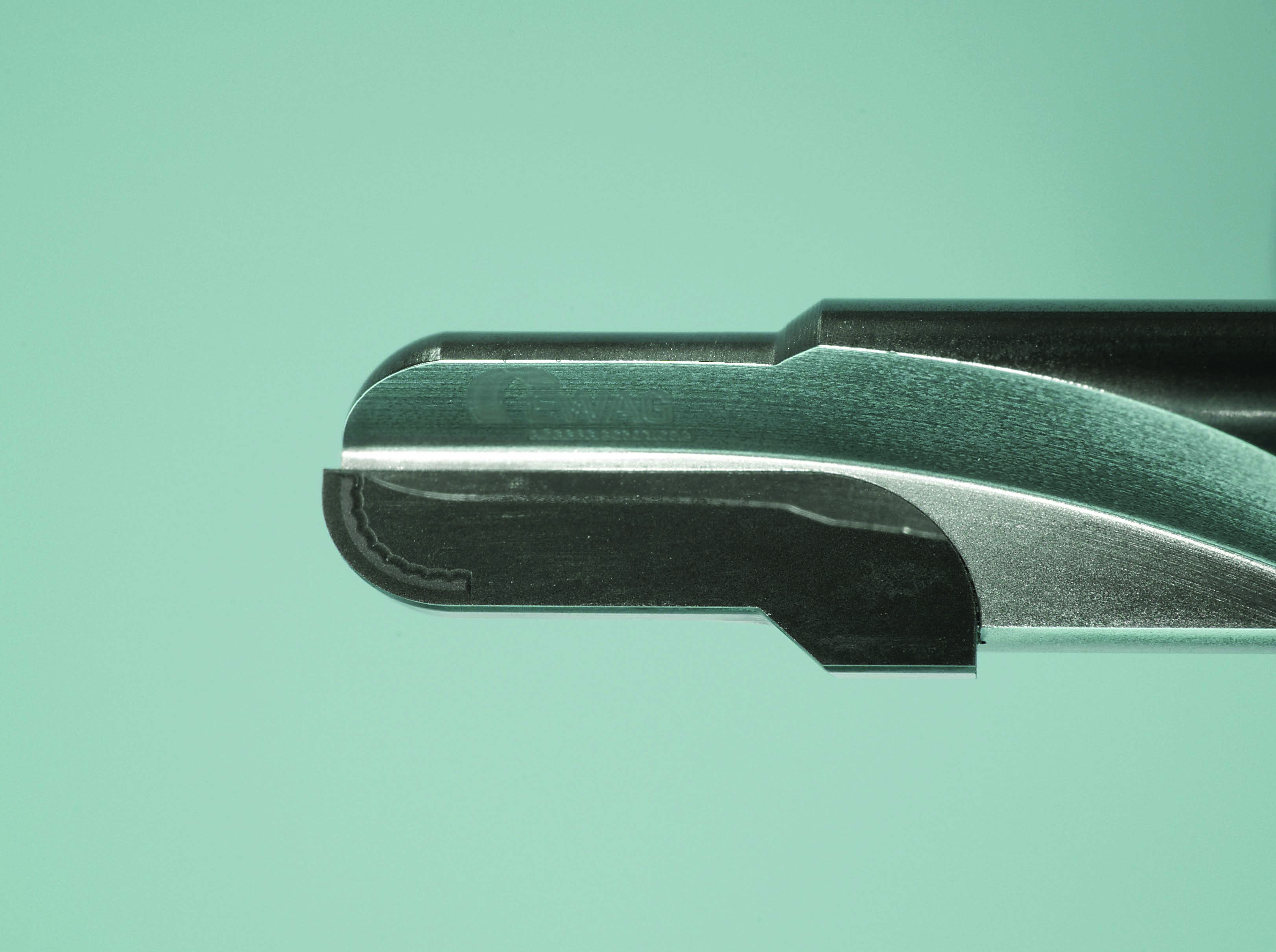
This PCD tool was produced on a EWAG machine using a Coherent laser. Image courtesy of EWAG.
Gaebler said both nanosecond fiber lasers in the 532nm (green) wavelength range and picosecond pulsed lasers are being used for cutting ultrahard materials. Ultrafast picosecond lasers provide higher precision and can create more-sophisticated surfaces on these materials than nanosecond lasers.
“When processing PCD, in particular, the problem of creating voids is completely eliminated with the laser,” he said. That is because it is a noncontact process, which has no tendency to pull grains loose from the matrix, enabling the use of larger diamond grains and extending the life of tools.
According to Gaebler, ultrafast-pulsed laser ablation of the tool edge means cutting can be accomplished at a significantly lower temperature than with other processes. This keeps the crystal structure of the man-made diamond from converting to softer graphite and, therefore, yields a stronger cutting edge.
Gaebler believes that ultrafast, industrial-grade picosecond lasers are superior to fiber lasers for cutting these materials. “They give you higher flexibility for materials, higher ablation rates, and the highest process quality and accuracy, compared to nanosecond lasers,” he said.
The TMR report’s projected growth rate of over 10 percent for ultrahard material cutting machines is “pretty realistic,” Gaebler said, adding that the growth for the lasers powering these machines is even higher than that, as the market is ramping up.
“We’ve seen some really good growth in this business—north of 10 percent,” he said.