

Fiber vs. Fiber: Drilling Performance
Machining fiber-reinforced composite materials with fiber and other types of lasers can be an effective option.
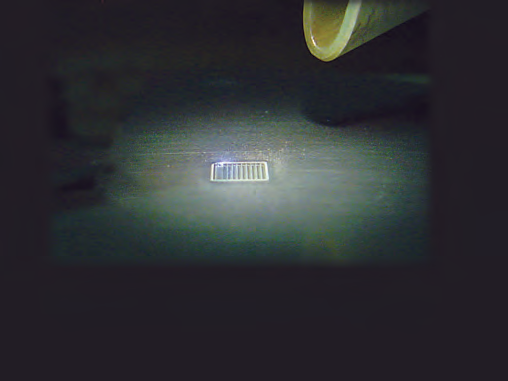
Courtesy of Laser Micromachining
A thermoplastic composite material is cut with a laser at Laser Micromachining.
Machining fiber-reinforced composite materials with fiber and other types of lasers can be an effective option.
Fiber-reinforced plastics may not sound like a material suitable for critical parts in jet engines and Formula 1 racecars, but they have properties that make them attractive for those types of components—even ones traditionally made of metal. These properties include low density, high strength and a high stiffness-to-weight ratio, which are especially desirable for aerospace applications because any reduction in an airplane’s weight translates to significant cost savings. This is especially true as fuel prices trend in one direction—up.
Multiple Materials
Because they machine differently than metals, composites can be challenging to cut. Shops have applied traditional cutting tools and alternatives like waterjetting to cut composites, but there is growing interest in using lasers for certain applications.
Composites encompass a host of different types. These include carbon, glass and aramid fiber-reinforced plastics, which are also known as composites and often used for structural parts, electronics and protective clothing, respectively. The specific properties vary depending on the type of composite, but they consist of at least two parts: the fibers and a resin matrix.
When producing parts, shops need to process composites, such as cutting them on conventional machine tools with mills and drills. That can cause material delamination problems, particularly during drill entry and exit.
In addition, aerospace companies have been investing in waterjet technology for machining carbon fiber-reinforced plastic (CFRP), according to a paper titled “Fibre Laser Material Processing of Aerospace Composites,” by Dr. Paul French, senior lecturer at the General Engineering Research Institute (GERI) based within Liverpool (U.K.) John Moores University; Mohammed Naeem, global key account manager for GSI Group Inc.’s JK Lasers division, Rugby, U.K.; and others. French noted that waterjetting can produce a high-quality cut without thermally damaging the material, but can also cause delamination. Also, waterjetting requires a mechanically drilled pilot hole if the cutting process starts anywhere other than at the edge of the workpiece.
Exposing composites to water, however, may not be the best approach. “The general impression I get is people don’t like water being close to composites because of water ingression,” French told CTE. “The people I’ve talked to tend to machine a lot of composites dry.”
Naeem added that some resins absorb water quicker than others, such as epoxy-based polyesters, and the waterjet process presents other obstacles. “The problems with the waterjet are it’s too noisy, the consumable costs are quite high and it’s difficult to cut complicated shapes,” he said.
Looking at Lasers
As an alternative to mechanical machining and waterjet cutting, the GERI group is investigating laser machining CFRP for aerospace and automotive applications. One example is an acoustic liner. It has a multitude of small holes on the leading edge of the nacelle that a jet engine sits in and basically controls the engine’s acoustic emissions, French noted. Part manufacturers mechanically drill those holes, but, obviously, are seeking a faster technique that achieves the required hole quality.
Using a 200w ytterbium fiber laser from JK to cut 1mm-dia., 2mm- to 3mm-thick holes in an acoustic liner for an aerospace company, researchers were able to achieve a “perfectly acceptable” hole quality, according to French. The next challenge is meeting the required holemaking speed. He added that the current system makes a hole in about 10 seconds, but the process needs to be about 10 times faster. “If we scale up to a 2kW fiber laser, which are being produced, we have a possibility of doing a hole a second,” French said.
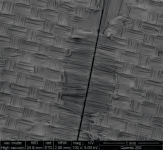
Courtesy of General Engineering Research Institute
This scanning electron micrograph shows typical damage that can result from laser machining carbon fiber-reinforced plastic.
Naeem noted that JK offers a 1kW fiber laser, which is primarily for cutting and welding metal, and cautioned that increasing a laser beam’s power to reduce cycle time also reduces part quality. That’s because more power means cutting with a larger laser spot size and putting more heat into the material, which increases the risk of generating an unacceptable heat-affected zone, charring the workpiece and causing delamination. The theoretical smallest spot size is 10µm for a 200w fiber laser, according to Naeem.
“Basically, people are looking for a cold process rather than a thermal process, trying to reduce thermal damage to the composite,” he said. “Right now, we are just trying to optimize cut quality and will worry about cycle time later.”
Naeem added that lasers are available with very short pulses to essentially cut composites via a cold ablation process, including picosecond (a trillionth of a second) and femtosecond (a quadrillionth of a second) ones. Because a fiber laser’s pulse duration of a nanosecond to a millisecond is significantly longer, it is able to cut composites significantly faster than a shorter pulse laser.
“People are looking for a practical solution, an industrial solution,” Naeem said. “To do pure R&D, I’m sure a femtosecond laser will produce beautiful results and nice papers for conferences, but it’s not for a production environment. The only way to do that is with a thermal process using a high-power laser, like 200w, 300w.”
Ultraviolet lasers have also been investigated for machining composites and have produced high-quality cuts, but their machining speed is too slow, according to French. “The fiber laser system is possibly the way to go for this,” he said.
On the Circuit
Naeem noted that JK Lasers’ work with the GERI group has concentrated on cutting CFRP with different resin matrices, but laser machining FR-4 composites, which are fiberglass-reinforced epoxy laminates, is also a major application, especially for printed circuit boards. Stephen Lee, product line manager for Coherent Inc., Santa Clara, Calif., pointed out that the laser machine builder drills FR-4 on a daily basis to demonstrate the capabilities of its equipment and provide application assistance, primarily using CO2 lasers with pulse widths from tens of nanoseconds to tens of microseconds, with the majority of work in the microsecond range. In addition to other types of lasers, Coherent manufactures CO2 lasers from 30w to 1,000w. “For most of the processing work, 100 to 150 watts is a good range,” Lee said.
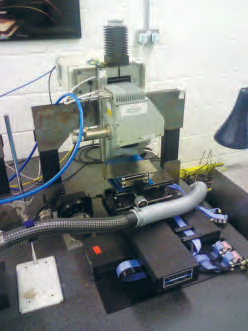
Courtesy of General Engineering Research Institute
Experimental setup of the JK200FL fiber laser at Liverpool John Moores University.
An additional type of thermal damage—epoxy recession—needs to be minimized when laser machining composites. That occurs because the fiber reinforcement is harder than the epoxy matrix, which tends to burn back farther than the fibers when laser machined. Fibers then protrude as a result.
That poses a problem when drilling blind-holes in multiple-layer, FR-4 printed circuit boards to interconnect the layers. “If the glass reinforcements are sticking out, the copper never really sticks well during the plating step that follows to make contact from one layer to another because copper doesn’t adhere very well to a glass fiber,” Lee explained. “So they get these partial contacts, which are difficult to work with.”
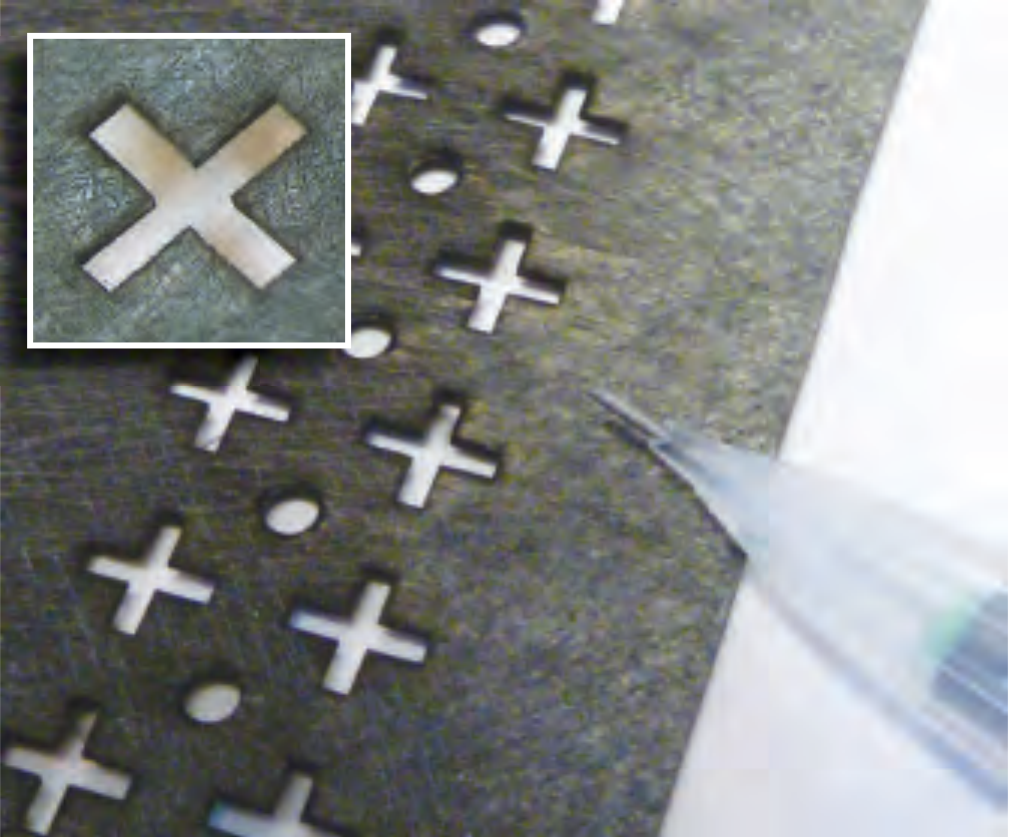
Courtesy of Laser Micromachining
Laser Micromachining Ltd. laser machines a variety of composites, including glass fiber-reinforced composites, such as this one with 5mm-wide crosses and 2mm-dia. holes.
PhotoMachining Inc. is one laser job shop that’s familiar with the challenges of machining FR-4. The Pelham, N.H., manufacturer micro via drills a lot of the material, noted CEO Ronald Schaeffer. “About 90 percent of the composite out there is FR-4 because printed circuit boards are everywhere,” he said, adding that PhotoMachining also cuts CFRP for the aerospace industry.
Because the woven fibers are harder than the host matrix, FR-4 must be cut at an energy level that’s significantly higher than what is needed to ablate the matrix, Schaeffer explained. He added that processing the material is further complicated because of its “special weave,” which results in some workpiece locations having multiple intersecting fibers, single fibers or no fibers.
“In all cases, you have to set the energy density and dwell time of the laser such that you can get through these fiber bundles, which is the most difficult situation,” Schaeffer said. “That means you’re slowing the process down compared to if you were just machining a homogenous matrix, and you may see more heat-affected zone around the areas that don’t have these bundles.”
Micro Matters
PhotoMachining has an array of laser machines and uses a Lumera UV laser with a 12-picosecond pulse and 20w to 100w Q-switched fiber lasers with pulses of 100 nanoseconds and shorter for micromachining composites.
Schaeffer defines micromachining as cutting workpiece materials up to 1mm thick and producing feature sizes 1mm and smaller—usually significantly smaller. Most of the shop’s work is from 10µm to 200µm in feature size and workpiece thickness.
Even so, PhotoMachining often laser machines composites in multiple passes to allow the heat to dissipate between passes, Schaeffer noted. Cutting a feature, such as a hole, in a single pass is quicker but the quality isn’t as high, he added.
To enhance cut cleanliness, PhotoMachining typically laser machines with the smallest possible kerf. “If we squeeze that energy per pulse down into a very small spot, we’ll have a higher peak power intensity, which is the key to clean processing,” Schaeffer said.
If the spot-size diameter doubles, for example, and more energy isn’t put into the beam, the spot’s energy density decreases by a factor of four and not two based on the area of the beam, he added. The spot size on target is typically from 15µm to 50µm for a UV laser and 100µm to 300µm for an infrared laser, such as a fiber one.
Review the print ads from this magazine to continue
This quick advertiser review unlocks the rest of the article and keeps the full-screen reader focused on the ads instead of the page chrome.
Advertisers included in this article experience
Print placements connected to this article
Cgctool
EVEN MORE REASONS ...
WHY WE DON’T OUTSOURCE. IS #17 PATENT NUMBERS WEAPONS OF MASS PRODUCTION.
EVEN MORE REASONS ... WHY WE DON’T OUTSOURCE. IS #17 PATENT NUMBERS WEAPONS OF MASS PRODUCTION. Contact Cgctool at 866-888-9600 or visit cgctool.com.
Visit Cgctool View this placement in the issue recordPrint ads from this magazine
WHY WE DON’T OUTSOURCE. IS #17 PATENT NUMBERS WEAPONS OF MASS PRODUCTION.
EVEN MORE REASONS ... WHY WE DON’T OUTSOURCE. IS #17 PATENT NUMBERS WEAPONS OF MASS PRODUCTION. Contact Cgctool at 866-888-9600 or visit cgctool.com.
Continue reading
June 2011
As its name implies, Laser Micromachining Ltd., Denbighshire, U.K., also cuts very small parts and features using lasers. “We concentrate on small feature sizes from a few microns to a few hundred microns in materials below 1mm thick,” said Dr. Nadeem Rizvi, managing director. “The thickness is driven by the fact that we have relatively modest powers in the tens of watts for our laser systems because we’re targeting high- precision work. We try to minimize the damage, so therefore we are in the regime of laser ablation.”
Rizvi noted that the laser job shop primarily machines workpieces made of a single material, but most of the composites it works with are multiple layers of different materials, such as polymers, metals, glass and semiconductor materials, used for sensors and biomedical devices. Because material properties can vary significantly from layer to layer, the shop uses different lasers to machine different layers, with the typical kerf width being from 20µm to 30µm.
Laser Micromachining uses a variety of pulsed lasers, ranging from ultraviolet to infrared and including femtosecond, picosecond and nanosecond ones. Depending on the workpiece material, the company balances various parameters including laser pulse duration, wavelength, energy density and repetition rates. “All the parameters that you’d want to play with,” Rizvi said. “We optimize them for each job.”
Wetting the Surface
In addition to laser machining composites to produce parts, the GERI group is using fiber lasers to micromachine 20µm to 30µm features across a composite surface prior to spreading an adhesive for bonding purposes. According to the group, the strength of the adhesive bond requires the adhesive to completely spread over the surface of the substrates to be joined. This is called wetting the surface.
The conventional texturing method is mechanically abrading a surface prior to applying an adhesive using a hand-held power tool with an abrasive disc. Laser micromachining provides more control and the ability to produce features, such as grooves, that enhance the wetting process, according to French of the GERI group.
“The ‘wetability’ of the surface is altered, so the adhesive spreads a lot better than if it just sat there solely on the surface,” French said. “What we believe is happening is, the laser is cutting the fibers into bundles and then these bundles are cleanly removed as the matrix vaporizes.”
Having the proper laser and technique are only parts of the puzzle when developing processes for laser machining fiber-reinforced composites. Developers must also obtain the specialized materials to suit the application, according to GSI Group’s Naeem. “The biggest problem we have right now is getting the composite,” he said. “You can’t buy this material from a supplier like metal, so you have to work with the customer, who can give you the right material, right thickness, right fiber.”
When all the pieces are in place, however, shops that focus on overcoming the challenges of laser machining fiber- reinforced composite materials might find a rewarding picture. “I’m looking for high value-added applications,” said PhotoMachining’s Schaeffer. “I’m not interested in doing what everybody else can do; I’m interested in doing what everybody else can’t do. And we charge a premium for it.” CTE
 About the Author: Alan Richter is editor of CTE, having joined the publication in 2000. Contact him at (847) 714-0175 or alanr@jwr.com.
Courtesy of General Engineering Research Institute
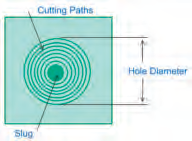
Figure 1. Laser spiral drilling employs a 100µm kerf width, which allows composite material to escape the kerf without the resin matrix adhering to the freshly cut face and stopping the slug of material from falling out.
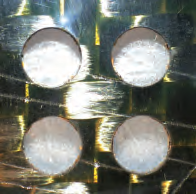
By controlling the pulse fiber laser parameters during spiral drilling, surface damage can be minimized.
Laser spiral drilling CFRP: New approach streamlines holemaking
When laser drilling, researchers are finding that composites are a very different animal than metals. Laser drilling carbon fiber-reinforced plastic as if it were a metal may not produce the desired results because the matrix material can resolidify and prevent the portion of the workpiece that needs to drop out from doing so, according to Dr. Paul French of Liverpool John Moores University’s General Engineering Research Institute (GERI) research laboratories. Laser machining composites in the conventional manner for cutting metal also leads to significant workpiece surface damage by exposing the underlying fibers.
The GERI group found those problems when making holes in composites thicker than 1.0mm. “It became obvious that what was needed was a larger kerf width that would allow material to escape the kerf without the resin matrix adhering to the freshly cut face and stopping the slug of material from falling out,” French said.
Therefore, the GERI group devised a new cutting strategy called “laser spiral drilling.” Each ring is an individual scan path for the laser beam with a kerf width of about 100µm, and the central slug of material will fall out as soon as the hole has been cut (Figure 1). The wider kerf also helps control the thermal input into the composite. “It gives it more time for the composite to dissipate the heat,” French said.
The GERI group conducted experiments in which the diameter of the slug was 1mm and the outer ring was 2mm in diameter. The distance between the individual rings was 200µm or 300µm. The GERI group reported that the parameters used to machine the hole with a JK200FL fiber laser in a modulation mode were 50 microseconds, pulse energy of 10 millijoules, a 10 percent duty cycle, 2 kHz frequency and 18w average power.
Although it’s a holemaking process, the GERI group employs a milling technique where the laser’s optical fiber is attached to a scanning, or galvo, head, which has mirrors that redirect the laser beam as needed, explained Mohammed Naeem of GSI Group Inc.’s JK Lasers division. Rather than cutting straight through the workpiece, the laser spiral technique removes material layer by layer to ensure minimal thermal damage to the fibers and matrix.
“The edge quality of the top surface of a laser spiral drilled hole tends to show less thermal damage than a hole cut in a more traditional laser processing technique,” French said.
—A. Richter
Courtesy of Trumpf
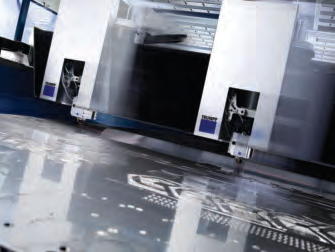
The TruLaser 7040 fiber laser machine from Trumpf includes a carbon-fiber crossbeam that the machine’s two laser cutting heads attach to, permitting accelerations up to 25 m/sec.2 and a maximum simultaneous axis speed of 304 m/min.
Transferring composite technology from outer space to Earth
Fiber-reinforced composite materials are not only being cut with laser machine tools. Machine design engineers are also making laser machine components out of them.
That’s the case at Trumpf GmbH & Co. KG, Ditzingen, Germany, which has incorporated a carbon-fiber composite crossbeam into its TruLaser 7040 fiber laser machine. The solid-state machine, which is also available with a CO2 laser, is for high-volume production, particularly for parts made of thin sheet metal.
The composite moving unit replaced one constructed of welded steel plates, according to Andreas Hultsch, director of engineering, 2-D laser machines at Trumpf’s Neukirch, Germany, site. “The stiffness of the moving unit has been doubled,” he said.
The machine’s two laser cutting heads are attached to the composite crossbar for a combined weight of 620 kg. The lightweight yet rigid construction permits accelerations up to 25 m/sec.2 and maximum simultaneous axis speed of 304 m/min., according to the company. “The goal is always to have the fastest possible processing to achieve short lead times,” Hultsch said. He added that the design also enables the moving unit to quickly change directions.
Trumpf’s use of the composite material was a result of the European Space Agency’s Technology Transfer Program connecting the machine tool builder with Schütze GmbH & Co. KG, Braunschweig, Germany, which designed carbon-fiber rods for ESA’s Rosetta spacecraft for probing comets. The rods are reportedly six times lighter than steel but up to 50 percent stiffer. While the aerospace industry focuses on using composites to reduce weight, machine engineers desire the material more for its high stiffness and ability to avoid exciting a machine’s chatter-inducing natural frequencies, according to Hultsch.
He noted that the crossbeam’s internal structure is made of glued “sandwich” panels with an aluminum honeycomb and carbon-fiber layers, and the material properties can be altered to satisfy load requirements by varying the fiber type, content and orientation.
Because of the benefits carbon-fiber composites provide in the TruLaser 7040 fiber laser machine, Hultsch noted that the usage of other carbon-fiber components is being studied. “The importance of carbon fibers used in engineering, especially for the machine tool industry, will increase in the future.”
—A. Richter
Contributors
Coherent Inc.
(866) 247-4767
www.coherent.com
GSI Group Inc., JK Lasers Div.
+44 1788 570321
www.gsiglasers.com
Laser Micromachining Ltd.
+44 1745 535937
www.lasermicromachining.com
Liverpool John Moores University
+44 151 231 2031
www.ljmu.ac.uk
PhotoMachining Inc.
(603) 882-9944
www.photomachining.com
Trumpf Inc.
(860) 255-6000
www.us.trumpf.com
Glossary terms in this article
Related


Subscribers can use MFGAxis notes, saves and discussion tools with their innoNET account.


