

Grinding large
The development of large diamond wheels for machining large parts.
The development of large diamond wheels for machining large parts.
Courtesy of All images: “ALKON”
Editor’s note: The most effective method of machining new structural and tool materials is a diamond-abrasive one, according to the concern “ALKON” of the National Academy of Sciences of Ukraine, which developed the technology of manufacturing large tools made with metallic and metallic-polymer composites. Such tools have been applied for machining large parts, including insulators, gears and cutting tools.
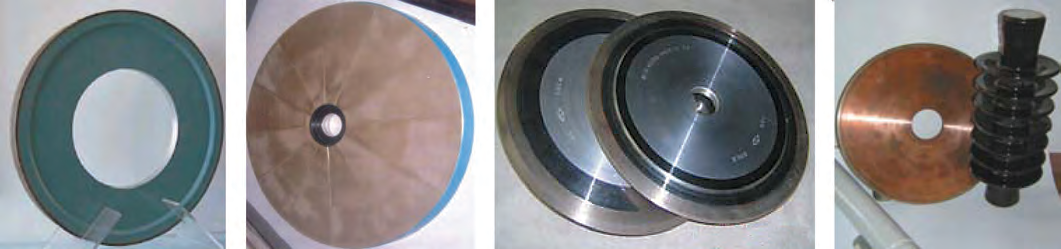
Figure 1: The V.N. Bakul Institute for Superhard Materials of the National Academy of Sciences of Ukraine developed a technology for fabricating large diamond wheels with (from left to right) 1A1, 6A2-SS, 1EE1 and 1A1R shapes. The 6A2-SS diamond grinding wheels, which each weigh 30 kg (66 lbs.), were developed for the first time.
Analysis of patents and scientific and technical information indicates that the development of large diamond wheels whose functional varieties and dimensions exceed existing standards requires:
• Studies on the technological basis and detection of regularities between the compositions and characteristics of metallic and metallic-polymer composites;
• Applications of the superhard materials’ powders with the uniformity coefficient equaling 1.2 to 1.3;
• Development of new designs of the tools’ cutting layers; and
• Optimization of the parameters for pressing, sintering and binding the cutting elements.
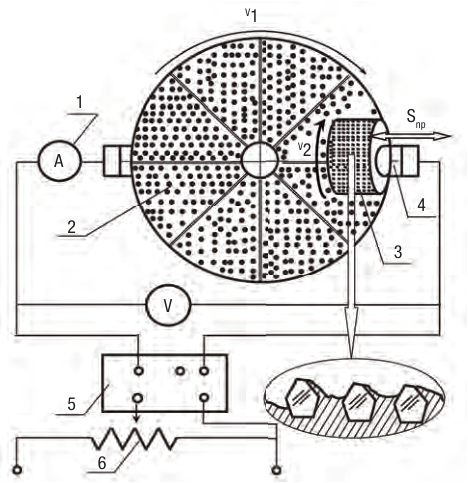
Figure 2: Truing via EDM of the 6A2-SS diamond-abrasive wheel. 1) Appartus to control electric current and voltage. 2) Diamond-abrasive wheel with the 6A2-SS shape. 3) Truing tool. 4) Current collector. 5) Rectifier. 6) Autotransformer. Snp) Reciprocal movement of the truing tool. V1) Rotational speed of the grinding wheel. V2) Rotational speed of the truing tool.
The main objective of the research was to increase the working capacity 1.5 to 2.0 times for the new tools compared with similar tools fabricated by Ukrainian companies and those in other countries.
The V.N. Bakul Institute for Superhard Materials of the National Academy of Sciences of Ukraine has developed a technology for fabricating large diamond wheels with the new 6A2-SS shape and existing 1A1R, 1EE1 and 1A1 shapes from 250mm to 600mm (10 ” to 24 “) in diameter (Figure 1). The cutting area of the diamond layer for these tools is up to 5,000 cm2 (775 cu. in.).
The new technology is based on utilization of the following:
• Scientifically proven foundation for the manufacturing processes of the integrated technology for tool production;
• Definition regularities for optimal composition and characteristics of metallic (declarative patent 70825A of Ukraine) and metallic-polymer (patent for a useful design No. 41448 of Ukraine) composites and the superhard material powders;
• Advanced designs of the cutting layer; and
• Computerized control and optimization of functional parameters of pressing, sintering and binding the cutting elements made of superhard materials.
Such technology secures production of large diamond wheels whose working capacity is 1.5 to 2.0 times that of conventional wheels.
While conducting the research on the composites made of superhard materials, the following equipment was used:
• The roentgen-spectral analysis was performed on an Ultra 55 Gementi FE-SEM raster electron microscope with STEM-detector from Carl Zeiss to work in a regime of a transmissible microscope and a Kemskan-4dv raster electron microscope-analyzer having a Link-860 analysis system;
• The hardness was measured by a HRA-2 Rockwell tester (Rockwell scale A);
• Study of the structure of composites was performed on a Microtech MMO-1600 metallographic microscope with an HDCE-10A camera;
• Computerized treatment of the experimental results;
• Complex evaluation method for the rates of working capacity of the grinding wheels made of synthetic diamonds and CBN, based on their applications.
The studies of relationships between compositions and technical characteristics of the metallic (MX series) and metallic-polymer (B2-01-1 series) composites for large wheels were conducted on the following tool shapes and geometries:
• Wheels with a 1A1 shape are 400mm to 500mm (16 ” to 20 “) in diameter, and the cutting layers are 40mm to 100mm (1.6 ” to 4.0 “) wide;
• Wheels with the 6A2-SS shape are 600mm (24 “) in diameter, and the cutting layers are 250mm (10 “) wide;
• Wheels with the 1A1R shape are 400mm to 500mm (16 ” to 20 “) in diameter, and the cutting layers are 10mm (0.4 “) wide;
• Wheels with the shape 1EE1 have cutting layers 10mm (0.4 “) wide.
Surface Deviation
It was determined that deviation of the cutting surface of a diamond wheel after being EDMed did not exceed 20μm to 50μm (790 to 1,970 μin.), while the required protrusion of diamond grains from the tool binder is achievable. Flexible steel rods measuring 0.12mm (0.005 “) in diameter were used as truing tool electrodes. The truing process creates fine-dispersed relief, containing reinforced miniature posts for the diamond grains in a wheel.
Review the print ads from this magazine to continue
This quick advertiser review unlocks the rest of the article and keeps the full-screen reader focused on the ads instead of the page chrome.
Advertisers included in this article experience
Print placements connected to this article
Time to think about grinding in-house.
How would you sharpen these tools?
We send them out O.K.…But how much time do you spend? for resharpening Lost production while waiting for tools? Manual tool grinder How do you keep up? Quality? Training? Maybe it’s time to think about a WALTER CNC? WALTER POWER That’s what most people check – over 7,000 shipped! Super fast for short cycle times. Fastest setup – On the.
How would you sharpen these tools? We send them out O.K.…But how much time do you spend? for resharpening Lost production while waiting for tools? Time to think about grinding in-house. Manual tool grinder How do you keep up? Quality? Training? Maybe it’s time to think about a WALTER CNC? WALTER POWER That’s what most people check – over 7,000 shipped! Super fast for short cycle times. Fastest setup – On the machine or off-line so machine stays productive. Most versatile. Simplest and most reliable autoloaders –
Visit Time to think about grinding in-house. View this placement in the issue recordWalter Tools
THE IDEAL
CUTTING MATERIAL. MAXIMUM HARDNESS. MAXIMUM TOUGHNESS. Introducing The benefits of CVD and PVD in one break through grade! If you mill steel or cast iron you can expect lower manufacturing costs due to: • Up to 80% higher tool life on wet milling application versus your existing grade. • Up to 30% higher tool life on dry milling.
THE IDEAL CUTTING MATERIAL. MAXIMUM HARDNESS. MAXIMUM TOUGHNESS. Introducing The benefits of CVD and PVD in one break through grade! If you mill steel or cast iron you can expect lower manufacturing costs due to: • Up to 80% higher tool life on wet milling application versus your existing grade.
Visit Walter Tools View this placement in the issue recordPrint ads from this magazine
We send them out O.K.…But how much time do you spend? for resharpening Lost production while waiting for tools? Manual tool grinder How do you keep up? Quality? Training? Maybe it’s time to think about a WALTER CNC? WALTER POWER That’s what most people check – over 7,000 shipped! Super fast for short cycle times. Fastest setup – On the.
How would you sharpen these tools? We send them out O.K.…But how much time do you spend? for resharpening Lost production while waiting for tools? Time to think about grinding in-house. Manual tool grinder How do you keep up? Quality? Training? Maybe it’s time to think about a WALTER CNC? WALTER POWER That’s what most people check – over 7,000 shipped! Super fast for short cycle times. Fastest setup – On the machine or off-line so machine stays productive. Most versatile. Simplest and most reliable autoloaders –
Continue reading
June 2010
Table: Technical specifications for manufacturing large diamond wheels. Nomenclature of grinding wheelsCharacteristics of similar wheels made of superhard materials*Technical specifications
Diamond grinding wheels, 1A1 shape, 400mm to 600mm in diameter, metallic-polymer binder type is B2-01-1
1A1 600mm × 40mm × 6mm × 203-AC6
125/100-B2-01-1-100-1970,0
28.5-05417377-
200:2009-12-04;
25000.00705
Diamond grinding wheels, 6A2-SS shape, 600mm in diameter, metallic binder type is MX5-10
6A2-SS 600mm × 3mm × 30mm × 58-AC6
50/40-MX5-5-50-1930,0
25000.00706
Diamond cutoff wheels, 1A1R shape, 400mm to 500mm in diameter, a 10mm-thick cutting layer, metallic binder type is MX5-2
1A1R 500mm × 2.6mm × 10mm × 20-AC65
200/160-MX5-2-50-90,0
88-090.010-96-09; 25000.00706;
25000.00708
Diamond grinding wheels, 1EE1 (14EE1) shape, 250mm in diameter, a 10mm-thick cutting layer, metallic binder type is MX5-5
1EE1 250mm × 6mm × 10mm × 110º × 32-AC15 80/63-MX5-5-50-99,0
25000.00706
Diamond grinding wheels, 1EE1 shape, 160mm to 250mm in diameter, metallic binder type is MX5-5
1EE1 160mm × 8.5mm × 6mm × 75º × 51-KB 125/100-MX5-5-50-157,0
88 Ukraine 90.626-79
(Notification 24.1-18.09:2009);
25000.00706
* Numeric sequence designates the following from left to right: OD × cutting layer width × cutting layer thickness × ID (for the spindle). The angular dimensions, 110º and 75º, are the included angles of the cutting layers.
The process of truing via EDM with flexible metallic electrodes provides high productivity when truing a wheel with the required geometry for the working surface. The truing process takes 3 to 10 minutes, depending on wheel dimensions. The average height of the grains’ protrusion above the tool binder is 10μm to 15μm (390 to 590 μin.).
Studies of regularities of the working capacity of the tools with modified powders of synthetic diamond and CBN with the uniformity coefficient of 1.2 to 1.3 resulted in the following:
• It was determined that an increase in the content of the main fraction and the uniformity coefficient of the diamond grains, wheel life and the workpiece surface finish satisfied the requirements. At the same time, the minimal values of the working effectiveness are provided by using superhard materials powders with a uniformity coefficient of 1.2 to 1.3.
• The effectiveness of the newly developed tools made of metallic composites was proven when grinding cutting tools and machining large insulators made of electrically insulating porcelain, large gears and other large parts.
The following companies have implemented the newly developed tools and technologies (companies outside the Ukraine are shown in parentheses):
State estimated enterprise at “ALKON” of the National Academy of Sciences of Ukraine, OAO (a public joint-stock company) Slavyansky high-voltage insulator plant, OAO Nizhne-Saldinsky metallurgical plant (Russia), OAO Dyat’kovsky crystal plant (Russia), Deko-Glass (Poland), sugar production plants, OAO Azovmash and OAO Krasnogorsky refractory plant. Sales of the diamond wheels exceeded $95,000.
Technical documentation and manufacturing processes have been developed for the large diamond wheels (see Table). R&D projects for implementation of the diamond wheels have been prepared. Production and implementation of the diamond wheels and machining processes should be treated as an integrated system of modern material science and tool manufacturing.
Applications of the superabrasive wheels for machining basic cutting tool materials, such as cemented carbides, tool steels, ceramics, tungsten-free cemented carbides and boron carbide-based materials, solve the problems relating to the effective use of these materials, provide the possibility of increased productivity when machining, provide effective manufacturing processes and guarantee high-quality machining of tools and parts. CTE
About the Authors: A.A. Shepelev, D.Sc., V.G. Sorochenko, Ph.D., S.V. Ryabchenko and A.A. Shepelev Jr. are with the V.N. Bakul Institute for Superhard Materials of the National Academy of Sciences of Ukraine; and E.P. Poladko, Ph.D., and B.B. Grzhybovskyi are with the concern “ALKON” of the National Academy of Sciences of Ukraine. The original article was adapted from one published in Equipment and Tools for Professionals, International Magazine for Metalworking, Issue No. 1, 2010. For more information, contact “ALKON” via e-mail at alcon2_zakaz@ism.kiev.ua. The article was translated from the Russian version by Dr. Edmund Isakov, metalcutting consultant and writer.
Glossary terms in this article
Related




Subscribers can use MFGAxis notes, saves and discussion tools with their innoNET account.


