

Hold fast: General Industry Coverage
High-speed machining is an amorphous term, but can generally mean anything from 10,000 rpm to, at least theoretically, 500,000 rpm or higher. At high speeds, even the slightest toolholder movement or runout can drastically reduce tool life, spindle life, surface finish and part quality.
High-speed machining is an amorphous term, but can generally mean anything from 10,000 rpm to, at least theoretically, 500,000 rpm or higher. At high speeds, even the slightest toolholder movement or runout can drastically reduce tool life, spindle life, surface finish and part quality.
There is no one correct HSM toolholder solution; essentially, one that is balanced or balanceable and offers sufficient clamping force and minimal runout can do the job. Four of the most common options are shrink-fit holders, collet chucks, hydraulic chucks and endmill adapters.
Shrink-fit plays a prominent role in HSM because it has virtually no moving parts, making it the easiest holder to balance, noted Jack Burley, vice president of sales and engineering at toolmaker BIG Kaiser Precision Tooling Inc., Hoffman Estates, Ill.
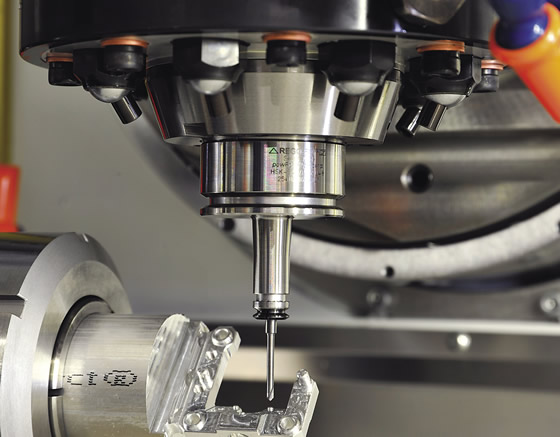
Rego-Fix powRgrip collet chucks are designed for HSM. Image courtesy Rego-Fix Tool.
“If you make a shrink-fit toolholder precisely concentric, do a lot of profile grinding on the outside, perform the necessary work on the inside and accommodate for any symmetrical imbalances—such as drive keys for HSK or chip holes—you can have a very repeatable product for balancing,” he said.
Justin London, sales engineer for Briney Tooling Systems, Bad Axe, Mich., agreed that shrink-fit toolholders are the first choice for HSM applications. “If you were to take an imaginary centerline and split the toolholder down the middle from end to end, what you would want to see is symmetry on both sides so that balance adjustments will be minimal,” he said.
However, a shrink-fit system is not without its drawbacks—namely, it is expensive and tool changes can be cumbersome. Some shops cannot justify the up-front cost of the toolholders and the induction-heating system, London said, while others want to change tools in process, something shrink-fit toolholders are ill-equipped for.
In addition, shrink-fit holders have limited contraction after being heated, added Burley, so the tool and toolholder-bore tolerances determine the amount of interference—essentially, the amount of clamping force.
“If you have a toolholder on the high side of the hole tolerance while the tool itself is made to the low side of the tolerance, you will have the least amount of interference when you put the tool in,” he said. “When you get into high speeds, you’re competing with centrifugal force trying to force the bore to expand. When the bore gets bigger, you have even less interference, and that can cause tool slippage or pullout.”
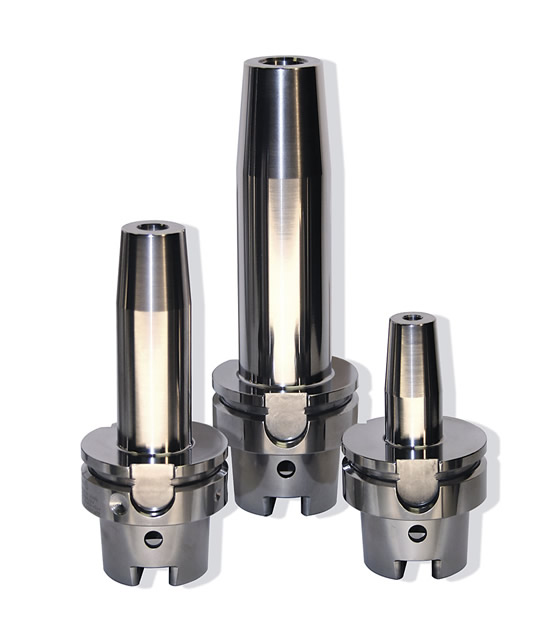
Shrink-fit toolholders are often the first choice for high-speed operations. Image courtesy Briney Tooling Systems.
Many toolholder manufacturers compensate for this with thicker outer walls, reducing the influence of tolerances on overall clamping effectiveness, Burley noted.
When performing HSM, one alternative to a shrink-fit holder is an ER collet chuck.
Review the print ads from this magazine to continue
This quick advertiser review unlocks the rest of the article and keeps the full-screen reader focused on the ads instead of the page chrome.
Advertisers included in this article experience
Print placements connected to this article
A true performance guarantee ensuring your PRAB
• Chip and Fluid Systems Integration
• Risk Mitigation • Increased Metal Scrap Value • Wastewater Treatment Systems Your trusted partner in complete chip processing and environmental compliance support. Chip Systems Dualpak™ Briquetters Ultrafiltration Wastewater Treatment Systems equipment achieves the specific results it was designed and manufactured to deliver. And if you.
• Chip and Fluid Systems Integration • Risk Mitigation • Increased Metal Scrap Value • Wastewater Treatment Systems Your trusted partner in complete chip processing and environmental compliance support. Chip Systems Dualpak™ Briquetters Ultrafiltration Wastewater Treatment Systems A true performance guarantee ensuring your PRAB equipment achieves the specific results it was designed and manufactured to deliver. And if you need technical support, call us. We are available 24/7.
Visit A true performance guarantee ensuring your PRAB View this placement in the issue recordPrint ads from this magazine
• Risk Mitigation • Increased Metal Scrap Value • Wastewater Treatment Systems Your trusted partner in complete chip processing and environmental compliance support. Chip Systems Dualpak™ Briquetters Ultrafiltration Wastewater Treatment Systems equipment achieves the specific results it was designed and manufactured to deliver. And if you.
• Chip and Fluid Systems Integration • Risk Mitigation • Increased Metal Scrap Value • Wastewater Treatment Systems Your trusted partner in complete chip processing and environmental compliance support. Chip Systems Dualpak™ Briquetters Ultrafiltration Wastewater Treatment Systems A true performance guarantee ensuring your PRAB equipment achieves the specific results it was designed and manufactured to deliver. And if you need technical support, call us. We are available 24/7.
Continue reading
July 2015
“When changing a tool during HSM, the centerline of the cutting tool must precisely locate to the centerline of the toolholder; the runout has to be as close to zero as possible,” Burley said. Therefore, a traditional collet chuck that has runout of more than 0.0010 ” (0.0254mm) will cause an eccentricity that must be accounted for.
However, BIG Kaiser’s Mega Chucks repeat to an accuracy of less than 1µm (0.00004 “). This is achieved in part with a pilot hole in the clamping nut, meaning the clamping nut locates on a bore on the toolholder base.
But unlike shrink-fit toolholders, collet chucks have moving parts, which can introduce unwanted vibration during HSM. To adjust for this, BIG Kaiser recommends using on-size collets that fit to the exact diameter of the cutting tool, as this minimizes the amount of mechanical movement. The Mega Chucks from 0.010 ” to 0.315 ” (0.254mm to 8.001mm) in diameter are suitable for speeds up to 50,000 rpm, while larger ones up to 0.787 ” (19.990mm) in diameter are for speeds closer to 20,000 rpm—comparable to heat-shrink toolholders.
Rego-Fix Tool Corp., Indianapolis, offers the powRgrip collet system as an alternative to heat-shrink holders for HSM. Engineering and Technical Manager David McHenry explained that both the collet OD and toolholder ID have a taper of just 1:100. The collet is then placed in the holder and pressed in using a bench-top press with up to 9 tons of force.
“We wind up with a self-locking taper because of the shallow angle, as well as extreme clamping forces resulting from the interference fit between the collet, the toolholder and the cutting tool,” he said. “The principle is the same as shrink fit, because we’re using the material’s elasticity to clamp on the cutting tool; we just do it in a totally different fashion. Using a press-fit system, we can design our toolholder to always be elastic and never damage the material, which allows us to have tools in service for more than 20,000 cycles.”
According to McHenry, the powRgrip system is accurate to within 3µm (0.00012 “), which enables users to impart fine surface finishes, as well as allowing increased speeds and feeds.
However, collet/holder assemblies can be larger in diameter than shrink-fit units, requiring greater clearance, and, unlike side-lock endmill holders, clamping force is determined by the interference fit of the assembled components.
But if shrink-fit holders and collet chucks are not the right fit for your HSM application, fear not! Hydraulic chucks are extremely concentric, offer minimal mechanical movement and are suitable for speeds up to 20,000 rpm, according to BIG Kaiser’s Burley.
Additionally, Briney’s London said the company will occasionally use its Tru Position side-lock endmill adapters for HSM. “Our endmill adapters are unique, in that we eccentrically grind toward the setscrew,” he said. “Typically, endmill adapters are concentrically ground back to the taper shank, and when you clamp down the side-lock setscrew, you’ll push the tool off center. When you spin the assembly in the spindle, you’ll see runout on the cutter assembly from 0.0002 ” to 0.0006 “. Our endmill adapters bring the tool to within 0.0001 ” of center.”
Both London and Burley stressed the importance of toolholder balance when high-speed machining.
“Many manufacturers claim their toolholders are balanced to a certain rpm, but balance consists of two specs: rpm and gram weight millimeters, or the G level,” London explained. “G 6.25 is the general tire-balance specification on most consumer vehicles, while a typical gyroscope is balanced to G 0.5, a much tighter spec. G 2.5 is the beginning of the spec for machine components.”
However, with small toolholders, that level is difficult to attain. As a result, a technical advisory group (of which Burley is currently the only U.S. member) that reports to the International Standards Association is developing a new standard: ISO 16084.
“This will overhaul the requirements for balancing toolholders, taking into consideration additional factors besides the spindle,” Burley said. “The idea is that machinists can have a more-qualified balance criteria for specific cutting tools, rather than a one-size-fits-all number that doesn’t actually fit every situation.” CTE
About the Author: Evan Jones Thorne is assistant editor for CTE. Contact him at (847) 714-0177 or ejonesthorne@jwr.com.
Glossary terms in this article
Related




Subscribers can use MFGAxis notes, saves and discussion tools with their innoNET account.


