

Honing provides benefits for all types of tools
Honing the edge of a cutting tool improves tool life, improves workpiece surface finish, reduces spindle load and reduces overall manufacturing cost.
Honing the edge of a cutting tool has benefits, including improved tool life, improved workpiece surface finish, reduced spindle load and reduced overall manufacturing cost.
Mutschler Edge Technologies LLC, which builds edge-prep machines, defines honing as the creation of a controlled radius and surface finish improvement at the intersection of two surfaces that form the cutting edge. Honed edges can be full radii, waterfall or reverse waterfall.
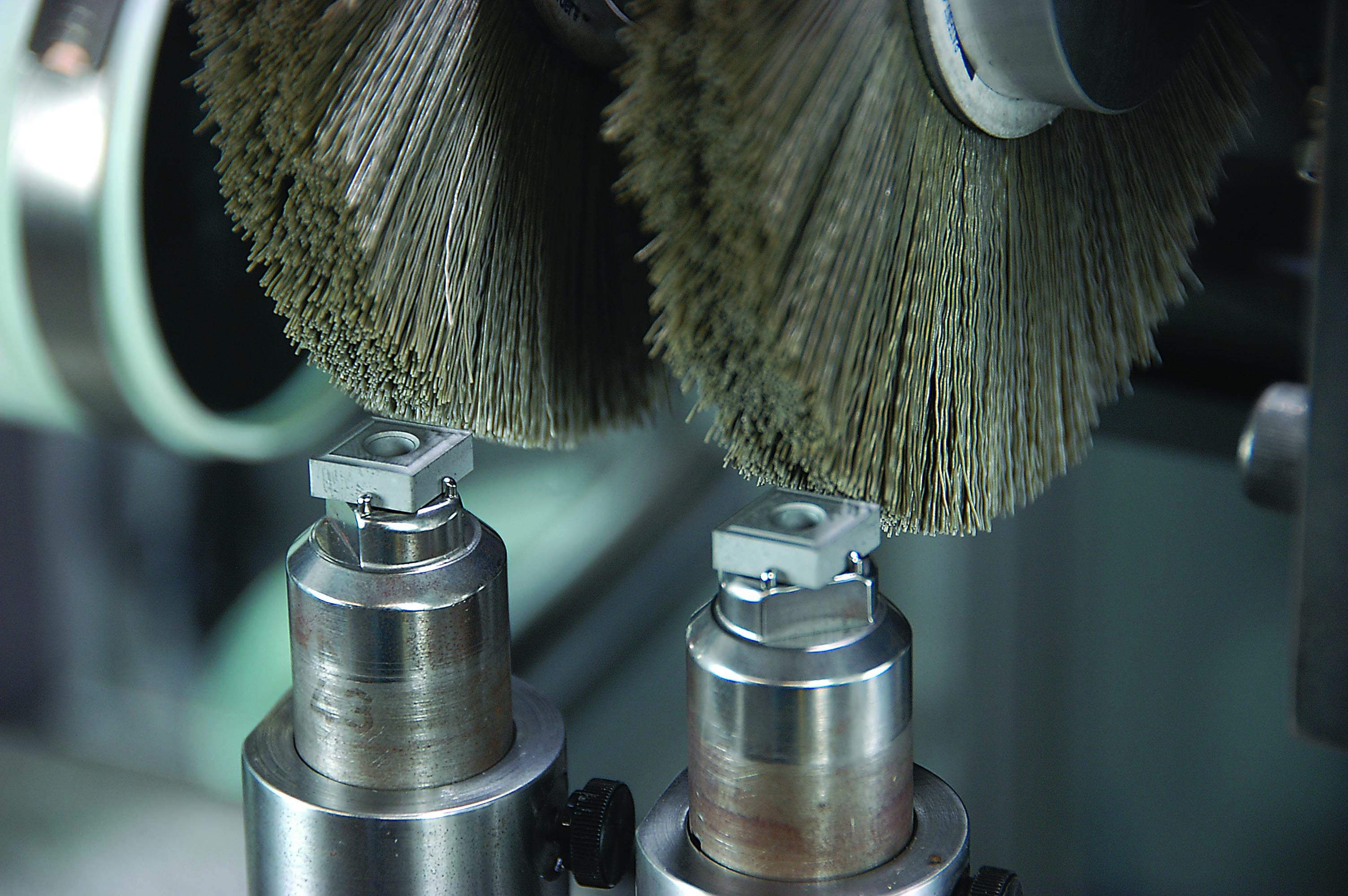
A machine preps the cutting edges of carbide inserts. Image courtesy of Mutschler Edge Technologies
Honing provides benefits for all types of tools, including HSS and carbide ones. The major benefits occur on a carbide tool prior to coating it. The radius edge allows the coating to better adhere to the tool surface because no dead-sharp corners or burrs are present. A coating reduces friction, increases the contact area of the cutting edge to the workpiece and strengthens the tool. If not honed prior to coating, the edge can fracture and expose the substrate, shortening the life and effectiveness of the coating and the tool. The surface finish of the edge is also improved, reducing friction and allowing for improved chip evacuation.
Tools that are not coated can also benefit from the controlled radius applied to the cutting edge.
Honing is a dry process achieved by applying a nylon-abrasive-filament brush to the edges of the cutting tool. The brush filaments are constructed from a nylon carrier that is co-extruded with an abrasive grain. This means that as the brush wears, new abrasive grains are constantly being exposed to the workpiece. These flexible brush filaments act as “flexible files,” wrapping and wiping across all edges evenly.
There are two separate dynamics to using these brushes: the cut that the abrasive creates and the force of the filaments as they contact the surface. Many factors determine the result, such as speed, direction, cycle time, depth of engagement and centerline placement.
Review the print ads from this magazine to continue
This quick advertiser review unlocks the rest of the article and keeps the full-screen reader focused on the ads instead of the page chrome.
Advertisers included in this article experience
Print placements connected to this article
Komaprecision
INSTALLATION
Onsite Turn-key Installations for Tsudakoma Rotary Tables for Vertical and Horizontal Machining Centers.
INSTALLATION Onsite Turn-key Installations for Tsudakoma Rotary Tables for Vertical and Horizontal Machining Centers www.komaprecision.com | [email protected] | 1.800.249.5662
Visit Komaprecision View this placement in the issue recordPrint ads from this magazine
Onsite Turn-key Installations for Tsudakoma Rotary Tables for Vertical and Horizontal Machining Centers.
INSTALLATION Onsite Turn-key Installations for Tsudakoma Rotary Tables for Vertical and Horizontal Machining Centers www.komaprecision.com | [email protected] | 1.800.249.5662
Continue reading
July 2018
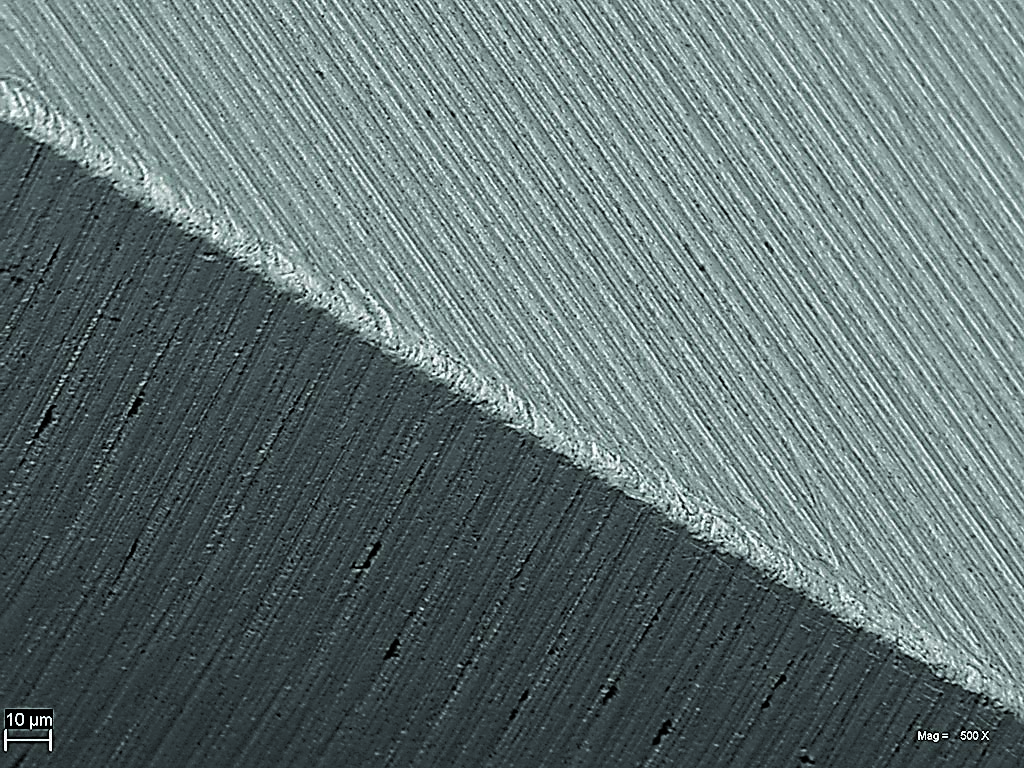
A 500× magnification of an edge preparation on a cutting tool. Image courtesy of Mutschler Edge Technologies
Nylon-abrasive brushes can be made in many configurations. The filaments can be round or rectangular, straight or crimped, and are available in many different diameters, depending on the application. The abrasives used in the brush can also vary greatly, depending on the application. They include silicon carbide, aluminum oxide, ceramic and diamond.
When an edge is sharpened, the post-ground material creates a ragged edge as the grinding wheel exits the cutting edge. This happens because there is no force pushing back on the edge to shear the burr away. If this edge is not addressed, the tool will have a dead-sharp cutting edge that will quickly wear and fracture.
Once a process is defined, it can be controlled to within 0.0001″ from part to part.
The edge can be measured a few different ways. Common methods include visual measurements under a microscope and contour tracing. Also, image analysis software is available for inspection, allowing the user to measure in 2D and 3D.
The range of available hones is as broad as the range of cutting tools. As a rule, the harder the workpiece material, the larger the hone required. The best way to perfect the honed edge of a tool is to test the results and make adjustments accordingly, as each application is different.
—Mutschler Edge Technologies LLC, Cleveland, www.mutschleredgetech.com
Glossary terms in this article
Related



 MFGAxis Discussion
Be part of the shop-floor conversation
Like, save, or comment on this CTE story.
MFGAxis Discussion
Be part of the shop-floor conversation
Like, save, or comment on this CTE story.


MFGAxis Discussion