

HUNCH launches student manufacturing—literally
High school manufacturing programs teach students to create production parts, preparing them for careers in industry. Those parts are primarily for terrestrial applications. However, unique and exciting opportunities to produce parts for use above the earth are available to partner-schools in a 14-year-old government program called HUNCH (High schools United with NASA to Create Hardware).
High school manufacturing programs teach students to create production parts, preparing them for careers in industry. Those parts are primarily for terrestrial applications. However, unique and exciting opportunities to produce parts for use above the earth are available to partner-schools in a 14-year-old government program called HUNCH (High schools United with NASA to Create Hardware).
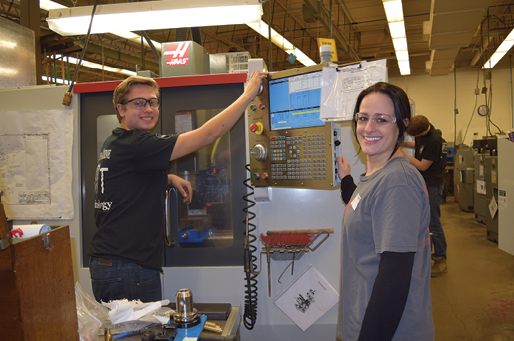
NASA program support machinist Amanda Phelps (right) and high school student Brandon Ptak machine stowage locker components on a CNC mill. Image courtesy Bill Rakonczay, Orleans/Niagara BOCES.
“We have flown close to 200 items [manufactured by high school students] into space, with about 100 more in process right now,” said Blake Ratcliff, NASA’s HUNCH program manager, who’s based in Houston. “We have students doing prototype work, build-to-print, software development, communications products—it’s a huge range of products, many for use on the International Space Station or the rockets that fly there.”
A galley table, a specialized tape dispenser, foot restraints for maneuverability and nearly countless individual components are in orbit, all manufactured, and in some cases designed, by teenagers.
Students at the Orleans/Niagara BOCES Orleans Career and Tech Ed Center, Medina, N.Y., have been manufacturing spaceflight hardware for the past 4 years, according to Bill Rakonczay, an instructor at the center.
“We make parts for the International Space Station,” he said. “Every year, it’s different; this year, we’re making parts for stowage lockers—knobs, latches, door panels, bottom plates, fixturing—whatever is needed.”
Review the print ads from this magazine to continue
This quick advertiser review unlocks the rest of the article and keeps the full-screen reader focused on the ads instead of the page chrome.
Advertisers included in this article experience
Print placements connected to this article
Nachiamerica
US ries
e w Se N ck o St AQUA DRILL EX CARBIDE DEEP HOLE DRILLS 10D, 15D, 20D, 25D, 30D, 40D New Sizes Now Available Metric and Fractional.
US ries e w Se N ck o St AQUA DRILL EX CARBIDE DEEP HOLE DRILLS 10D, 15D, 20D, 25D, 30D, 40D New Sizes Now Available Metric and Fractional
Visit Nachiamerica View this placement in the issue recordPrint ads from this magazine
e w Se N ck o St AQUA DRILL EX CARBIDE DEEP HOLE DRILLS 10D, 15D, 20D, 25D, 30D, 40D New Sizes Now Available Metric and Fractional.
US ries e w Se N ck o St AQUA DRILL EX CARBIDE DEEP HOLE DRILLS 10D, 15D, 20D, 25D, 30D, 40D New Sizes Now Available Metric and Fractional
Continue reading
January 2017
Students typically machine parts on a Haas CNC mill or lathe, with inspection being done on a coordinate measuring machine.
“There’s a lot of quality control that needs to be done,” Rakonczay noted, “but there’s also a lot of pride involved in making parts for the International Space Station, a lot of motivation to get things right the first time.”
The program, according to Ratcliff, is set up so that the schools provide the students and the facilities, while NASA provides the materials, the drawings and a mentor who works with the students and the faculty and ensures everything is up to NASA standards.
Orleans/Niagara BOCES’ mentor, Amanda Phelps, is a NASA program support machinist who travels from Cleveland every few weeks to work with students, hand out production orders and inspect parts. A build-to-print development cycle can be completed in anywhere from weeks to months, while the prototype and development level projects can take up to a year.
However, HUNCH is looking to expand its reach.
“We are reaching out to partners in industry to work with our schools,” Ratcliff said, “to outfit them with the latest equipment and the latest methods. The goal is that when these kids graduate, they will not only have built actual spaceflight hardware, but they will be ready for whatever the next step may be, whether it’s into the workforce or further in academia.”
Related




Subscribers can use MFGAxis notes, saves and discussion tools with their innoNET account.


